

Additional Buyer's Stamp Duty in Singapore runs from 0%) to 65%, layered on top of Buyer's Stamp Duty, depending on who is buying and how many residential properties they already hold. Singapore Citizens pay no ABSD on a first home, with increased rates for additional homes; Permanent Residents pay increased rates for additional homes; foreigners pay a flat high rate on any residential purchase; entities and trustees pay the highest rate. ABSD is calculated based on the higher of the purchase price or IRAS's market valuation, and must be paid in cash within a strict time frame.
TL;DR:
- ABSD rates vary significantly depending on buyer profile, property number, and whether the buyer is Singaporean, PR, foreign, or an entity, with some rates reaching 65%.
- ABSD is calculated on the higher of the purchase price or IRAS valuation and must be paid in cash within strict deadlines, often before mortgage approval or completion.
- Joint purchases with mixed profiles trigger the highest ABSD rate for the entire transaction, and property counts include overseas assets and shared interests, which can unexpectedly increase duties.
- Foreigners face a flat 60% ABSD on any residential property, but citizens from certain countries like the US, Norway, and Switzerland qualify for treatment as Singaporeans with proper documentation.
- Planning strategies such as decoupling, transferring ownership, or trust placement require precise timing and cost calculations, with IRAS scrutinizing transactions that appear solely aimed at duty avoidance.
Table of Contents
- Current ABSD rates by buyer profile
- Who pays: buyer profiles, joint purchases and property counting
- How ABSD and BSD combine: three worked examples
- Payment timing and penalties for missing the deadline
- Remissions, exemptions and special cases
- Budgeting for ABSD: strategies, costs and risks
- How Haio helps you model ABSD before you commit
- Where to verify ABSD figures and file remissions
- Why the ABSD conversation misses the point
- Sources
Current ABSD rates by buyer profile
The rate table below has held since 27 April 2023, when the Ministry of Finance last revised it as part of a broader package of demand-side cooling measures. As of 2026, these remain the rates buyers should budget against.
| Buyer profile | 1st residential property | 2nd residential property | 3rd and subsequent |
|---|---|---|---|
| Singapore Citizen (SC) | no ABSD on first property | increased rate on second property | further increased rate on third and subsequent properties |
| Singapore Permanent Resident (SPR) | low ABSD on first property | higher rate on second property | higher rate on third and subsequent properties |
| Foreigner | high flat ABSD rate on any residential property | same high rate applies on subsequent properties | same high rate applies on further properties |
| Entities (companies, associations) | highest ABSD rate applies on any residential property | same highest rate on additional properties | same highest rate on further properties |
| Trustees (any residential property transferred into a trust) | highest ABSD rate applies on any residential property transferred into a trust | same rate on subsequent transfers | same rate for further properties |
| Housing developers | moderately high ABSD rate with a portion non-remittable on any residential property | same rate on further purchases | same rate on additional purchases |
Every rate in that table comes directly from IRAS's ABSD schedule, and it is worth reading each row on its own terms rather than assuming a flat number applies across the board.
There is no stepped structure for this group, and no property count that reduces the liability. The only relief comes through Free Trade Agreement provisions, discussed below.
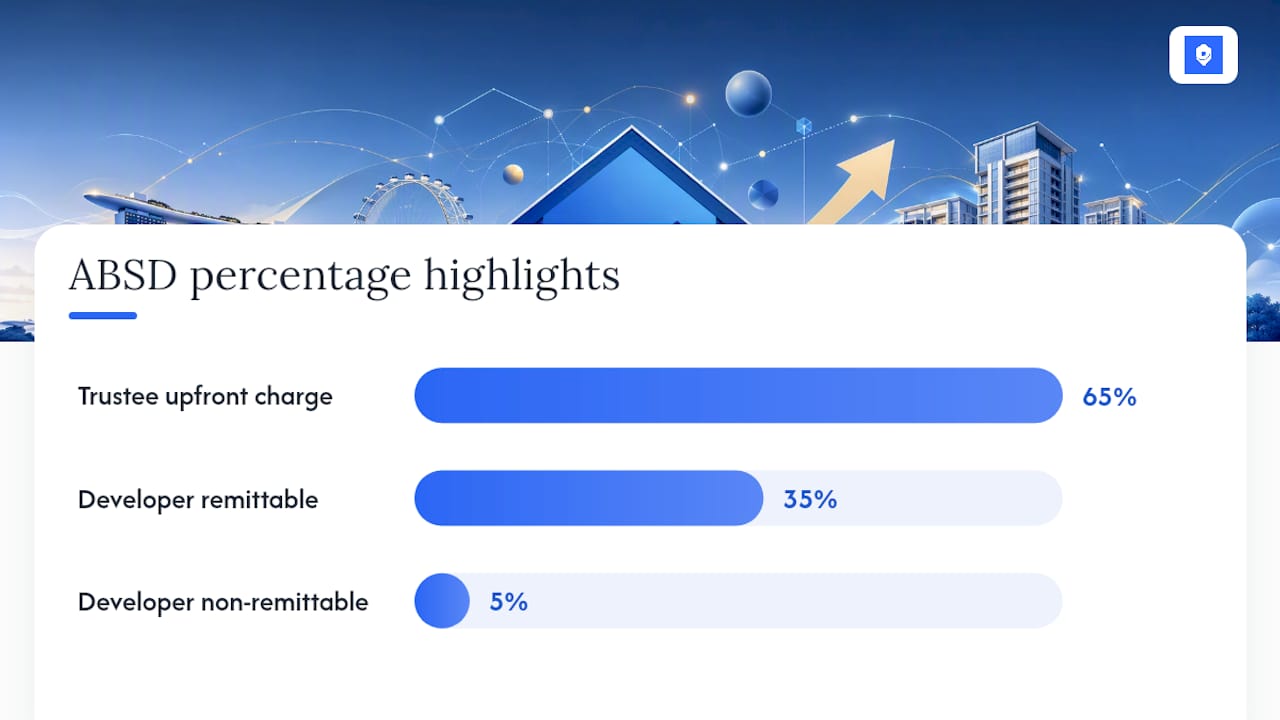
A trustee acquiring a residential property on behalf of beneficiaries is treated at the entity rate upfront, even when the eventual beneficiary would personally qualify for a lower SC or SPR rate. IRAS allows a remission application afterwards if the beneficial owner's profile justifies a lower rate, but the 65% is charged and payable at the point of purchase.
Developers get a distinct two-part structure: 35% is remittable if the developer meets conditions tied to construction and sale timelines (broadly, completing and selling all units within a set period), while a further 5% is non-remittable and stays payable regardless of how the project unfolds. This structure exists because Singapore's residential land supply for private development depends on developers building and releasing stock promptly rather than banking land.
One point trips up otherwise well-prepared buyers: FTA nationals from Iceland, Liechtenstein, Norway, Switzerland, and the United States are treated as Singapore Citizens for ABSD purposes, not as foreigners. That status is not automatic. IRAS requires documentary proof of nationality and residency status at the point of stamping, so leave time to gather passports, citizenship certificates, or equivalent documents before the OTP deadline arrives.
Who pays: buyer profiles, joint purchases and property counting
IRAS fixes a buyer's profile on the date the Option to Purchase is exercised or the Sale & Purchase Agreement is signed, not on the completion date. A Singapore Citizen who becomes a Permanent Resident, or a Permanent Resident who acquires citizenship, after signing the OTP is still assessed on the status held that day. This timing detail matters more than most buyers realise, particularly for anyone mid-way through a citizenship or residency application.
Joint purchases follow a "highest rate applies to the whole transaction" rule, which surprises couples and business partners alike:
- If one buyer is a foreigner and the other is a Singapore Citizen, ABSD is charged at the foreigner's 60% rate on the entire purchase price, not apportioned between the two profiles.
- A Singapore Citizen buying jointly with a Permanent Resident pays the SPR rate on the whole transaction, even if the SC holds the larger equity share.
- Entities co-purchasing with an individual trigger the entity rate of 65% across the full price.
Property counting looks at residential property held anywhere, whether in Singapore or overseas, and whether held solely or jointly. A half-share in an inherited condominium, an overseas apartment, or a property held through a nominee arrangement can all push a buyer into a higher ABSD tier they didn't expect. Transfers into a living trust are counted separately under the ABSD (Trust) regime rather than under an individual's own property count, and a purchase by a housing developer for construction and sale is treated under the developer schedule rather than the individual or entity rates.
Anyone unsure whether an existing property, part-share, or overseas asset counts against them should check their exposure before signing, since reversing a wrongly stamped document after the fact is far harder than getting the profile right from the outset.
How ABSD and BSD combine: three worked examples
ABSD is never the only duty in play. Buyer's Stamp Duty applies to every residential purchase regardless of citizenship or property count, using tiered bands from 1% to 6%: 1% on the first S$180,000, 2% on the next S$180,000, 3% on the next S$640,000, 4% on the next S$500,000, 5% on the next S$1.5 million, and 6% on anything beyond that. Both BSD and ABSD are calculated on the higher of the purchase price or IRAS's assessed market value, so a buyer who negotiates a price below market value doesn't escape the higher figure. IRAS will simply stamp against its own valuation.
Pro Tip: Ask your agent or conveyancing lawyer for IRAS's indicative valuation range before signing the OTP. If it sits meaningfully above your agreed price, budget your ABSD cash against the higher number, not the contract price.
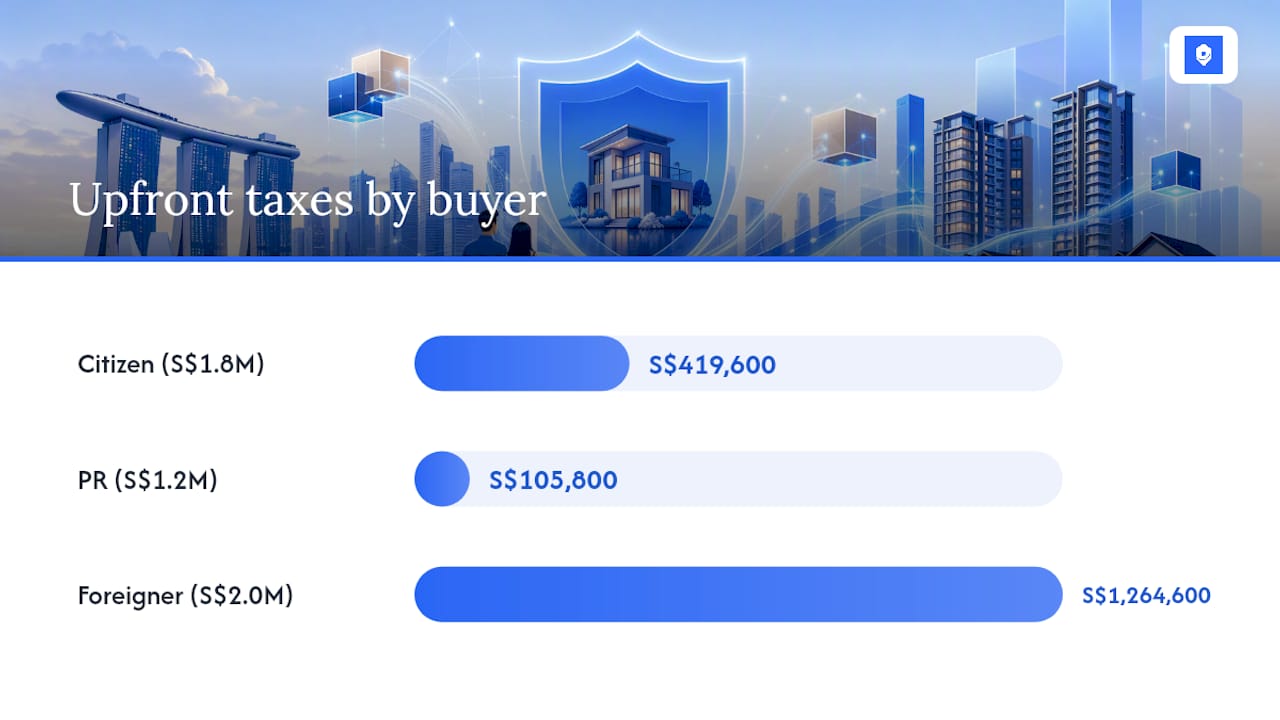
- Singapore Citizen buying a second private condominium at S$1,800,000. BSD works out to S$180,000 × 1% + S$180,000 × 2% + S$640,000 × 3% + S$500,000 × 4% + S$300,000 × 5% = S$1,800 + S$3,600 + S$19,200 + S$20,000 + S$15,000 = S$59,600. ABSD at 20% (second property, SC) adds S$360,000. Total stamp duty payable: S$419,600.
- Permanent Resident buying a first private property at S$1,200,000. BSD comes to S$1,800 + S$3,600 + S$19,200 + S$21,200 (remaining balance in the 4% band) = S$45,800 roughly, adjusted precisely against the bands. ABSD at 5% (first property, SPR) adds S$60,000. Total: around S$105,800.
- Foreigner buying any residential property at S$2,000,000. BSD on this price comes to roughly S$64,600. ABSD at the flat 60% rate adds S$1,200,000. Total cash required at signing: approximately S$1,264,600, on top of any down payment.
That third example is the one that catches first-time foreign buyers off guard: ABSD alone can exceed half the purchase price, and it sits entirely outside the mortgage. A S$2 million purchase can require well over S$1.2 million in duties and deposit before a loan is even drawn down.
Payment timing and penalties for missing the deadline
ABSD payment is due within a limited statutory period after executing the purchase agreement, with a slightly longer deadline if contracts are signed overseas and imported into Singapore. Both deadlines come directly from IRAS's payment guidance, and neither moves for holidays, financing delays, or valuation disputes.
Key payment rules to plan around:
- ABSD must be settled in cash; it cannot be financed through the mortgage itself.
- CPF Ordinary Account savings can, in limited circumstances, be used towards BSD and ABSD once the property purchase completes, but the funds are typically only accessible after the initial cash payment has already been made, meaning buyers still need liquid cash at signing.
- Some buyers who overpay or later qualify for a remission can seek reimbursement or top-up their CPF after IRAS processes a refund, but this happens after the fact, not at the point of stamping.
- Late payment penalties can escalate significantly, reaching multiple times the amount of unpaid duty, potentially causing serious financial consequences.
If a deadline is genuinely at risk, contacting IRAS before the 14 or 30 day window closes gives far more room to negotiate than waiting for a penalty notice to arrive. IRAS's e-Stamping portal remains the primary channel for payment, and buyers who anticipate a cash timing gap should raise it with their conveyancing lawyer as soon as the OTP is exercised, not once the clock is already running.
Remissions, exemptions and special cases
Several remission pathways can lower or refund ABSD, though every one of them comes with conditions, deadlines, and paperwork that IRAS enforces strictly.
- Married-couple remission. A married couple where one spouse already owns a residential property can, under IRAS's married-couple remission rules, claim a refund of ABSD paid on a new purchase, provided the earlier property is sold within six months of the new one's completion (for completed properties) or within six months of the Temporary Occupation Permit or Certificate of Statutory Completion (for properties bought under construction). The remission is not automatic. It must be applied for, and missing the sale window forfeits the refund entirely.
- HDB upgraders and Executive Condominiums. Households selling an HDB flat to buy a private property, or vice versa, generally still pay ABSD upfront on the second property if they haven't disposed of the first, then apply for remission once the sale completes. Permanent Residents face an additional restriction: they typically cannot buy a new Executive Condominium directly from a developer, which narrows their upgrading path compared with citizens.
- Developer remission. The 35% remittable portion of the developer rate is conditional on meeting construction and sale deadlines set by IRAS. Fail to sell all units or complete within the required timeline, and the remitted amount becomes payable retroactively, alongside interest.
- Trust transfers. Residential property transferred into a living trust is taxed under ABSD (Trust) treatment at the entity rate of 65%, paid by the trustee at the point of transfer. Where the identifiable beneficiary's own profile would attract a lower rate, a remission application can claw back the difference, but the trustee pays the full 65% first and reclaims later, not the other way round.
- FTA nationals. Citizens of Iceland, Liechtenstein, Norway, Switzerland, and the United States qualify for citizen-equivalent treatment, but only with the right documentary proof of nationality lodged at the point of stamping.
Every one of these remissions runs on a clock, and every one requires an active application to IRAS rather than an automatic adjustment. Buyers who assume a remission will simply "sort itself out" after settlement are the ones most likely to miss the window and forfeit a refund they were otherwise entitled to.
Budgeting for ABSD: strategies, costs and risks
ABSD behaves as an immediate capital outlay, not a financeable cost, so it needs to sit in a buyer's cash plan alongside the down payment, not inside the mortgage calculation. A buyer targeting a S$1.5 million second property as a Singapore Citizen needs roughly S$300,000 in ABSD alone, on top of whatever cash portion the down payment requires. Underestimating that figure is the single most common reason property purchases stall between OTP and completion.
Several planning strategies come up repeatedly among buyers trying to reduce their ABSD exposure, and each carries real cost and scrutiny:
- Decoupling, where one spouse transfers their share of an existing property to the other so the couple can buy a second property under one clean profile, involves legal conveyancing fees, potential BSD on the internal transfer, and possible capital gains-type exposure depending on financing arrangements.
- Transferring ownership to a lower-ABSD-rate family member before a fresh purchase can work, but IRAS scrutinises transactions that look structured purely to avoid duty, and misrepresenting the substance of a transfer risks penalties well beyond the ABSD saved.
- Trust placement defers the ABSD question to the beneficiary's profile, but only after the trustee has already paid the 65% entity rate upfront and successfully applied for remission, a process that ties up cash for months.
Pro Tip: Before pursuing decoupling or a trust structure, get a written cost estimate from a conveyancing lawyer covering legal fees, potential BSD on the transfer, and the realistic remission timeline. Buyers frequently discover the "saving" is smaller than expected once these costs are netted off.
Whether an investment case still works after ABSD depends heavily on expected rental yield and holding period. Anyone weighing a strategy beyond a straightforward purchase should treat professional legal and tax advice as a cost of the transaction, not an optional extra.
How Haio helps you model ABSD before you commit
Working out BSD and ABSD by hand across multiple scenarios, at market valuation rather than asking price, is where most manual calculations go wrong. Haio's platform is built to close that gap for Singapore buyers weighing a purchase against their actual cash position.
- Instant property valuation gives a data-backed estimate closer to what IRAS might assess, rather than relying solely on the asking price when budgeting for ABSD.
- A stamp duty estimator lets you model BSD and ABSD together across different buyer profiles (SC, SPR, foreigner, entity) before you commit to an Option to Purchase.
- Affordability and mortgage rate comparisons show how much cash you need on hand once ABSD is factored in, separate from the loan itself.
- Haio's data feeds are kept aligned with current IRAS rate schedules and market movements, so estimates reflect the rules in force at the time you're planning, not an outdated snapshot.
For buyers juggling multiple "what if" scenarios, whether that's a second property, a joint purchase with a foreign spouse, or a possible trust transfer, running the numbers through Haio's tools before signing anything gives a far clearer picture than a back-of-envelope estimate.
Where to verify ABSD figures and file remissions
Rates and remission conditions change with policy, so treat this article as a starting point and confirm figures directly before transacting. IRAS's ABSD page carries the current rate schedule and developer conditions. The BSD page covers the tiered bands separately. IRAS's payment and penalty guidance sets out deadlines and consequences for late stamping, while the married-couple remission page details eligibility and application steps. The Ministry of Finance publishes the policy rationale behind rate changes. Check these before any OTP is exercised, since rates have moved before and can move again.
Why the ABSD conversation misses the point
Most guidance on ABSD stops at the rate table, as if knowing the percentage were the hard part. It isn't. The rate table takes thirty seconds to read; working out how a joint purchase, an inherited half-share, or a pending citizenship application changes your profile takes far longer, and that's where buyers get caught out.
The bigger gap is cash sequencing, not cash amount. Buyers budget for ABSD as a lump sum but forget it lands before the mortgage does, on a 14-day clock that doesn't care about loan approval timelines. That mismatch, not the headline percentage, is what causes deals to collapse between OTP and completion.
Our view: treat ABSD as the first number you calculate, not the last. Run the market valuation and the buyer-profile check before you fall in love with a listing, not after you've signed an Option to Purchase. Decoupling and trust structures have their place, but they're expensive insurance policies, not shortcuts, and they only make sense once the plain-vanilla numbers have been run properly first.
— HAIO
This article is general information, not a substitute for advice from a qualified financial advisor. Consult a qualified financial professional about your own circumstances before acting on anything here.