

Buyer's Stamp Duty in Singapore follows a banded schedule of 1%) to 6% for residential property and 1% to 5% for non-residential property, calculated on whichever is higher: the purchase price or the market value. Buyers must pay within 14 days of signing the Option to Purchase or Sale and Purchase Agreement, and Additional Buyer's Stamp Duty sits entirely separate from this calculation, applied only to certain buyer profiles.
TL;DR:
- Buyers should be aware that BSD is calculated progressively in bands, with the top rate reaching 6% for properties over S$3 million, but the effective rate is usually below 5%.
- The duty is based on the higher of the purchase price and market value, and is rounded down to the nearest dollar, which affects high-value transactions.
- BSD is due within 14 days after signing the SPA or OTP, with payments made online via IRAS's portal, and late payments incur penalties.
- BSD applies to all property types, but ABSD adds extra costs based on buyer profile, significantly increasing costs for foreigners and multiple property owners.
- Using trustworthy valuation and calculating BSD and ABSD separately helps prevent budget shortfalls or overestimations, especially in off-market and landed deals.
Table of Contents
- What are the current BSD rates for residential and non-residential property?
- How do you calculate BSD rates step by step?
- When and how do you pay BSD in Singapore?
- How does BSD interact with ABSD, and who actually pays each?
- Can you use CPF savings to pay BSD?
- What does BSD actually cost across typical Singapore property prices?
- How haio helps you estimate BSD before you commit
- Getting BSD budgeting right before you sign anything
- Sources
- FAQ
What are the current BSD rates for residential and non-residential property?
The Inland Revenue Authority of Singapore sets out a progressive schedule where each portion of the price or value is taxed at a different rate, rather than one flat rate applied to the whole sum. This banded structure has applied since 15 February 2023, when the top two tiers (5% and 6%) were introduced for higher-value transactions. Buyers should always check the IRAS stamp duty page before signing anything, since rates have shifted before and will likely shift again.
Here is the schedule as it stands:
| Portion of price or value | Residential rate | Non-residential rate |
|---|---|---|
| First S$180,000 | 1% | 1% |
| Next S$180,000 | 2% | 2% |
| Next S$640,000 | 3% | 3% |
| Next S$500,000 | 4% | 4% |
| Next S$1,000,000 | 5% | 5% (remainder above S$1,000,000 also 5%) |
| Remainder above S$3,000,000 | 6% | Not applicable |
Non-residential property, covering commercial units, industrial space, and most shophouses, caps out at 5% once the price or value crosses S$1,500,000. Residential property keeps climbing, hitting 6% on anything above S$3,000,000. That extra one-point gap at the top end is deliberate policy, aimed squarely at higher-value residential purchases rather than commercial investment.
Two mechanical details trip up a surprising number of buyers. First, BSD is rounded down to the nearest dollar, so a calculation ending in cents gets trimmed, never rounded up. Second, there's a minimum duty of S$1, which matters only in the rare case of a nominal or very low-value transaction. Neither rule changes the outcome for a typical HDB or condo purchase, but they're worth knowing so a stamping receipt doesn't look "wrong" when it's actually correct to the cent.
One point worth flagging early: BSD is charged on the higher of the two figures, purchase price or market value, not simply the agreed price. If you've negotiated a price below market value, perhaps buying from a relative or in a private off-market deal, IRAS will still base the duty on the market valuation. This is where a credible, data-backed valuation matters, since an inflated or understated figure can trigger queries during stamping.
How do you calculate BSD rates step by step?
Working out BSD by hand is straightforward once you treat each band separately rather than applying one rate to the full amount. The method: subtract each band's ceiling in sequence, multiply the portion falling within that band by its rate, then sum the results.
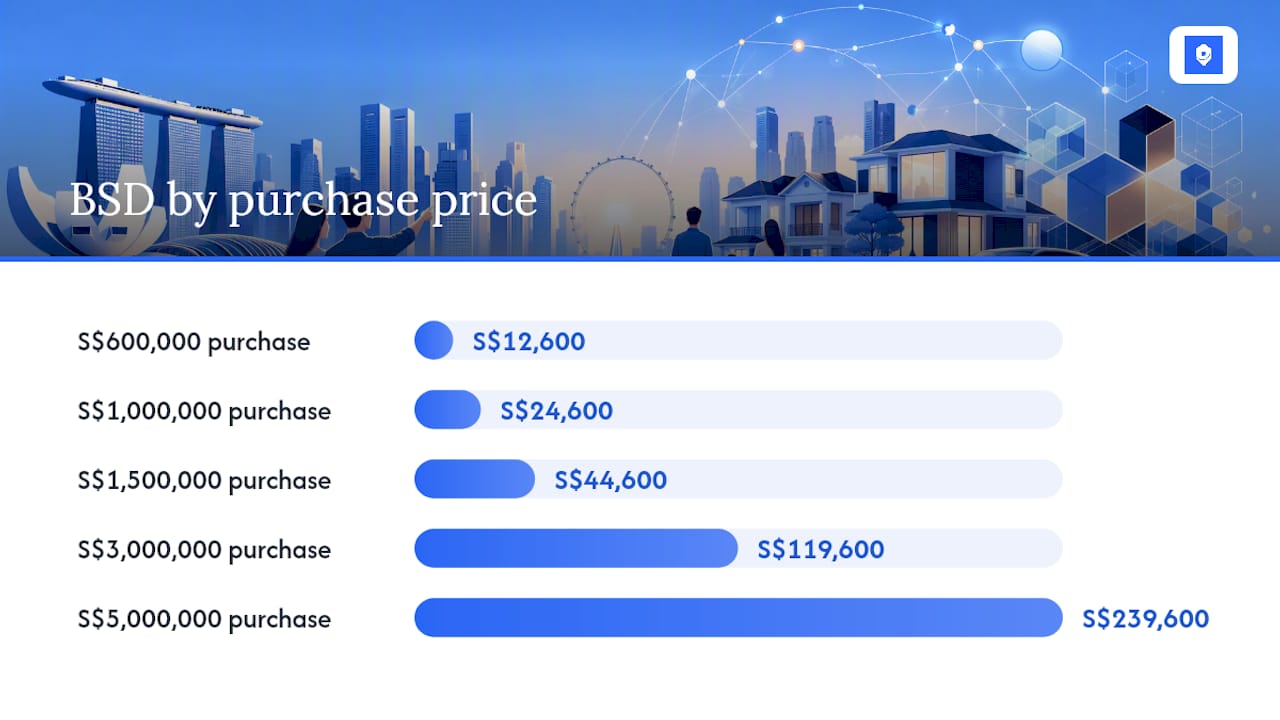
Here's how that plays out across five representative price points:
- S$600,000: 1% × 180,000 + 2% × 180,000 + 3% × 240,000 = S$1,800 + S$3,600 + S$7,200 = S$12,600, matching the worked example commonly cited by legal guides.
- S$1,000,000: 1% × 180,000 + 2% × 180,000 + 3% × 640,000 = S$1,800 + S$3,600 + S$19,200 = S$24,600.
- S$1,500,000: previous S$24,600 + 4% × 500,000 = S$24,600 + S$20,000 = S$44,600.
- S$3,000,000: previous S$44,600 + 5% × 1,500,000 = S$44,600 + S$75,000 = S$119,600.
- S$5,000,000: previous S$119,600 + 6% × 2,000,000 = S$119,600 + S$120,000 = S$239,600.
Statistic callout: on a S$5,000,000 residential purchase, the effective BSD rate works out to roughly 4.79%, well below the 6% headline figure, because the lower bands are still taxed at 1% to 5%. Only the slice above S$3,000,000 attracts the top rate.
For speed, shortcut formulas exist within specific price ranges. For V between S$1,000,000 and S$1,500,000, BSD = 4% × V − S$15,400, a formula noted by SingaporeLegalAdvice. These shortcuts only hold within their stated bands. Applying the S$1M formula to a S$3M property will produce a wrong figure, so always confirm with the banded method or a reliable calculator when the price sits near a band boundary.
When and how do you pay BSD in Singapore?
BSD becomes due within 14 days from the date the Option to Purchase or the Sale and Purchase Agreement is signed, if that document is executed in Singapore. Missing this window doesn't void the purchase, but it does trigger penalties, and the longer payment is delayed, the larger those penalties grow.
Payment and stamping run through IRAS's online channel:
- Log in to the myTax Portal using Singpass to e-stamp the document and settle the duty.
- Have the signed OTP or SPA, along with the agreed purchase price and any valuation report, ready before starting the online submission.
- Confirm the exact duty payable using the portal's calculator, since it applies the same rounding down to the nearest dollar and the S$1 minimum duty automatically.
- Keep the stamp certificate once issued. It's proof of stamping and often required by your lawyer or bank during completion.
- If payment is late, expect a penalty computed on the outstanding duty, and act promptly through your conveyancing solicitor to regularise the position.
Most buyers never touch this process directly. Conveyancing lawyers typically handle stamping as part of the transaction, but knowing the mechanics helps you sanity-check what you're being billed for.
How does BSD interact with ABSD, and who actually pays each?
BSD applies to every buyer, on every residential and non-residential property, with no exceptions based on citizenship or how many properties you already own. Additional Buyer's Stamp Duty is a different creature entirely: it's an overlay charged on top of BSD, and it depends entirely on the buyer's profile, according to IRAS's ABSD guidance. A Singapore citizen buying a first home pays no ABSD at all. A Singapore citizen buying a second property pays a meaningful ABSD rate on top of the standard BSD bands. A foreign buyer faces the steepest ABSD rate of any profile, applied to the entire purchase price or market value, whichever is higher.
A foreign buyer on that same purchase would owe BSD of S$64,600 plus an ABSD amount calculated separately at their applicable rate, a sum that typically dwarfs the BSD itself.
Practical takeaways for budgeting:
- Treat BSD and ABSD as two separate line items, never one combined "stamp duty" figure.
- Check your own ABSD profile carefully. Citizenship, residency status, and the count of properties you or your spouse already hold all change the rate.
- Remember ABSD calculates on the same "higher of price or value" basis as BSD, so an undervalued purchase price won't reduce either charge.
Can you use CPF savings to pay BSD?
No. CPF Ordinary Account funds cannot be applied directly to BSD at the point of stamping, according to the CPF Board. Buyers pay BSD in cash first, then apply separately for reimbursement from their CPF savings where the rules permit it.
The typical sequence runs like this:
- Pay BSD in cash through the myTax Portal at the point of stamping, within the 14-day deadline.
- Once stamping is complete and you hold the certificate, submit a CPF reimbursement application through your solicitor or directly via CPF's online channels.
- Provide the stamp certificate, the signed OTP or SPA, and your CPF account details as supporting documents.
- Allow processing time before funds are credited back to your CPF Ordinary Account, factoring this into your short-term cash flow.
Pro Tip: Check your CPF Ordinary Account balance well before your completion date, and flag the reimbursement timeline to your solicitor early. A shortfall discovered on stamping day, when cash is due immediately, is a far worse problem than one spotted three weeks earlier.
What does BSD actually cost across typical Singapore property prices?
Converting the banded schedule into effective rates makes the real-world impact clearer. The percentage you actually pay rises gradually as price increases, never jumping straight to the top band rate.
- S$500,000 (typical resale HDB flat): BSD of S$9,600, an effective rate of 1.92%.
- S$800,000 (larger HDB or entry condo): BSD payable consistent with the progressive schedule, with an effective rate around the mid-range for that price.
- S$1,200,000 (mass-market condo): BSD of S$32,600, an effective rate of 2.72%.
- S$1,500,000 (mid-tier condo): BSD of S$44,600, an effective rate of 2.97%.
- S$2,000,000 (larger condo or smaller landed): BSD of S$64,600, an effective rate of 3.23%.
- S$3,000,000 (landed or high-end condo): BSD of S$119,600, an effective rate of 3.99%.
- S$5,000,000 (luxury landed or bungalow): BSD of S$239,600, an effective rate of 4.79%.
The progressive banding does real work here, and it's the single most misunderstood feature of the whole schedule.
The pattern holds for HDB resale flats, mass-market condominiums, and landed housing alike. The banding is identical; only the price point changes the outcome. Where purchase price and market valuation diverge, and this happens more often in private resale and landed transactions than in new launches, IRAS applies duty to whichever figure is higher. Getting an independent, up-to-date valuation before you commit avoids an unwelcome surprise at stamping.
How haio helps you estimate BSD before you commit
Working out BSD by hand is manageable, but pairing it with a genuine sense of your property's market value takes more than a calculator. Haio's Property Analysis tool draws on Singapore's residential transaction data to surface a realistic valuation range, the same figure IRAS cares about when price and value diverge. Run that alongside haio's Affordability tool to see how BSD, ABSD where applicable, and your loan repayments fit together before you sign an Option to Purchase.
Getting BSD budgeting right before you sign anything
The conventional advice on BSD tends to stop at "here's the table, do the maths." That's technically correct and practically incomplete. The real risk sits in the gap between purchase price and market value, particularly for landed property and off-market private deals, where a buyer who anchors their BSD estimate to the negotiated price rather than the valuation can be caught out at stamping.
The other blind spot is treating BSD and ABSD as one number. They're governed by entirely different logic: BSD is a flat function of price banding, applied universally, while ABSD is a policy lever tied to buyer profile. Conflating the two leads either to underestimating total cash needed, dangerous for foreign buyers and second-property purchasers, or to unnecessary anxiety for first-time citizen buyers who owe no ABSD at all.
If there's one priority, it's this: get an honest valuation before you calculate anything, then run BSD and ABSD as two distinct calculations, in that order. The maths itself is the easy part.
— HAIO
This article is general information, not a substitute for advice from a qualified financial advisor. Consult a qualified financial professional about your own circumstances before acting on anything here.
Sources
- Which property-related fees can I use my CPF savings for? - Central Provident Fund Board
- Stamp Duty Calculator - MoneySmart
FAQ
Do I need to pay BSD for an HDB flat?
Yes. BSD applies to every residential purchase in Singapore, including HDB resale flats and new BTO flats, with no exemption for public housing. The same banded schedule of 1% to 6% applies regardless of whether you're buying HDB, private condominium, or landed property.
Why is Buyer's Stamp Duty so high on expensive properties?
BSD isn't a flat rate.
Can I use my CPF savings to pay BSD?
Not directly. CPF Board guidance confirms BSD must be paid in cash at the point of stamping, after which you can apply to have eligible amounts reimbursed from your CPF Ordinary Account.
How is Seller's Stamp Duty calculated, and is it the same as BSD?
Seller's Stamp Duty is a separate charge from BSD, applied to sellers who dispose of residential property within a specified holding period after purchase, rather than to buyers at acquisition. It's calculated on a different rate structure tied to how long the property was held, so it should never be confused with the buyer-side BSD bands covered in this schedule.