
If you can wait around four years and live rent-free, a BTO flat usually delivers the lower net cost; if you need a home now or want a specific location, resale wins on certainty. The decisive trade-off is time against choice, and it hinges on how you handle grants from HDB, the Enhanced CPF Housing Grant (EHG), and the Minimum Occupation Period (MOP) that follows either purchase.
TL;DR:
- Resale flats can be more cost-effective if buyers qualify for maximum grants, stack the CPF Family and Proximity Housing Grants, and pay minimal renovation costs.
- Waiting three to five years for a BTO reduces total net cost but incurs significant interim rent, which may outweigh the savings for many buyers.
- The value of combined resale grants can bring the effective purchase price close to or below BTO costs, especially in mature estates with high COVs.
- Buyers must consider lease length, minimum occupation period, and resale restrictions, which impact long-term value and flexibility.
- For immediate move-in needs or specific location requirements, resale flats often provide better certainty and immediate access.
Table of Contents
- BTO vs resale: quick shortlist for your situation
- Grants and eligibility: what each grant does and who qualifies
- Price and net cost: a worked BTO vs resale example
- Wait time and interim housing costs: what to budget
- Lease, MOP and classification: the long-term trade-offs
- Location and unit choice: ballot limits vs pick-any freedom
- Housing condition and renovation: what to expect and inspect
- How to choose: a practical decision checklist
- How Haio's tools help you model BTO vs resale
- Financing options and mortgage differences
- Property tax and stamp duty on resale flats
- Transfer and legal fees compared
- Common mistakes and a pragmatic way forward
- Model your own BTO vs resale numbers with Haio
- Sources
BTO vs resale: quick shortlist for your situation
Both paths solve the same problem, housing, but they suit different circumstances. The shortlist below narrows things down before you get into the numbers.
Choose BTO if:
- You can wait three to five years from ballot to key collection without needing to move immediately.
- You qualify for the full Enhanced CPF Housing Grant and want the lowest possible headline price.
- You're comfortable living with parents or in a cheaper rental during the wait, since interim housing costs eat into any BTO discount.
- You want a brand new unit with a fresh 99-year lease and don't mind a randomised location within your chosen town.
Choose resale if:
- You need to move within months, not years, whether for marriage, a growing family, or a lease ending elsewhere.
- Location matters more than price, for example proximity to a specific school or ageing parents.
- You can stack the Proximity Housing Grant with the EHG and Family Grant to bring resale's net cost closer to BTO's.
- You want a shorter remaining lease with a known layout, renovation history, and immediate CPF/loan clarity.
A representative 4-room BTO in a non-mature estate often launches in a moderate price range before grants, while a comparable resale flat in the same town can be well above that price according to SmartCalculator's 2026 analysis. Run both scenarios through a mortgage and affordability calculator before committing to either path.
Grants and eligibility: what each grant does and who qualifies
Grant stacking is where most first-time buyers underestimate resale's competitiveness. Three grants dominate the calculation, and knowing which applies to which flat type changes the entire comparison.
- Enhanced CPF Housing Grant (EHG): Available to eligible first-timer families and singles buying either a BTO or resale flat, with the amount tapering according to household income, as set out on HDB's CPF housing grants page.
- CPF Family Grant: Applies to resale purchases only, since BTO buyers already benefit from a subsidised build price and don't need this additional offset.
- Proximity Housing Grant (PHG): Gives S$20,000 to S$30,000 depending on whether you live with or near parents or adult children, according to HDB's Proximity Housing Grant guidance, and it's exclusive to resale flats.
This is the structural reason resale can close the price gap: BTO buyers typically only draw on the EHG, while resale buyers can combine EHG, Family Grant, and PHG. Market commentary in 2026 notes combined grants can reach substantial amounts for well-positioned resale buyers, according to Cashew's analysis. A couple buying a S$550,000 resale flat near a parent's home, eligible for S$50,000 EHG, S$40,000 Family Grant, and S$20,000 PHG, brings their effective price down to S$440,000, a gap that can rival a comparable BTO once interim rent is factored in. The CPF Board's grant guide confirms how these grants interact with CPF use and income ceilings.
Price and net cost: a worked BTO vs resale example
Headline price is only the starting point. The number that actually matters is net outlay, meaning purchase price minus grants, plus interim rent and renovation, all measured in CPF and cash terms.
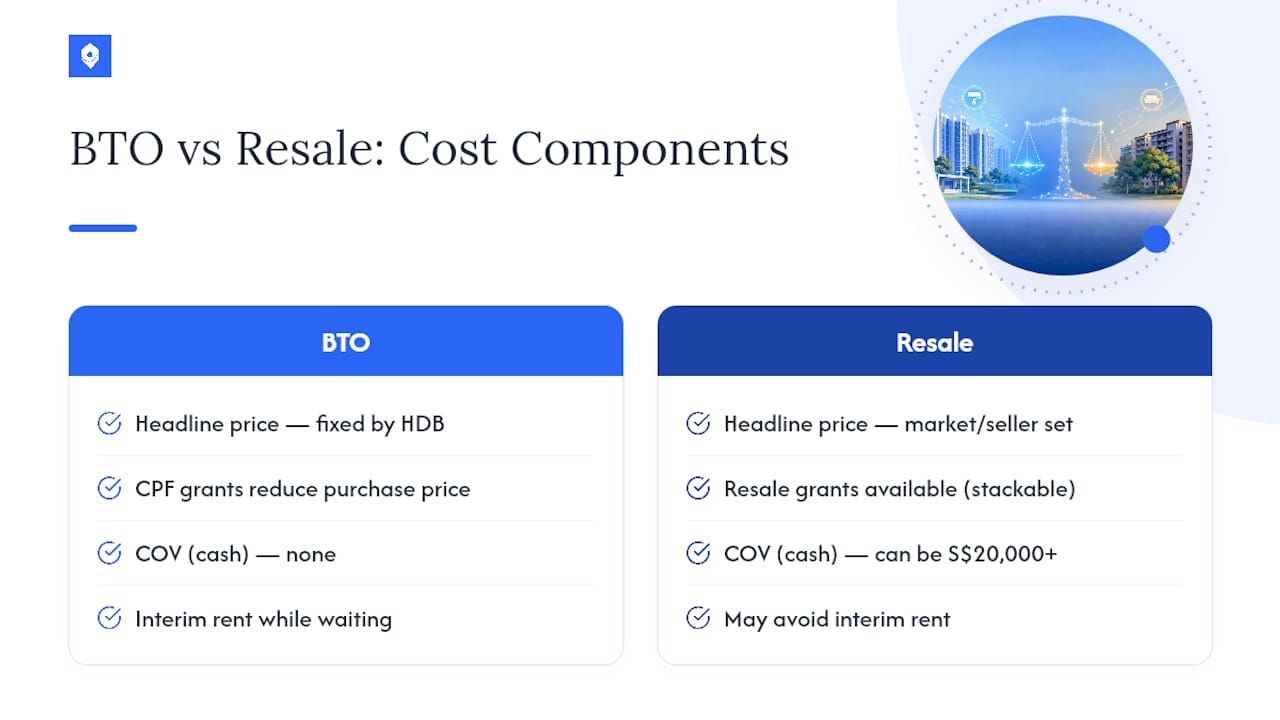
Resale prices also carry Cash Over Valuation (COV), the amount a buyer pays above HDB's official valuation, settled entirely in cash rather than CPF or a housing loan. A hot mature estate can see COV of S$20,000 or more, which adds directly to cash outlay without reducing the loan-eligible amount. BTO prices, by contrast, are fixed by HDB and carry no COV.

The table shows BTO still wins on paper in most cases, but the gap narrows sharply for buyers who would otherwise pay years of rent while waiting, or who can stack the full resale grant package. A couple who already lives with parents and needs no interim rent, and who qualifies for maximum resale grants, can find resale genuinely cheaper once renovation and COV are weighed against a multi-year wait. Third-party numeric analysis consistently flags interim rent as the variable that flips the comparison for renting couples.
Wait time and interim housing costs: what to budget
A BTO ballot requires a wait that carries a real price tag many buyers may overlook.
- BTO timeline: Ballot result, then booking a unit, typically three to five years from booking to key collection depending on project size and location.
- Resale timeline: Option-to-purchase, valuation, and completion usually take eight to twelve weeks from offer to keys.
- Interim rent: A room or small unit in a non-mature estate can cost S$1,000 to S$1,500 monthly; a full rental flat runs S$2,200 to S$3,500. Over three years, that's S$36,000 to S$126,000 depending on arrangement.
- Reducing interim costs: Staying with parents avoids rent entirely and may unlock the PHG later on the eventual resale purchase; co-renting with another young couple splits costs; short leases under twelve months give flexibility if the BTO completes early.
Multiply your expected monthly rent by the realistic wait, not the optimistic one, before assuming BTO is automatically the cheaper choice.
Lease, MOP and classification: the long-term trade-offs
Lease length and occupation rules shape not just when you can sell, but how much you'll get for the flat when you do.
- Lease length: New BTOs come with a fresh 99-year lease; resale flats carry whatever remains, which affects CPF usage limits and loan tenure once the flat has fewer than 60 years left.
- MOP duration: Standard-classification flats carry a 5-year MOP, while Plus and Prime flats, HDB's newer classification for better-located projects, carry a 10-year MOP with subsidy clawback on resale, as detailed in HDB's Standard, Plus and Prime framework.
- Subsidy clawback: Plus and Prime flats require sellers to return a percentage of the subsidy received, on top of the resale levy, reducing eventual profit.
- Resale flats: Already past MOP in most cases, so buyers can sell or rent out rooms sooner, though lease decay becomes the bigger long-term concern instead of clawback.
The 2024 Standard/Plus/Prime framework changed exit planning significantly; a well-located Prime flat costs less upfront but locks owners in longer and claws back more on sale.
Location and unit choice: ballot limits vs pick-any freedom
HDB assigns launch locations based on planned town development, so a BTO buyer chooses a project, not a specific block or unit with certainty of getting it.
- How BTO location works: HDB releases limited projects per town each exercise; popular mature-estate launches draw high application rates and long ballot queues.
- Ballot limits in practice: You can rank flat types and sometimes unit stacks, but final allocation depends on ballot order, meaning your preferred floor or facing isn't guaranteed.
- Resale freedom: Buyers can target a specific mature estate, a block near a preferred school (which also affects PHG eligibility if buying near parents), or a particular floor level immediately.
- Long-term implications: Mature estate resale flats tend to hold value better due to limited future supply, while new BTO towns carry more uncertainty until amenities mature.
If school proximity or a specific neighbourhood is non-negotiable, resale is usually the only realistic route, since BTO offers no guarantee of landing in that estate this decade.
Housing condition and renovation: what to expect and inspect
New and old flats demand very different renovation budgets, and skipping inspections on a resale unit is one of the costliest mistakes a first-time buyer can make.
- BTO renovation: Mostly cosmetic, flooring, kitchen cabinetry, and painting, typically running S$40,000 to S$62,000 according to LovelyHomes' 2026 buyer guide.
- Resale renovation: Often involves hacking old tiles, rewiring, and replacing plumbing, pushing costs above S$60,000 and sometimes past S$90,000 for older units.
- Red flags to inspect: Damp patches on ceilings, spalling concrete near bathrooms, uneven flooring, and outdated electrical panels that may not meet current load demands.
- Budgeting tip: Get an independent inspection before signing the Option to Purchase, not after, since defects found post-purchase become your problem alone.
Pro Tip: Ask the resale seller for the flat's last renovation date and any HDB-approved permits for hacking works; undocumented structural changes can complicate your own renovation plans later.
How to choose: a practical decision checklist
Narrowing a genuinely personal decision down to three questions makes it far easier to act on.
- Can you wait three to five years? If not, resale is the realistic path regardless of price difference.
- Can you live rent-free during the wait? Staying with family while balloting removes the single biggest hidden cost of choosing BTO.
- Is location non-negotiable? If a specific school zone, estate, or proximity to parents matters, resale gives you that certainty immediately.
Before deciding, run your household income through an EHG eligibility check, price out interim rent for your actual timeline, and compare net outlay, not headline price, across both options using a proper affordability calculator.
How Haio's tools help you model BTO vs resale
Haio's valuation tool lets you pull an instant estimate on any resale listing, comparing it against recent transacted prices in the same block or estate. Pair that with the affordability check to see how grants, including EHG and PHG, adjust your net cash and CPF outlay, and the mortgage comparison feature to check current rates against your loan tenure. For BTO buyers, launch alerts flag upcoming projects in your preferred towns, so you can model a hypothetical BTO scenario alongside a live resale listing and compare net cost side by side rather than guessing.

Financing options and mortgage differences
BTO and resale buyers approach financing from different starting points, and the gap affects both upfront cash and monthly repayments.
BTO buyers commit at booking stage using an HDB loan or bank loan based on the flat's fixed price, with disbursement staged as construction progresses, meaning cash flow needs are spread over the build period rather than paid upfront. Resale buyers must secure financing faster, since the Option to Purchase and completion timeline runs mere weeks, and the loan quantum depends partly on the flat's remaining lease. Flats with fewer than 60 years left face reduced CPF usage and shorter maximum loan tenure, which can push resale buyers of older units towards larger cash components. Bank loans versus HDB loans carry different interest structures too. HDB loans track the CPF Ordinary Account rate plus a small margin, offering predictability, while bank loans often start lower but float with market rates. Resale buyers relying on COV, the cash-only premium above valuation, need that amount ready in cash regardless of loan approval, since no financing instrument covers COV.
Property tax and stamp duty on resale flats
Resale buyers face upfront costs that BTO buyers largely avoid, and they change the net cost calculation meaningfully.
Buyer's Stamp Duty applies to both BTO and resale purchases based on purchase price, but resale buyers pay it on a typically higher headline price, meaning a larger absolute amount even at the same rate. Additional Buyer's Stamp Duty applies only where a buyer already owns another property or is a permanent resident or foreigner purchasing an additional home, a scenario more common among resale buyers upgrading or investing than among first-time BTO applicants. Annual property tax, based on the flat's Annual Value, applies equally to both flat types once occupied, so it isn't a differentiator between BTO and resale, but it's a recurring cost first-time buyers sometimes forget to budget alongside the mortgage. Because resale transactions complete faster, buyers should have stamp duty funds ready in cash within weeks of signing the Option to Purchase, unlike BTO buyers whose staged payment schedule allows more time to arrange this.
Transfer and legal fees compared
Legal costs differ modestly between the two paths, but resale carries a few extra line items worth budgeting for.
Both BTO and resale purchases require conveyancing, typically handled through HDB's resale portal for resale transactions or directly through HDB for new flats, with legal fees for resale usually running slightly higher due to title checks, outstanding loan redemption if the seller has an existing mortgage, and caveat lodgement. Resale buyers also pay for a valuation report if using a bank loan, since HDB's own valuation and the bank's independent valuation can differ, occasionally requiring buyers to cover a valuation gap in cash. BTO buyers face simpler documentation since there's no existing owner, no outstanding loan to redeem, and no valuation dispute, keeping legal costs modest and largely fixed regardless of flat type or town.
Common mistakes and a pragmatic way forward
The biggest error is assuming BTO always wins on price without pricing in years of rent. A close second is ignoring the PHG entirely when family already lives nearby. The pragmatic approach: ballot for a BTO while actively watching resale listings, run both net-cost scenarios numerically, and let your actual timeline, not the headline price, decide.
— HAIO
Model your own BTO vs resale numbers with Haio
Haio turns the maths in this guide into something you can run against your own household numbers in minutes, rather than rebuilding spreadsheets from scratch. Pull an instant valuation on any resale listing, check affordability against your income and grant eligibility, compare current mortgage rates across lenders, and set launch alerts for BTO projects in your preferred towns, all from one place. Whether you're leaning towards waiting out a ballot or moving on a resale flat this year, try Haio's tools to model both scenarios side by side before you commit.