
Most private condominium owners in Singapore pay between S$300 and S$700 a month in maintenance fees, though luxury developments regularly exceed S$1,000. These fees split into two separate pots, a management fund for day-to-day running costs and a sinking fund for major repairs, and both are set out in the annual budget your Management Corporation Strata Title puts to owners. Before you sign anything, request the latest AGM minutes and audited accounts.
TL;DR:
- Maintenance fees can surge significantly if the sinking fund is under-contributed, with recent increases reaching up to 65 percent in some developments.
- The sinking fund must be adequate for major repairs like lift overhauls and façade work, or owners face potential special levies calculated based on share values.
- Larger units and luxury developments tend to pay higher monthly fees, often exceeding S$1,000, due to more extensive facilities and larger share allocations.
- Reviewing recent AGM minutes, audited accounts, and the sinking fund status helps predict potential fee increases or levies before purchase.
- Sharp fee rises or arrears require proactive questioning and resolution at meetings or through legal channels to avoid costly surprises or penalties.
Table of Contents
- What are typical condo maintenance fees in Singapore?
- What fees pay for: management fund vs sinking fund
- How are condo maintenance fees calculated in Singapore?
- Why do fees vary so much by unit size and development tier?
- How healthy does the sinking fund need to be?
- Why have maintenance fees risen recently?
- What documents should you check before buying a condo?
- Who sets condo maintenance fees and what law governs them?
- What should you do if fees rise sharply or you fall into arrears?
- HAIO perspective: reading fee risk before you make an offer
- Where to check the original figures and rules
- Sources
What are typical condo maintenance fees in Singapore?
Fee bands vary widely by development tier, but recent local explainers converge on a consistent picture. Mass-market condominiums in the Outside Central Region typically sit at the lower end, while City Fringe and Core Central Region developments climb steadily as facilities and staffing costs increase.
- Mass-market (OCR): roughly S$250 to S$400 a month for smaller units
- Mid-tier (RCR): roughly S$400 to S$650 a month
- Luxury and Core Central Region: S$700 to over S$1,000 a month, driven by concierge services, larger pools, and multiple lift cores
Recent reporting shows this range can move sharply. Local news has documented cases where maintenance fees jumped by as much as 65% at specific developments, usually following a budget reset or a special levy for deferred works. That single data point is worth remembering: a quoted "typical" fee today tells you little about what you might owe in three years if the sinking fund has been under-contributed.
Before committing to a purchase, three documents matter more than any brochure: the latest AGM minutes, the audited financial statements, and the sinking fund statement showing current balance against the next scheduled major works. A sinking fund sitting below what the Management Council projects it needs for upcoming lift overhauls or façade repairs is the clearest early warning sign of a levy on the horizon.
What fees pay for: management fund vs sinking fund
Every dollar you contribute lands in one of two accounts, and understanding the split explains both your monthly bill and the risk of a sudden special levy.
The management fund covers recurring, operational costs that keep the estate running month to month:
- Security personnel and access control systems
- Cleaning of common areas, pools, and gyms
- Landscaping and pest control
- Utilities for common property (lighting, water for shared facilities, lift power)
- Managing agent fees for administration, accounting, and contractor coordination
- Insurance premiums for the building and common property
- Minor, routine repairs
The sinking fund covers capital expenditure, the large, infrequent items that a monthly budget can't absorb without saving ahead:
- Lift replacement or major overhaul
- Façade repainting and waterproofing
- Roof repairs and structural works
- Swimming pool re-tiling or filtration upgrades
- Car park resurfacing and mechanical system replacement
The BCA's guidance for condo owners is blunt about why this distinction matters: timely contributions and a healthy sinking fund are what keep common facilities safe and functional, and a shortfall in one account cannot simply be plugged by overspending in the other. If your MCST has been dipping into the sinking fund to cover operating shortfalls, that's a structural problem that eventually surfaces as either a special levy or a steep increase in your regular monthly charge.
How are condo maintenance fees calculated in Singapore?
Your monthly fee isn't set arbitrarily. It's derived from a fixed number called share value, assigned to your unit at subdivision and recorded permanently in the strata title plan. Share value reflects your unit's proportional stake in the development, generally scaled to size and sometimes to type, and it doesn't change unless the strata plan itself is formally amended.
The formula used across most Singapore developments, as set out in guides from LovelyHomes and Propertynet, works like this:
- The MCST's Management Council prepares an annual budget covering both the management fund and sinking fund contributions.
- That total annual levy is divided by the development's total share value to find the levy rate per share.
- Your unit's monthly fee equals (your unit's share value ÷ total development share value) × total annual levy, divided by 12.
Here's a worked example using realistic figures for a mid-sized condominium:
| Item | Value |
|---|---|
| Total annual levy (management + sinking fund) | S$500,000 |
| Total development share value | 10,000 shares |
| Your unit's share value | 8 shares |
| Your share of the annual levy | (8 ÷ 10,000) × S$500,000 = S$960 |
| Your monthly maintenance fee | S$960 ÷ 12 = S$80... |
That figure looks low because this example uses a small share allocation for illustration. In practice, a typical two-bedroom unit might carry a share value proportionally larger, producing the S$400 to S$650 range seen across most mid-tier developments. The mechanics stay the same regardless of unit size: larger share value means a larger slice of the total levy, which is why penthouse and larger units almost always pay disproportionately more than smaller units in the same block.
Why do fees vary so much by unit size and development tier?
Share value drives your fee, but the total annual levy, and therefore the levy rate every owner pays per share, is driven by what the estate actually needs to run and maintain. That's why two condos with similar unit sizes can post very different monthly charges.
- Studios and one-bedroom units in OCR developments often pay S$250 to S$350 a month, reflecting lower share value and typically leaner facility lists.
- Two and three-bedroom units in RCR developments commonly fall in the S$400 to S$650 band, where pools, gyms, and function rooms add recurring costs.
- Larger units in CCR or boutique luxury developments frequently exceed S$1,000 a month.
According to recent explainer data, most Singapore condos in 2026 charge between S$300 and S$700 a month, with luxury developments the main outlier pushing past that ceiling.
Luxury fees climb past S$1,000 for a few consistent reasons: fewer units sharing the total cost base, larger and more elaborate facilities (multiple pools, private lift lobbies, concierge staffing round the clock), and higher-specification building systems that cost more to insure and maintain. A 300-unit mass-market development spreads its security and cleaning costs across far more share value than a 90-unit boutique tower with the same staffing headcount, so smaller luxury developments often carry a heavier per-unit burden even when their absolute budgets are similar.
How healthy does the sinking fund need to be?
Singapore law doesn't fix a fee amount, but it does require MCSTs to maintain sinking fund contributions at a level the Management Council considers adequate for anticipated capital works, and BCA guidance treats a well-funded sinking account as essential to keeping common facilities safe and functional. In practice, most well-run MCSTs aim to hold a sinking fund balance that covers several years of projected major works, reviewed and topped up at each AGM.
When the fund falls short, a special levy fills the gap. The mechanics are straightforward:
- The Management Council identifies a capital need, a lift replacement or roof repair, for example, that the sinking fund can't cover.
- A resolution is tabled at an AGM or EGM, with the amount and payment schedule set out for a vote.
- Owners vote by share value, and a passed resolution obliges every unit to pay its proportional share, calculated the same way as regular fees.
- The levy is typically invoiced as a lump sum or split across several instalments.
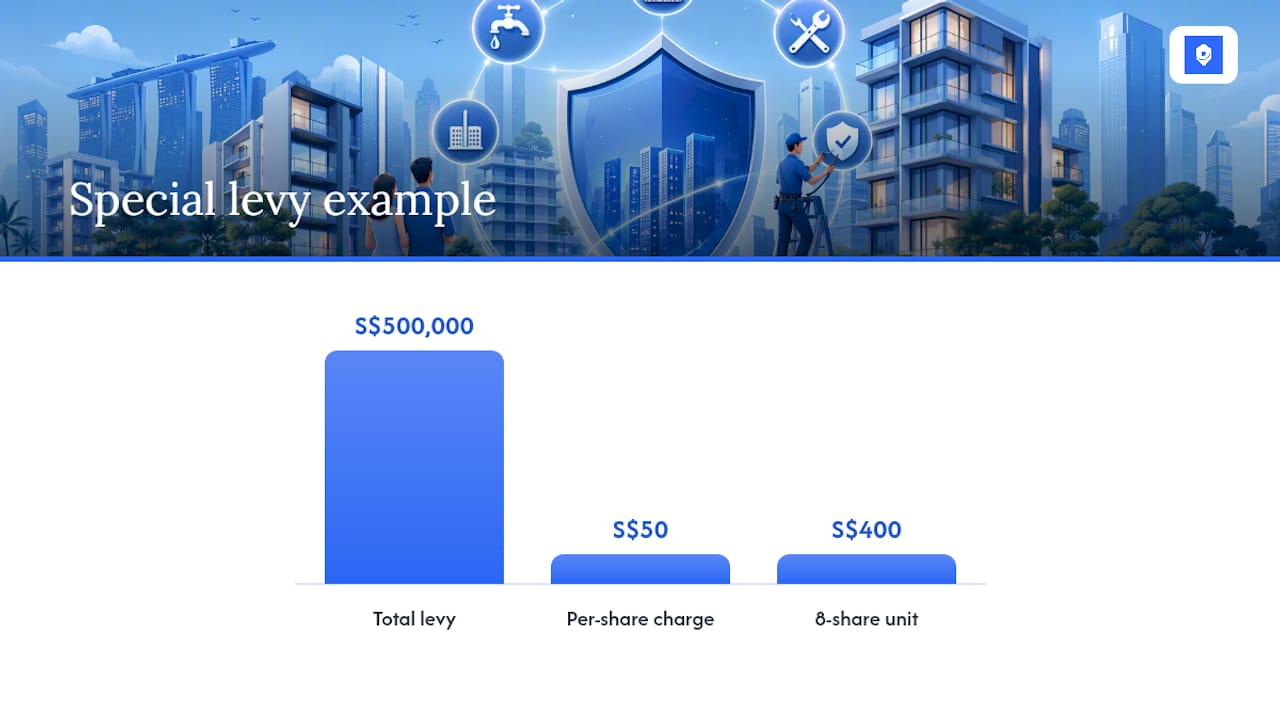
To estimate your exposure, apply the same share-value formula to the proposed levy amount rather than the annual budget. A S$500,000 levy divided across a 10,000-share development charges a unit with 8 shares roughly S$400, payable as agreed at the EGM.
Pro Tip: Scan AGM minutes from the past two to three years for repeated mentions of deferred works or owners repeatedly questioning the sinking fund balance. That pattern is one of the more reliable early signals that a special levy is coming, often well before it's formally tabled.
Why have maintenance fees risen recently?
Several structural pressures have pushed monthly charges upward across Singapore developments, and it's worth distinguishing which are temporary and which are here to stay.
- The Progressive Wage Model has steadily raised minimum pay for security officers and cleaners, two of the largest line items in most management fund budgets, and this pressure is scheduled to continue as wage floors rise further under MOM's framework.
- Utilities and materials costs have climbed alongside broader inflation, affecting everything from pool chemicals to lift maintenance contracts.
- GST registration thresholds can catch larger MCSTs whose annual collections cross the compulsory registration mark, adding a layer of tax administration that smaller developments avoid.
- Ageing estates built 15 to 25 years ago are now reaching the point where major systems, lifts, waterproofing, façade coatings, need simultaneous attention, and MCSTs that under-contributed to sinking funds in earlier years are catching up all at once.
The Channel NewsAsia reporting on fee surges of up to 65% at specific developments illustrates how these pressures compound. A development that deferred sinking fund top-ups for several years while wage and utility costs rose can face a budget reset that feels sudden to owners, even though the underlying drivers had been building for some time.
What documents should you check before buying a condo?
A property listing tells you the asking price. It won't tell you whether the MCST is financially sound, and that gap is where due diligence earns its keep.
Request these documents before making an offer:
- The latest AGM minutes (ideally the past two to three years), to spot recurring complaints about arrears, deferred works, or fee disputes
- Audited financial statements, showing actual income and expenditure against budget
- The current sinking fund statement, showing balance and planned drawdowns
- The proposed budget for the coming year, if available, to see whether a fee increase is already planned
- The MCST's by-laws, which govern renovation rules, pet policies, and use of common facilities
Ask the seller or managing agent directly about any planned major works, pending insurance claims, or outstanding arrears from other units, since unpaid contributions from delinquent owners can strain the fund even when your own account is clean. Watch for red flags in the accounts: repeated invoices to the same contractor for "urgent" repairs can indicate a facility in chronic disrepair rather than routine upkeep, and a sinking fund balance that hasn't moved in several years despite scheduled major works is a sign contributions have been diverted or simply under-set.
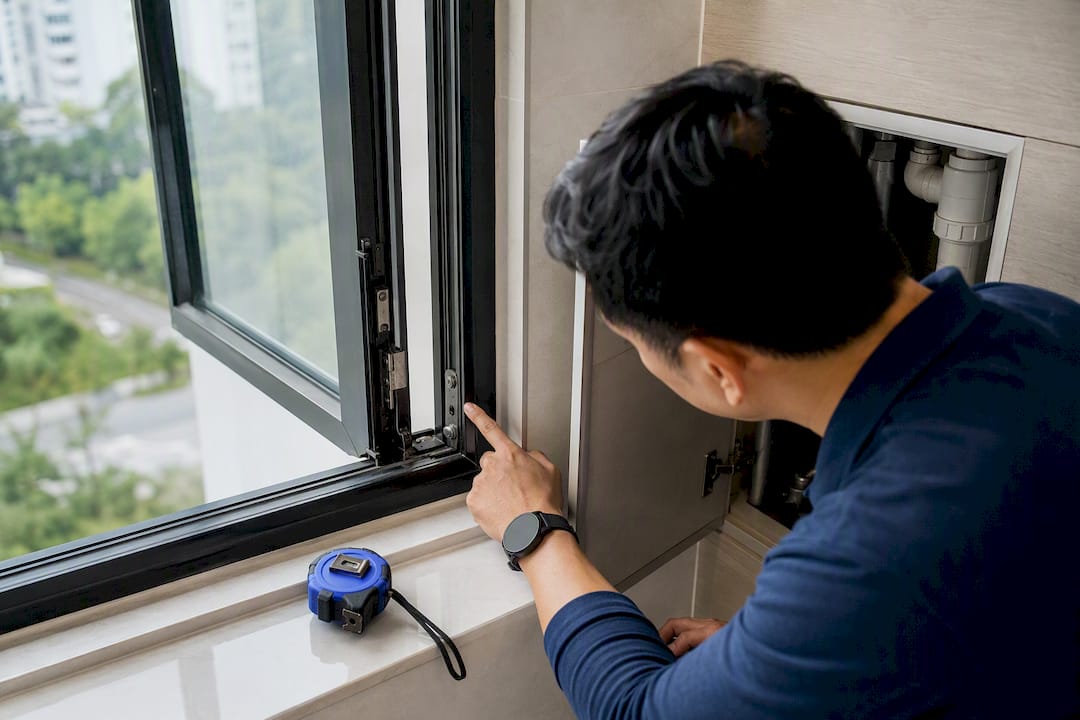
One detail buyers often overlook: BCA guidance notes that owners can be personally liable for damage to common property caused by neglected in-unit components, openable external windows and internal plumbing among them. Inspecting these during a viewing isn't just about your own unit's condition; it's about avoiding a liability the MCST could later pursue you for.
Who sets condo maintenance fees and what law governs them?
Fees aren't set by a developer or a managing agent acting alone. The Management Corporation Strata Title, formed automatically when a development is subdivided, holds legal responsibility for common property, and its elected Management Council proposes the annual budget that determines your fee.
- The Management Council drafts the budget, covering both funds, and presents it at the Annual General Meeting for owner approval.
- Votes at AGMs and EGMs are weighted by share value, not by one-vote-per-unit, so larger unit owners carry proportionally more say.
- The governing statute is the Building Maintenance and Strata Management Act, which sets out MCST powers, owner obligations, and the levy mechanism itself.
- Disputes that can't be resolved internally go to the Strata Titles Boards, a tribunal set up specifically to hear MCST-related disagreements, including fee disputes and by-law challenges.
If you believe a fee increase was improperly passed, the first step is always raising it formally at the next AGM or EGM before escalating to the Strata Titles Boards.
What should you do if fees rise sharply or you fall into arrears?
A sudden increase or an arrears notice both call for the same first move: don't ignore it and don't pay blind.
- Request an itemised budget breakdown from the managing agent, asking specifically what changed since the previous year's figures.
- Ask about phased payment arrangements if a special levy or steep increase creates a genuine cash-flow problem; most Management Councils will negotiate rather than pursue legal recovery immediately.
- Raise the issue formally at the next AGM or EGM, where you can question the budget assumptions directly and, if enough owners agree, seek a revised resolution.
- Escalate to the Strata Titles Boards if internal resolution fails and you believe the levy or fee was improperly approved.
- If you're buying a resale unit with existing arrears, insist on an MCST clearance certificate before completion. Outstanding fees can otherwise attach to the unit rather than the previous owner.
Unpaid maintenance fees accrue interest and can ultimately result in legal recovery action or a charge against the property title, so early engagement is always cheaper than letting arrears compound.
HAIO perspective: reading fee risk before you make an offer
Maintenance fees are one of the few ongoing property costs that buyers routinely underestimate, largely because listings rarely disclose sinking fund health or recent AGM history in any usable form. HAIO's view is that comparing a unit's asking price without comparing its likely fee trajectory against similar developments nearby is an incomplete picture of the real cost of ownership.
Data-led comparison across comparable developments, tracking reported fee levels, unit size, and estate age, gives buyers a sharper sense of where a levy might be brewing before it appears in an AGM notice. Reviewing valuation and market trend data on haio alongside the documents covered above puts you in a stronger position before you make an offer, not after you've signed.
— HAIO
Where to check the original figures and rules
For the statutory framework, read the Building Maintenance and Strata Management Act directly. For owner responsibilities and sinking fund guidance, see BCA's condo owner resource. For fee calculation examples, LovelyHomes and PropertyNet.SG both offer detailed worked breakdowns worth reading in full.