

Decoupling a private property in Singapore is legally possible, but only when it is a genuine transfer supported by a licensed valuation, bank consent and separate legal advice. HDB flats generally fall outside this strategy. The Singapore High Court and IRAS) treat sham transactions harshly, so check CPF refund obligations and your bank's TDSR assessment before committing to anything.
TL;DR:
- Decoupling is only legally viable for private residential properties with proper valuation, bank approval, and legal advice; HDB flats are not eligible.
- Transfer structures like gift, partial sale, or 99-to-1 arrangements face strict scrutiny, with courts condemning arrangements solely aimed at tax avoidance.
- Stamp duty calculations rely on market value assessments to prevent underpayment, and ABSD or SSD may still apply if the arrangement is deemed a sham.
- CPF refunds, including accrued interest, are mandatory, and TDSR calculations must confirm refinancing feasibility before proceeding.
- Costs involved often outweigh potential savings unless the ABSD avoided is substantial, requiring detailed modeling and thorough pre-transaction checks.
Table of Contents
- What is property decoupling and who does it apply to?
- HDB and public housing: what you must know
- Legal structures: gift, part-sale and 99-to-1 arrangements
- Stamp duty and tax risks: BSD, ABSD and SSD
- CPF and mortgage implications: refunds, accrued interest, TDSR
- Costs and a worked example: does decoupling actually pay?
- Timeline and execution: the practical step sequence
- How to prepare: documents and questions before you commit
- How Haio helps you model decoupling outcomes before you spend on conveyancing
- Does decoupling affect eligibility for housing grants and schemes?
- Practitioner perspective: quick rules of thumb from real cases
- Model your numbers before you brief a lawyer
- Sources
What is property decoupling and who does it apply to?
Property decoupling in Singapore means restructuring ownership of a jointly held property so one co-owner ends up as the sole registered owner, while the other exits the title entirely. The remaining owner then holds the property free of any name from the departing co-owner, which frees that person to buy a second property without triggering Additional Buyer's Stamp Duty (ABSD) on the new purchase.
Most couples pursuing this route are managing three things at once: ABSD exposure on a next purchase, estate planning ahead of inheritance, or restructuring finances around a single income. Whichever the motive, the mechanics turn on how the property is held.
Ownership sits in one of two forms:
- Joint tenancy — co-owners hold the property as a single indivisible unit with a right of survivorship; there are no separate "shares" to sell or gift.
- Tenancy-in-common — each owner holds a distinct, quantifiable share (commonly 99% and 1%), which can be transferred independently.
If your property is under joint tenancy, a lawyer must first sever it into tenancy-in-common before any share can be transferred. This distinction matters because decoupling as a strategy applies almost exclusively to private residential property. HDB flats and executive condominiums within their Minimum Occupation Period sit under a separate, far stricter regime, covered next.
HDB and public housing: what you must know
Since 2016, HDB has disallowed spousal ownership transfers designed to circumvent ownership rules, which effectively closed the decoupling route for public housing. HDB will not approve a transfer whose evident purpose is letting one spouse buy a private property while avoiding ABSD on that purchase.
Exceptions remain narrow and administrative rather than strategic:
- Death of an owner, where the flat passes under the estate or survivorship.
- Divorce, where a court order reallocates ownership.
- Documented financial hardship, assessed case by case by HDB.
Outside these categories, HDB reviews change-of-ownership applications specifically for ABSD-avoidance intent. Attempting a transfer that falls outside the permitted exceptions risks outright rejection, and in more serious cases, scrutiny of the household's broader eligibility for HDB schemes. If you own an HDB flat and are weighing your options, the honest starting point is accepting that decoupling, as commonly understood for private property, is not available to you.
Legal structures: gift, part-sale and 99-to-1 arrangements
Three structures dominate decoupling transactions in Singapore, and each carries a different risk profile with IRAS and the courts.
- Gift transfer. This works cleanly only when the property is unencumbered, meaning any outstanding mortgage has been fully redeemed and any CPF charge on the title discharged. The transferor gives up their share for no consideration. Because no money changes hands, IRAS still assesses Buyer's Stamp Duty (BSD) on the market value of the share transferred, not on a nominal figure.
- Part-sale. This is the typical route when a mortgage still exists. The transferee buys out the transferor's share at market value, backed by a licensed valuation and a formal Sale and Purchase Agreement. The bank must approve the transferee taking on the full loan in their own name, which brings TDSR assessment into play early.
- 99-to-1 arrangement. One owner takes 99% and the other 1%, then the 1% owner exits shortly after. Courts and IRAS view this structure with particular suspicion because the sequencing often looks engineered purely to minimise duty rather than reflect genuine co-ownership.
A Singapore High Court decision in Ngor Shing Rong Jake v Wong Mei Lee Millie confirmed that decoupling is unlawful where the sole purpose is tax avoidance, applying a substance-over-form test to the arrangement. The court looked past the paperwork to ask whether the transferor genuinely gave up beneficial ownership, not just legal title.
To withstand that scrutiny, document real commercial reasoning: independent legal advice for each party, a licensed valuation setting the transfer price, evidence the transferor actually relinquishes financial control, and a credible, non-tax rationale for the timing.
Pro Tip: Keep dated records of why the transfer happened when it did, separate from any property purchase you're planning. A transfer that coincidentally lines up with a new acquisition announcement invites exactly the scrutiny you want to avoid.
Stamp duty and tax risks: BSD, ABSD and SSD
BSD applies to every share transferred, private property or otherwise, calculated against the market value of that share rather than the price stated in the transfer documents if the two diverge. IRAS requires a licensed valuer's assessment precisely because understating consideration to shrink the duty bill is a common but easily detected manoeuvre. BSD is charged on graduated slabs, so the exact rate depends on the value of the share being moved.
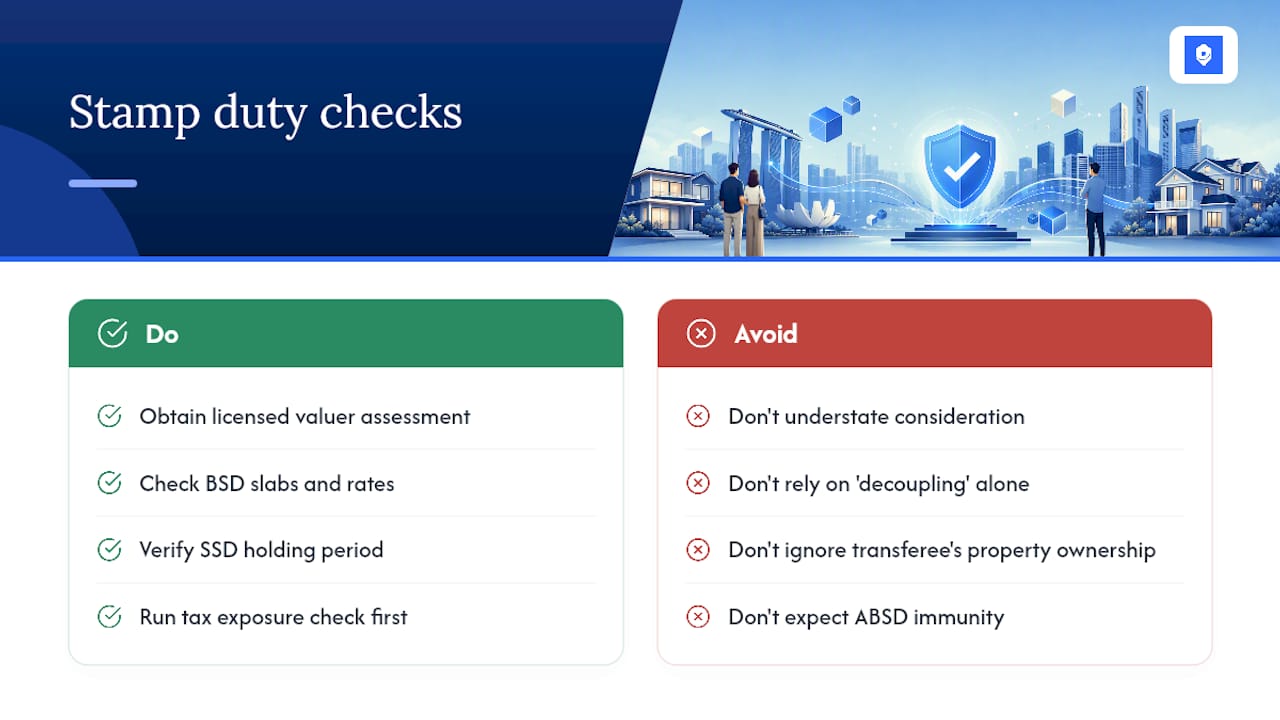
ABSD risk does not disappear just because you called the transaction a "decoupling." If the transferee already owns another property, or if IRAS concludes the whole arrangement is a sham designed to let the transferor buy a second property ABSD-free, ABSD can still be assessed retrospectively. The 99-to-1 structure sits squarely in this exposure zone.
Seller's Stamp Duty (SSD) also needs checking against the holding period. If the transfer counts as a disposal within the applicable SSD holding window, the transferor may owe SSD on top of everything else, layering another cost onto a transaction meant to save money.
The enforcement reality: MOF's policy statement on 99-to-1 arrangements confirms that transfers structured to avoid stamp duty face assessment, clawback of the ABSD that should have been paid, and a surcharge of 50% of the additional duty owed. That surcharge lands on top of the ABSD itself, not instead of it.
Sequence your tax exposure check before you sequence anything else. A decoupling that saves ABSD on paper but triggers SSD, a BSD reassessment, and a 50% surcharge is not a saving at all.
CPF and mortgage implications: refunds, accrued interest, TDSR
If either owner used CPF savings to fund the original purchase, CPF Board requires the transferor to refund the principal amount withdrawn plus accrued interest into their CPF Ordinary Account once their share is sold or transferred. This refund is not optional and is not negotiable with the other party.
The accrued interest is where budgets go wrong. It compounds at the prevailing CPF interest rate from the date of withdrawal, so on a property bought a decade or more ago, the accumulated interest alone can run into tens of thousands of dollars. That amount needs to be found in cash or from the sale proceeds before the transfer completes.
Three practical checks before you go further:
- Pull your CPF withdrawal statement to see exactly how much principal was used and how long it has been accruing interest.
- Confirm whether your bank will allow sole-name refinancing, since not every lender processes this the same way.
- Run a TDSR calculation using the transferee's income alone, because the loan can no longer rely on both incomes once the transferor exits.
Pro Tip: Ask your bank for a TDSR pre-assessment before you engage a lawyer. A refusal at the refinancing stage after legal fees are sunk is the single most common way a decoupling plan collapses.
Costs and a worked example: does decoupling actually pay?
Every decoupling transaction carries a bundle of costs that must be weighed against the ABSD it is meant to avoid: BSD on the share transferred, conveyancing fees, the licensed valuation, the CPF refund (including accrued interest), and any early redemption or refinancing charges from the bank. Add these up before you add up the tax saved.
A simplified worked example, using round figures for a $1,500,000 private condominium held jointly, with a 50:50 share and $150,000 of CPF principal used originally:
| Cost component | Approximate amount |
|---|---|
| BSD on 50% share transferred | Calculated on graduated BSD slabs |
| Legal/conveyancing fees | a few thousand dollars |
| Licensed valuation fee | a few hundred dollars |
| CPF refund: principal | $150,000 |
| CPF accrued interest (estimate, varies by holding period) | Several thousand to tens of thousands, compounding |
| Bank refinancing/early redemption fee | varies depending on lock-in terms |
Compare that total against the ABSD you would otherwise pay on the next property purchase, which for many buyers runs into six figures. If the combined decoupling costs sit well below the ABSD saved, the strategy usually pays for itself. If CPF accrued interest and refinancing penalties eat most of that gap, the maths gets far tighter, and it is worth modelling your specific numbers before instructing anyone.
Timeline and execution: the practical step sequence
The sequence and speed of a decoupling transaction depend heavily on whether a mortgage is involved. Conveyancing guides in Singapore report timelines of two to four weeks for an unencumbered property, stretching to six to ten weeks once refinancing is needed.
- Instruct a licensed valuer to establish current market value of the property and the share being transferred.
- Engage separate conveyancing lawyers for each party, since a single lawyer acting for both sides invites conflict-of-interest questions later.
- Approach the bank early to confirm sole-name refinancing is possible and to run the TDSR assessment.
- Settle the CPF refund, including accrued interest, with CPF Board before the transfer is registered.
- Pay stamp duty (BSD, and ABSD or SSD if applicable) to IRAS.
- Register the completed transfer with the Singapore Land Authority (SLA) to finalise the new ownership record.
The most common source of delay is starting legal work before the bank has confirmed refinancing terms. Get the bank's in-principle approval first, then instruct your lawyer, and the whole process moves considerably faster.
How to prepare: documents and questions before you commit
Walk into your first meeting with a lawyer or bank officer armed with the right paperwork and you save weeks. Bring the property title deed, current loan statements, your CPF withdrawal history for the property, and the original purchase date and price.
For your lawyer, ask directly: what valuation evidence will support the transfer price with IRAS, how will the transaction be reported for stamp duty purposes, and will they act for one party only given the potential conflict of interest in a two-sided transfer.
For your bank, ask: can the remaining owner refinance the full loan in their sole name, what income and debt figures will the TDSR assessment use, and what fees apply for early redemption or partial repayment if the transfer happens mid-lock-in.
- Title deed and latest CPF statement showing property-related withdrawals.
- Current mortgage statement with outstanding loan balance.
- Original purchase agreement showing the acquisition date and price.
- A written quote from your bank on refinancing fees and TDSR outcome.
How Haio helps you model decoupling outcomes before you spend on conveyancing
Before paying a single legal fee, you can run your own numbers through Haio's property tools to see whether decoupling clears the break-even bar. Start with an instant valuation to estimate BSD on the share being transferred, then use the affordability check to model the CPF refund plus accrued interest against your remaining cash position. Layer in Haio's mortgage rate comparison to simulate a TDSR outcome for the sole remaining owner. If the modelled numbers hold up, you have a solid basis to instruct a lawyer with confidence rather than guesswork.
Does decoupling affect eligibility for housing grants and schemes?
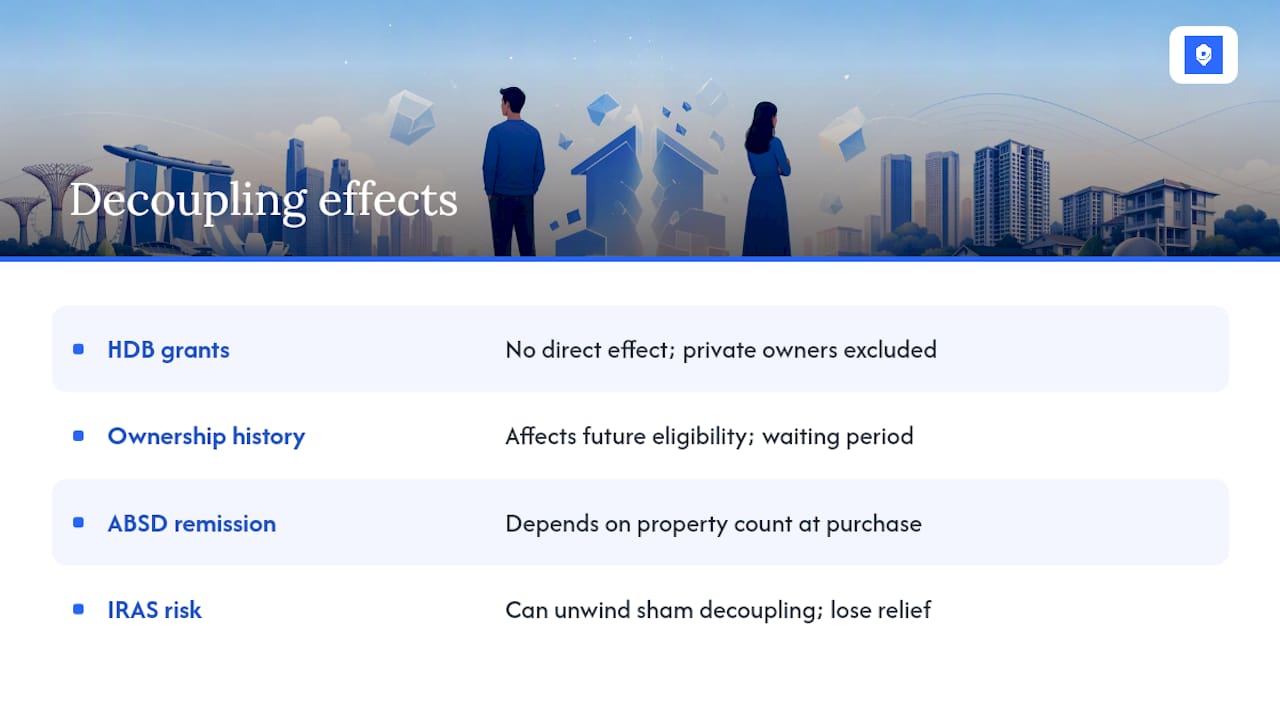
Decoupling a private property does not, by itself, affect HDB grant eligibility, because HDB grants such as the CPF Housing Grant apply specifically to HDB flat purchases, and private property owners are already excluded from most of those schemes regardless of how their private property is held. Where the impact shows up is in future eligibility categories tied to property ownership history.
If you decouple from a private property specifically to appear as a first-time buyer for a later HDB purchase, HDB's eligibility checks look at your ownership record, not just your current title status. A recent disposal of private property typically triggers a waiting period before you can apply for certain HDB flat types, and this waiting period is not bypassed by having decoupled beforehand.
For ABSD remission schemes and other IRAS-administered concessions, your eligibility depends on your property count at the time of the next purchase, which is exactly the number decoupling is designed to change. But if IRAS later determines the decoupling was a sham, it can unwind the remission or exemption you relied on, alongside the surcharge already discussed. The safest approach is to treat any anticipated grant or scheme benefit as conditional on the decoupling being genuine and defensible, not as a guaranteed outcome you can bank on before the transfer is even registered.
Practitioner perspective: quick rules of thumb from real cases
Decoupling tends to succeed when the remaining owner has clear income headroom for the full mortgage, the ABSD avoided is substantial relative to the transaction costs, and CPF exposure is modest. It tends to fail when there is any hint of secret beneficial interest retained by the transferor, when a 99-to-1 structure sits at the centre, or when the bank baulks at sole-name refinancing.
Before you sign anything, answer one question honestly: can you show, on paper and in practice, that the transferor genuinely gives up beneficial ownership? If the answer is unclear, get separate legal advice before proceeding, not after.
— HAIO
Model your numbers before you brief a lawyer
There are other ways to test a decoupling plan, from asking a conveyancing lawyer for a rough estimate to consulting a mortgage broker directly. A faster first pass is to run an instant valuation on your property, check affordability under the TDSR assumptions a bank would actually use, and compare current mortgage rates, all before a single legal invoice lands. That sequencing matters because the costly part of a failed decoupling is discovering a bank refusal or a CPF shortfall after fees are already sunk. Such online tools are not a substitute for legal or tax advice, but they give you the numbers to decide whether that advice is worth paying for. Try Haio's valuation and affordability tools to model your own figures before you commit to conveyancing.
Sources
- Policy on 99-to-1 arrangements for stamp duty payment in property transactions and measures to prevent recurrence
- Singapore High Court rules that property ‘decoupling’ is illegal if done solely to avoid taxes | The Straits Times
- CPF refund when selling or transferring property
- Written answer by Ministry of National Development on applications to list spouse as owner and the other as essential occupier