

The Deferred Payment Scheme is no longer available for new uncompleted Executive Condominiums as of 8 May 2026, when the Ministry of National Development formally abolished it. Any historical DPS scope covered only completed private developments or older EC launches before this change. Buyers evaluating new launches should now assume the Normal (Progressive) Payment Scheme applies, with no option to defer major payments until Temporary Occupation Permit.
TL;DR:
- Buyers should now prepare for progressive payment schemes in all new uncompleted EC launches starting from May 8, 2026, as the deferred payment scheme is abolished.
- The removal of DPS will likely reduce speculative buying and short-term flipping at the EC level, favoring buyers with stable cash flow and long-term ownership plans.
- Pre-completion transfers and resale transactions of units bought under DPS are more complex and often require developer consent, legitimate legal review, and careful valuation adjustments.
- Buyers should run detailed calculations factoring interest, premium, and delay scenarios before agreeing to any deferred-style or resale arrangements, using reliable affordability tools to avoid unexpected costs.
Table of Contents
- What the Deferred Payment Scheme was and how it worked
- Who DPS applied to and eligibility rules in Singapore
- The MND announcement and what changes for buyers now
- Pros and cons for buyers: when DPS made sense and the hidden costs
- How DPS compared with the normal progressive payment scheme
- Practical checks and calculations before accepting any deferred-style offer
- How deferred payment affected resale and transfer processes
- Common disputes and legal issues in Deferred Payment Scheme agreements
- Comparing DPS with other financing options available to buyers
- What the abolition of DPS means for your next move
- Sources
What the Deferred Payment Scheme was and how it worked
A Deferred Payment Scheme let buyers pay a small fraction of the purchase price upfront and postpone the bulk of it until much closer to completion, rather than paying in stages as construction progressed. It typically ran along these lines:
- Booking fee, usually 5% of the purchase price, paid to secure the unit.
- Down payment, bringing the total upfront commitment to around 20%, paid within a set window (commonly eight weeks) after the Option to Purchase.
- Deferred balance, the remaining 80%, due only at Temporary Occupation Permit (TOP) or Certificate of Statutory Completion (CSC), sometimes years later.
Marketing teams dressed this structure up under various names, including "stay-then-pay" and reservation-style schemes, but the mechanics underneath were consistent: delay the bulk of the price, charge a premium for the privilege. Developers liked DPS because it accelerated sales velocity, helped manage Qualifying Certificate deadlines, and gave buyers who were waiting on other property sales or Additional Buyer's Stamp Duty timing a reason to commit early.
Who DPS applied to and eligibility rules in Singapore
DPS was never a blanket option across every uncompleted property in Singapore. Its reach was narrower than most buyers assumed, shaped by both property type and long-standing regulation.
- New EC launches occasionally offered DPS before the 2026 change, subject to developer discretion and eligibility rules limiting first-round buyers to Singapore Citizens and Singapore Permanent Resident households meeting income ceilings.
- Resale ECs and completed private condominiums could technically use DPS-style arrangements, since the restriction targeted uncompleted stock specifically.
- Uncompleted private residential properties have been barred from offering DPS since October 2007, when the government disallowed the practice to curb speculative buying tied to delayed financial commitment.
- CPF usage also differed by scheme: buyers under DPS typically drew on CPF Ordinary Account funds at booking and again near TOP, rather than in the staged draws that come with progressive payment.
Foreign buyers and second-timer households at EC launches never had the same access as first-timer citizen households, which meant the practical DPS-eligible pool was already thin before the 2026 abolition.
The MND announcement and what changes for buyers now
The Ministry of National Development confirmed in a parliamentary written answer that the Deferred Payment Scheme would be abolished for new uncompleted Executive Condominiums, effective 8 May 2026.
Since October 2007, deferred payment schemes have been disallowed for uncompleted private residential properties. As of 8 May 2026, this restriction has been extended to new uncompleted Executive Condominiums, which must now be sold under the Normal (Progressive) Payment Scheme.
That single regulatory line closes the last remaining gap in Singapore's payment framework for uncompleted homes. Every new EC launch from that date must use progressive payment, with instalments tied to construction milestones rather than a single deferred lump sum at TOP.
The timing lines up with a broader tightening of EC rules; reporting around the same announcement noted the Minimum Occupation Period for ECs was extended to 10 years alongside the DPS removal. Both moves point the same direction: discourage buyers who treat ECs as short-term speculative plays and push payment schedules toward something that tracks actual construction risk. For anyone with an EC launch on their radar, the practical takeaway is straightforward: budget for progressive payment cashflow from day one, not a deferred lump sum years out.
Pros and cons for buyers: when DPS made sense and the hidden costs
DPS suited a specific type of buyer: someone with strong future liquidity (an inheritance, a bonus, proceeds from selling another unit) but tight cash today. It let them lock in a unit, defer the bulk of the payment, and potentially rent out or occupy the unit closer to TOP without straining their finances mid-construction.
The cost of that flexibility was rarely trivial. Developers who offered DPS typically built in a price premium of 2% to 5% over the equivalent progressive-payment price, and interest accumulated on the deferred sum throughout construction.
| Factor | Progressive payment | Deferred payment (historical) |
|---|---|---|
| Upfront cash needed | 20% plus staged instalments | 20% only, until TOP |
| Price premium | None | Typically 2% to 5% |
| Interest exposure | Minimal (loan disbursed in stages) | Accumulates on deferred balance |
| Delay risk | Spread across construction | Concentrated at TOP |
On an $800,000 deferred balance, a 3% per annum effective rate over four years of construction adds roughly $96,000 to the principal, before factoring in any premium already baked into the purchase price. That is the arithmetic developers rarely spell out in glossy brochures.
Pro Tip: Always ask for the pricing schedule that shows the equivalent progressive-payment price alongside the DPS price. If a developer can't produce one, treat the premium as undisclosed and negotiate accordingly.
How DPS compared with the normal progressive payment scheme
DPS collapsed most of that into two points: booking plus down payment, then one large sum at the end.
The practical differences that mattered most to buyers:
- Cashflow timing — progressive payment demands more frequent but smaller cash calls; DPS demands one large call late in the timeline.
- Loan disbursement — under progressive payment, banks disburse the mortgage in stages matching construction, so interest on the loan only accrues on amounts actually drawn; under DPS, the bank loan for the deferred portion typically only kicked in near TOP.
- Buyer profile fit — progressive payment suited buyers with stable, ongoing income; DPS suited buyers expecting a future lump sum, such as those awaiting sale proceeds from an existing home.
Investors chasing short-term capital appreciation gravitated toward DPS historically, since it minimised capital tied up during construction. That is precisely the behaviour the 2026 change targets.
Practical checks and calculations before accepting any deferred-style offer
Even with DPS gone for new ECs, deferred-style arrangements can still surface in completed developments or resale contexts, and buyers need a way to interrogate them properly.
- Check the interest schedule clause: is the rate fixed for the full deferral period, or can it float with market rates?
- Read the nomination and assignment clauses carefully; some contracts restrict your ability to sell or assign the unit before completion.
- Confirm liquidated damages provisions if the developer delays TOP, and whether they offset any of the interest you have accrued.
- Verify exactly what triggers TOP versus CSC in the contract, since some deferred sums are pegged to one and not the other.
- Cross-check the quoted premium against an equivalent progressive-payment quote for the same unit.
To estimate total deferred cost yourself, use a simple formula: deferred amount × estimated annual interest rate × years to completion, plus the quoted premium.
Pro Tip: Run that calculation three times, once at the expected completion date, once with a six-month delay, and once with a two-year delay. Construction slippage is common enough that the "best case" number alone will mislead you.
This is exactly the kind of scenario modelling haio's affordability checks and mortgage-rate tools are built for. Rather than guessing at interest exposure, you can run your own numbers against current mortgage rates and see how a delay scenario shifts your total cost before you sign anything.
How deferred payment affected resale and transfer processes
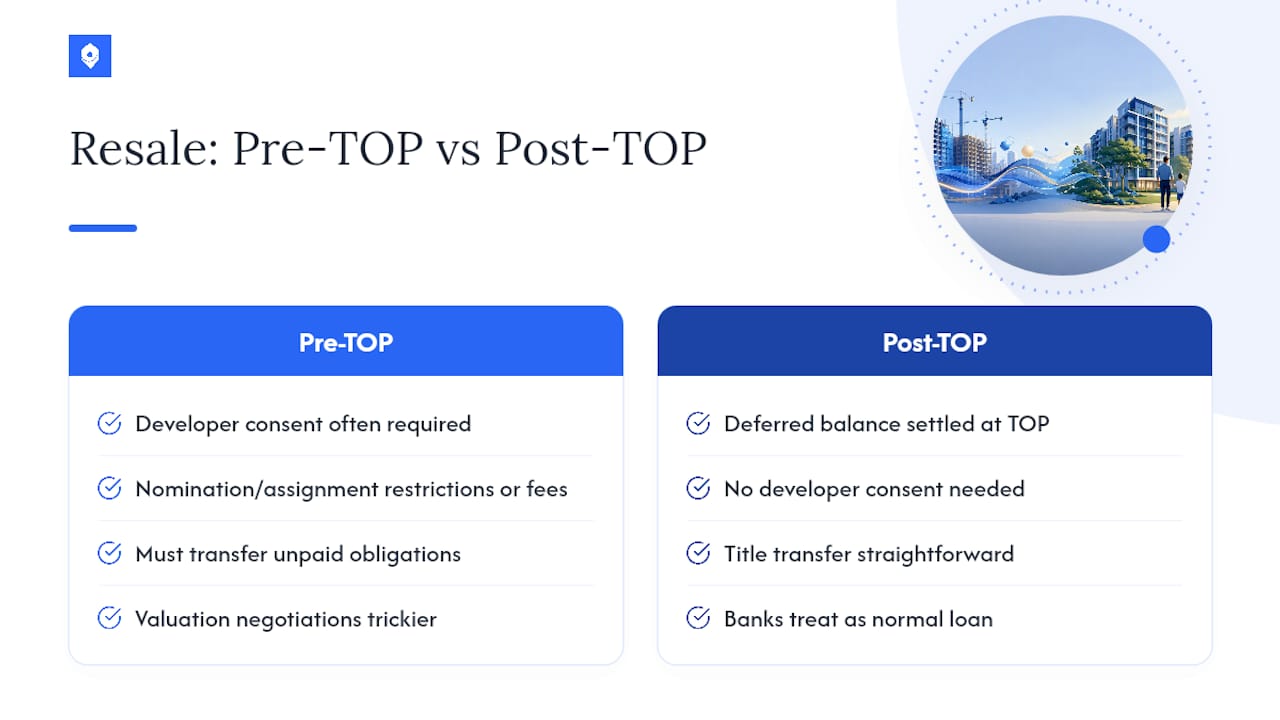
Units bought under DPS carried complications at resale that progressive-payment units generally avoided. Because a large portion of the purchase price remained unpaid until TOP, any resale or subsale attempted before completion required the developer's consent through a nomination or assignment clause, and many contracts either restricted this outright or charged an administrative fee for it.
Transfer of title was also more complex. A buyer looking to sell a DPS unit before TOP effectively had to transfer both the existing obligations (the outstanding deferred balance) and the benefit of the original purchase price to the incoming buyer, which made valuation negotiations trickier than a straightforward resale. Banks financing the incoming buyer needed clarity on exactly what had been paid, what remained outstanding, and under what schedule, before they would commit to a loan.
Completed units originally bought under DPS and later resold on the open market do not carry these complications, since the deferred balance is settled by TOP in every case. The friction was specific to pre-completion transfers, which is one reason DPS units historically traded less freely during the construction window than their progressive-payment equivalents. Anyone holding an older DPS-purchased unit that has since reached TOP can transact normally, though it is worth keeping the original payment schedule on file in case a buyer's solicitor asks for it during due diligence.
Common disputes and legal issues in Deferred Payment Scheme agreements
Most disputes traced back to three recurring flashpoints: interest calculation methods, delay-related liability, and ambiguity over what exactly triggered the final payment.
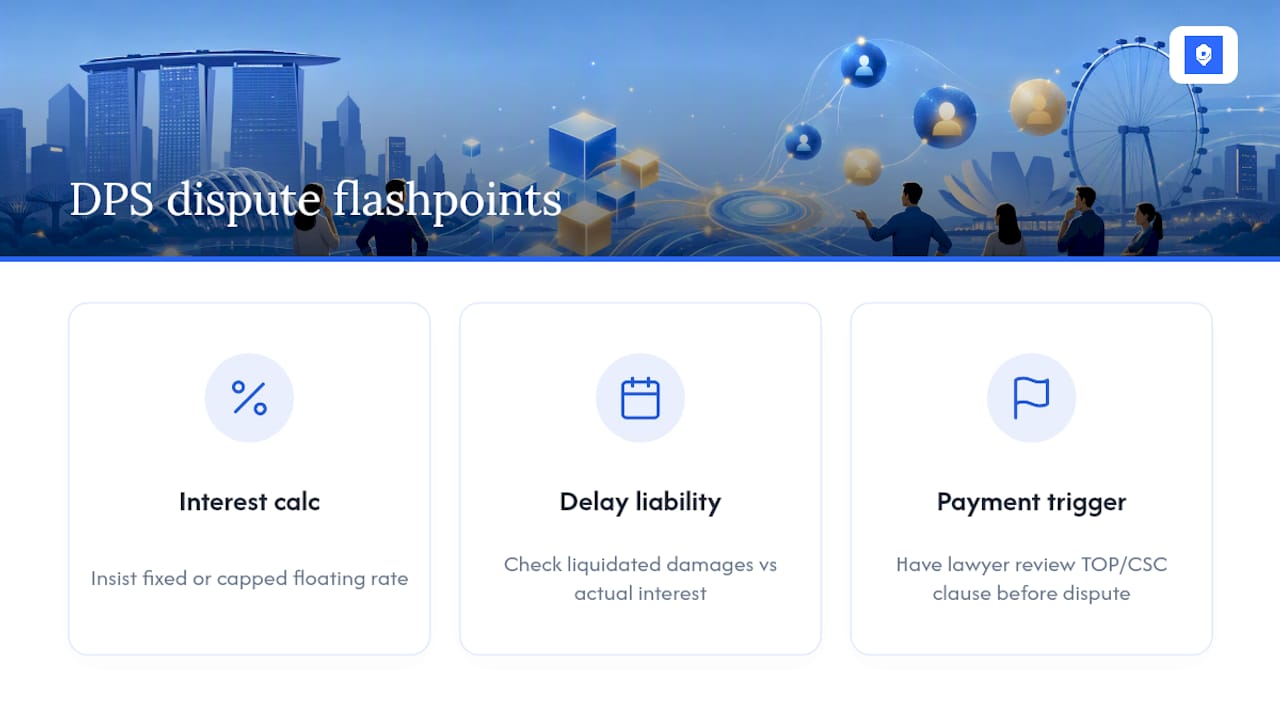
Interest disputes arose when contracts specified a rate "to be determined" or referenced a floating benchmark without a clear cap. Buyers who assumed a fixed cost at signing sometimes found the deferred balance had grown considerably more than expected by TOP. The fix here is preventive rather than remedial: insist on a fixed rate or a clearly capped floating rate before signing, and get it confirmed in writing rather than a verbal assurance from a sales representative.
Delay disputes were the second major category. When construction ran late, buyers argued the developer should absorb some of the additional interest that accrued during the extension, while developers pointed to force majeure clauses or standard liquidated damages provisions that capped their liability at a fixed daily rate, often far below the buyer's actual interest cost. This mismatch, between what buyers lost and what contracts compensated, was a frequent source of friction and occasional legal action.
The third category involved TOP and CSC definitions themselves. Some contracts defined the deferred payment trigger loosely enough that developers and buyers disagreed on the exact due date. Buyers facing any of these issues should engage a property lawyer to review the specific clause before disputing informally, since these agreements are contractually binding and rarely resolved through negotiation alone once a disagreement has hardened.
Comparing DPS with other financing options available to buyers
With DPS off the table for new ECs, buyers weighing cashflow options have a narrower but clearer set of choices. The Normal Progressive Payment Scheme is now mandatory for new EC and private uncompleted launches, spreading liability across construction milestones and aligning loan disbursement with actual work completed, which is the approach MAS guidance treats as the baseline for housing loan structuring.
Beyond payment scheme choice, buyers short on upfront cash have other levers: adjusting loan tenure within MAS limits to lower monthly instalments, timing CPF Ordinary Account withdrawals against each payment milestone rather than assuming a single lump-sum draw, or choosing a smaller or resale unit where the total quantum reduces cashflow pressure regardless of scheme.
It is worth being clear-eyed about one persistent point of confusion: retail "buy now, pay later" instalment plans, the kind used for electronics or fashion purchases, are structurally nothing like property DPS. MoneySense's guidance on instalment plans makes clear that retail BNPL involves short repayment windows and different default consequences entirely. Treating a property DPS offer as comparable to a retail BNPL plan understates the scale of financial exposure involved, since property deferrals run into hundreds of thousands of dollars over multi-year timelines rather than a few hundred dollars over a few months.
What the abolition of DPS means for your next move
Removing DPS for new ECs shifts the market toward buyers who can genuinely afford progressive payment cashflow, not just those who can find 20% today and hope for the best by TOP. That should reduce speculative flipping activity at the EC tier specifically, since the scheme that made minimal-capital entry possible no longer exists for new launches.
If you are buying now, model your cashflow against the full progressive payment schedule, not just the booking fee. Upgraders juggling an existing mortgage should stress-test their finances assuming no deferred cushion is coming. Investors should recalibrate expected holding-period returns without the leverage DPS previously offered. Whichever category you fall into, run the numbers before you commit, not after.
Buyers who want to pressure-test their own numbers before signing anything can run affordability checks and compare current mortgage rates through haio, which pulls together valuation data, market trends, and financing tools in one place rather than requiring a separate spreadsheet for every scenario.