

For eligible households earning under S$16,000 a month, an Executive Condominium usually delivers the cheapest legal route into condo living, with CPF grants and a launch discount most private condos cannot match. Buyers who earn above that ceiling, need immediate liquidity, or want a Core Central Region address have no such choice: a private condominium is the only option and often the better one regardless of income.
TL;DR:
- Households earning over S$16,000 monthly or needing immediate liquidity generally find private condos more suitable than ECs, which have strict eligibility and MOP restrictions.
- EC prices are typically 15 to 25 percent lower than comparable private condos at launch, with grants available only to first-timer EC buyers, increasing the cost advantage.
- Financing for ECs is limited by the Mortgage Servicing Ratio, often reducing borrowing capacity compared to private condos under the Total Debt Servicing Ratio.
- New EC land sites launched after May 8, 2026, have extended MOP and privatisation timelines, affecting resale and rental flexibility.
- Buyers planning to sell or rent within five years should avoid ECs due to the full MOP and resale restrictions during that period.
Table of Contents
- EC vs condo: the key differences at a glance
- What is an executive condominium?
- What is a private condominium?
- Who is eligible to buy an EC?
- How much cheaper is an EC than a private condo?
- How do MSR and TDSR change what you can borrow?
- When can you sell or rent an EC, and how do the 2026 rules change that?
- Which buyer profile fits an EC, and which fits a private condo?
- How can haio help you decide between an EC and a condo?
- Why the timeline matters more than the price tag
- Ready to run your own EC vs condo comparison?
- Sources
EC vs condo: the key differences at a glance
The two property types share condo facilities, similar architecture, and comparable build quality. The rules governing who can buy them, when they can be sold, and how they are financed diverge sharply.
- Eligibility: ECs require a household income under S$16,000 and no private property owned or disposed of in the past 30 months. Private condos have no income ceiling and no ownership restrictions.
- Grants: Eligible first-time EC buyers can receive CPF housing grants; private condo buyers cannot access equivalent housing grants.
- Financing: EC purchases from a developer fall under the Mortgage Servicing Ratio; private condos fall under the Total Debt Servicing Ratio, which allows more borrowing headroom for some buyers.
- Resale and rental flexibility: ECs cannot be sold or rented out in full during MOP; private condos can be rented or sold immediately.
One detail changes the calculation for anyone eyeing a launch after 8 May 2026: newer EC land sites carry a longer MOP and privatisation window than older projects. A unit launched under the previous regime and one launched after that date can sit on very different exit timelines, even if they look identical on a floor plan. Always check the specific site's tender conditions rather than assuming the older five-and-ten-year structure applies.
What is an executive condominium?
An executive condominium is a hybrid: sold initially under HDB rules to eligible households, then built and managed like a private condo, complete with swimming pools, gyms, and function rooms that HDB flats do not offer. Private developers design and construct ECs, but HDB sets the eligibility criteria at launch, which is why the scheme sits between public and private housing rather than fitting neatly into either category.
The privatisation path unfolds in stages. During the five-year MOP, owners must live in the unit and cannot sell or rent it out in full. After MOP, the unit can be sold on the open market, but only to Singapore citizens and permanent residents until it reaches the ten-year mark from TOP, at which point it privatises fully and foreigners can buy in. Most ECs sit in the Outside Central Region on 99-year leasehold land, which keeps land costs, and therefore launch prices, lower than comparable private stock closer to the city.
What is a private condominium?
A private condominium carries no MOP, no income ceiling, and no restrictions on who can buy or rent it. Anyone, Singaporean, permanent resident, or foreigner, can purchase one from day one, subject only to Additional Buyer's Stamp Duty rules where applicable.
Private condos also offer far more variety. Tenure ranges from 99-year leasehold to freehold, and location spans everywhere from the Core Central Region to suburban Outside Central Region estates. Unit sizes, facilities, and price points span a much wider range than the relatively standardised EC product, which gives buyers more room to match a purchase to a specific lifestyle or investment thesis.
Who is eligible to buy an EC?
Eligibility is the gate that decides whether EC vs condo is even a real choice for a given household. Miss any one of these conditions and the EC route closes, leaving private condo as the only path.
- Income ceiling: Combined household income must not exceed S$16,000 a month at the point of application.
- Property disposal rule: Applicants must not have owned or disposed of any private residential property, in Singapore or overseas, within the preceding 30 months.
- Family nucleus or single scheme: Most applicants buy under a family nucleus (spouse, parents, or children), though single Singaporean citizens aged 35 and above can apply under a separate scheme with a lower income ceiling and no co-applicant.
- First-timer priority: A portion of EC units is reserved for first-timer applicants, giving them priority balloting over second-timer households.
Private condos impose none of these tests. Anyone with the funds and, where relevant, ABSD paid can buy in immediately, with no family nucleus requirement and no disposal look-back.
The practical effect shows up after purchase too. During MOP, an EC owner cannot rent out the whole unit and must live there; a private condo owner can rent from day one. Post-privatisation, an EC behaves exactly like a private condo for resale and rental purposes, which is precisely why the wait matters so much to anyone planning an early exit.
How much cheaper is an EC than a private condo?
New EC launches price roughly 15 to 25 percent below nearby private condo benchmarks, based on 2026 launch pricing analysis. That gap narrows over time as land bid costs rise and as the unit approaches privatisation, when its market value tends to converge with comparable private stock in the same location.
Pro Tip: Compare an EC's launch PSF against the resale PSF of a nearby ten-year-old EC that has just privatised, not against a brand-new private launch. That comparison shows you where the price gap typically lands once the lock-in ends.
Grants widen the gap further for eligible buyers:
- First-timer households buying a new EC can receive CPF housing grants of up to S$30,000.
- Private condo buyers are not eligible for any equivalent housing grant, regardless of income or first-timer status.
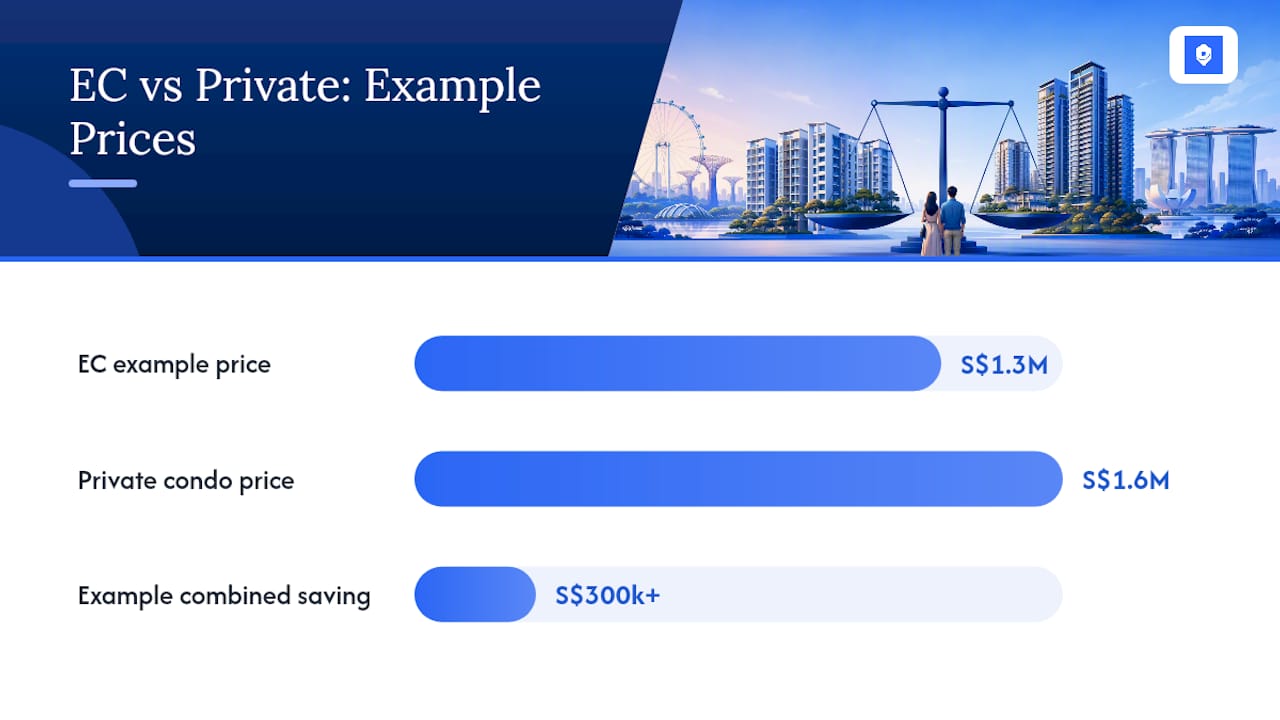
A worked example: on a S$1.3 million EC versus a S$1.6 million private condo of similar size nearby, a 20 percent discount plus a S$30,000 grant can lower the required cash and CPF outlay by well over S$300,000 combined against the private alternative, before financing differences are even considered. Some ten-year total cost of ownership models put the cumulative saving for eligible upgraders at several hundred thousand dollars, though the outcome depends heavily on holding period and location.
How do MSR and TDSR change what you can borrow?
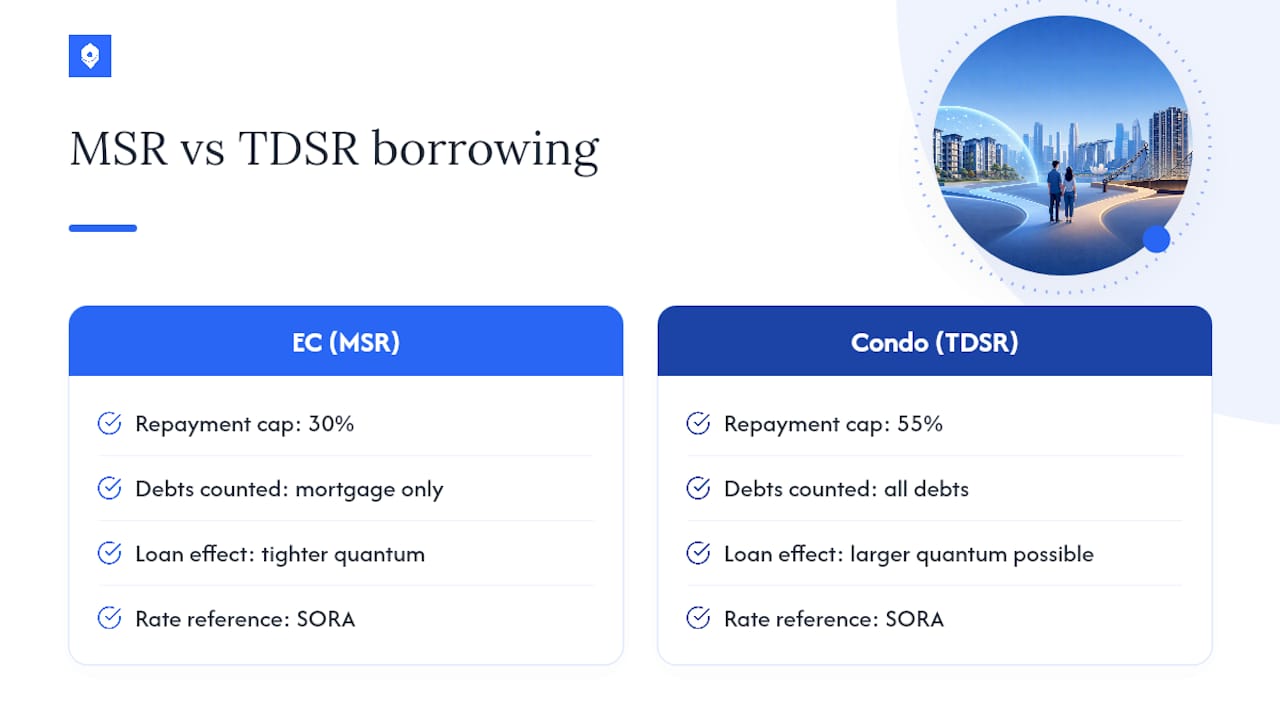
Financing rules bite before pricing ever does. ECs bought directly from a developer fall under the Mortgage Servicing Ratio, which caps monthly mortgage repayments at 30 percent of gross monthly income. Private condos fall under the Total Debt Servicing Ratio instead, which allows total debt obligations, including car loans and credit cards, up to 55 percent of income.
That difference often matters more than the headline price. A household with other debt commitments can find its EC loan quantum squeezed by MSR even though the unit itself costs less, while the same household might qualify for a larger loan on a pricier private condo under TDSR's more generous ceiling.
Stamp duty adds another layer for anyone upgrading, and if you need to clear or store belongings during upgrades or to coordinate the six-month disposal rule, Storage For Renters can help. Additional Buyer's Stamp Duty applies to a second property purchase, but the six-month disposal rule lets some upgraders sell their existing home within six months of the new purchase to reclaim ABSD paid upfront. Loan type matters too: most mortgages now reference SORA, so monthly servicing on either property type moves with the same interest-rate environment, meaning the financing decision is really about ratio headroom and loan quantum, not the rate itself.
When can you sell or rent an EC, and how do the 2026 rules change that?
The privatisation clock is the single biggest liquidity difference between the two property types, and it now splits into two regimes depending on launch date.
- Years 0 to 5 (MOP): Owners must occupy the unit; no subletting of the whole unit and no resale.
- Years 5 to 10: Resale permitted, but only to Singapore citizens and permanent residents.
- Year 10 onward: Full privatisation; the unit can be sold to anyone, including foreigners, and behaves like any private condo.
- Post 8 May 2026 launches: New EC land sites carry a longer MOP and privatisation timeline than the older five-and-ten-year structure, so check the specific tender conditions before assuming the shorter timeline applies.
Private condos carry none of this. An owner can sell or rent from the day keys are collected, which is why liquidity-sensitive buyers, particularly those who may need to relocate for work or realise capital within a few years, tend to lean private regardless of the price gap.
Which buyer profile fits an EC, and which fits a private condo?
Run through this checklist before comparing a single listing:
- Are you eligible? If household income exceeds S$16,000 or you own private property disposed of within 30 months, EC is off the table entirely.
- Do you need liquidity within five years? If yes, the MOP lock-in makes EC unsuitable regardless of price.
- Do you want a Core Central Region or freehold address? ECs sit almost exclusively in the Outside Central Region on leasehold land; private condos offer both freehold and central options.
- Is this a long-term family home or a wealth-building asset with an early exit plan? ECs suit the former better than the latter.
- Can you accept a longer wait for full privatisation if buying a post-8 May 2026 site? If timing to sell to foreigners matters, factor the extended window in now.
Recommended actions: an eligible family planning to stay put for a decade should shortlist ECs and apply for the CPF grant early. A high earner above the income ceiling has no choice but private. An investor prioritising rental yield or a quick exit should avoid ECs entirely because of the MOP ban on subletting. A buyer fixed on the Core Central Region should not waste time on EC balloting at all.
Pro Tip: Treat "I might need to sell within five years" as an automatic disqualifier for EC, not a maybe. The MOP ban on resale is absolute, not a soft guideline.
How can haio help you decide between an EC and a condo?
An affordability check can run your household income against the S$16,000 ceiling and flag EC eligibility instantly. PSF comparators can let you set a target EC launch against nearby private resale and new-sale benchmarks side by side, using current market data rather than guesswork.
To apply the checklist above, start by running the income and disposal filter, then compare PSF for your shortlisted EC against the nearest private alternative, then simulate MSR and TDSR outcomes against your actual debt profile before committing to either loan structure using available tools.
Why the timeline matters more than the price tag
Most buyers fixate on the launch discount and underweight the exit timeline. That is the wrong order of priorities in most real cases haio has modelled: a household that needs to relocate for a job within seven years loses far more to a forced MOP wait than it ever saved on price per square foot. Eligibility is the primary filter, but timeline and liquidity are what actually decide whether the "cheaper" option ends up being the more expensive one once CPF accrued interest and opportunity cost are factored into the exit.
— HAIO
Ready to run your own EC vs condo comparison?
Reading the rules is one thing; seeing how they apply to your actual income, savings, and target project is another. Haio brings scenario modelling, PSF comparisons, and affordability checks into one place, so you can test whether a specific EC launch clears the S$16,000 ceiling, how its price stacks up against a private condo three streets over, and what your MSR or TDSR outcome looks like before you commit to a loan. Some platforms offer premium features for buyers who want deeper valuation reports and Master Plan tracking alongside free tools. Head to Haio to run the numbers on your shortlist before your next viewing.