
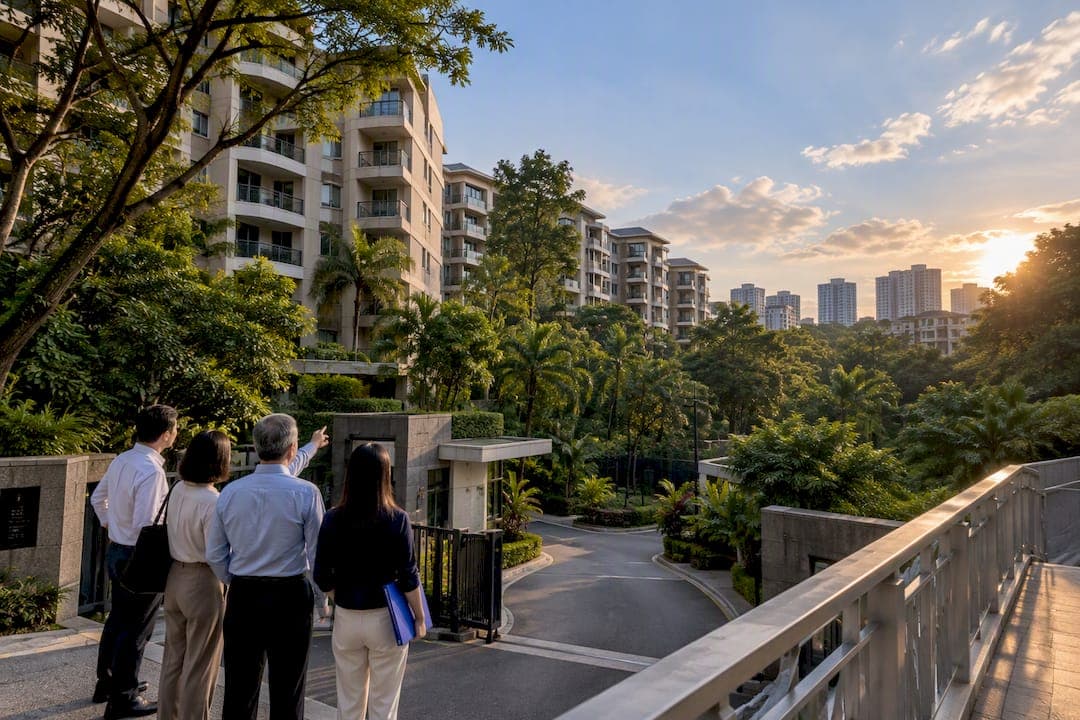
En bloc potential in Singapore now hinges on two forces pulling in opposite directions: lower consent thresholds under the 2026 amendments to the collective sale regime make owner sign-off easier, while a large Government Land Sales pipeline of 9,320 units gives developers less reason to bid. Owners should check both a site's technical eligibility and current developer appetite before starting a collective sale committee, ideally with a valuation report to test whether the numbers work.
TL;DR:
- Developers are now more cautious in Singapore due to a large government land sales pipeline and modest private price growth, favoring GLS sites over en bloc prospects.
- The 2026 amendments lower consent thresholds for older developments, but economic viability still depends on site-specific factors like plot ratio uplift and location.
- An en bloc sale's success hinges on technical eligibility, owner consent, and whether the proposed reserve price can cover redevelopment costs amid financing pressures.
- The collective sale process requires careful assessment of site fundamentals, with a structured workflow and valuation tools crucial for owners before committing.
- Industry experts expect a narrower, more disciplined batch of en bloc deals in 2026 focused on genuinely valuable sites, not a repeat of past boom cycles.
Table of Contents
- How 2026 supply and prices are shaping developer appetite
- Consent thresholds, the CSA window and the filing checklist
- What actually predicts strong en bloc potential
- Why an eligible site can still fail to sell
- A practical assessment workflow for owners and investors
- Testing en bloc scenarios with haio's data tools
- Will 2026 bring a broader wave of collective sales?
- How haio supports owners weighing an en bloc decision
- Where these figures and rules come from
- Sources
- FAQ
How 2026 supply and prices are shaping developer appetite
Developers weigh a collective sale site against the Government Land Sales programme, and 2026 tips that comparison firmly in favour of GLS. The Confirmed List for the second half of 2026 alone can yield 4,745 private residential units, and the full annual GLS supply for 2026 totals about 9,320 units. That volume gives developers a steady, lower-risk alternative to negotiating with dozens or hundreds of individual owners.
Private residential prices have moved only modestly through this period, which further limits how aggressively developers can bid for ageing collective sale sites. Several factors explain the preference for GLS land over en bloc sites:
- GLS sites come with clear title and no minority owner disputes to resolve.
- Land size, tenure and planning parameters are fixed and disclosed upfront by URA.
- Financing timelines are more predictable without a Strata Titles Boards application in the critical path.
A site with genuine redevelopment upside can still attract bids, but it now competes directly with government land rather than filling a supply gap developers cannot source elsewhere.
Consent thresholds, the CSA window and the filing checklist
The 2026 amendments to the Land Titles (Strata) Act rewrote the majority consent thresholds that owners must clear before applying for a collective sale, scaling them to the age of the development. The thresholds are based on both share value and strata area:
- Developments under 10 years old require 90% consent.
- Developments aged 10 to 39 years require 80% consent.
- Developments aged 40 to 59 years require 70% consent.
- Developments aged 60 years and above require 65% consent.
Once a collective sale committee is formed and the threshold is met, owners must prepare a Collective Sale Agreement, commission valuation and distribution method reports, and advertise the sale before filing with the Strata Titles Boards. That guidance sets out a filing window of 14 days from the advertisement date, alongside a standard application fee. The Board or the High Court can still refuse an application where proceeds would leave an objecting owner unable to redeem their mortgage, or where the sale would cause them demonstrable financial loss, so a viable reserve price protects the sale as much as the paperwork does.
What actually predicts strong en bloc potential
Age is the starting filter. Developments beyond roughly 30 years tend to carry higher maintenance liabilities that push owners towards a sale, and those past 40 years now clear a lower statutory threshold under the 2026 reforms. From there, several technical factors separate a realistic prospect from a hopeful one:
- Plot ratio uplift: a site built well below its permissible gross floor area leaves room for a larger redevelopment, which is what funds a premium over market value.
- Land size and unit count: very small sites often lack scale for an efficient redevelopment, while very large sites can require consent from too many owners; a moderate size with a manageable unit count tends to be the more workable target.
- Tenure: developers have historically shown a preference for freehold land, though leasehold sites with a long remaining lease can still attract interest, with proceeds per owner falling as the lease shortens.
- Location and connectivity: proximity to an MRT station and location within a district in active demand both strengthen a developer's redevelopment case.
Pro Tip: Compare your development's current gross floor area against its permissible plot ratio before assuming en bloc potential exists; without an uplift margin, there is little for a developer to fund.
Why an eligible site can still fail to sell
Meeting the consent threshold proves owners are willing to sell, not that a developer is willing to buy at a workable price. Additional Buyer's Stamp Duty and development charges both sit on the developer's side of the ledger and compress what they can offer owners once land cost, construction cost and financing are accounted for. A property financing guide for Singapore sets out how sensitive project viability is to interest rates and construction costs, both of which have been under pressure through 2026.
A useful discipline is testing replacement cost against the likely reserve price: if the redevelopment's total cost, including land, construction and financing, leaves too thin a margin over expected sale proceeds, developers will simply pass. Watch for these warning signs during a sale attempt:
- Multiple marketing rounds with no qualifying bids at or near reserve price.
- Feedback from agents that developers view the site as too small to justify tender costs.
- A widening gap between the independent valuation and what owners expect to receive.
A practical assessment workflow for owners and investors
Before committing time to a collective sale committee, run a structured check on the site rather than relying on anecdotal comparisons to nearby en bloc deals.
- Confirm the development's age, current plot ratio utilisation and unit count against the technical factors above.
- Check tenure and remaining lease length, since both affect proceeds and buyer appetite.
- Review mortgage and encumbrance exposure across units, since unresolved arrears or high loan balances on individual units can delay or block a sale.
- Commission an independent valuation and set a reserve price that reflects realistic replacement cost, not aspirational upside.
- Begin collecting Collective Sale Agreement signatures within the statutory window, which the 2026 amendments shorten for ongoing attempts to reduce prolonged pressure on minority owners.
- Proceed to tender only once signatures clear the applicable threshold and the reserve price has been tested against comparable transactions.
Pro Tip: If two consecutive tenders close without a bid near reserve price, treat that as a signal to reassess rather than repeat the same process a third time.
In those cases, individual resale or holding for rental income is often the more realistic route.
Testing en bloc scenarios with haio's data tools
Working out whether a site's numbers stack up is easier with structured data rather than guesswork. An instant valuation tool gives owners a market-based starting estimate, while valuation analysis services add the detail needed to sense-check a proposed reserve price against recent transactions.
- Run an instant valuation to establish a current market baseline for your unit and the wider development.
- Use Property Analysis to review plot ratio, land size and comparable transactions in the surrounding district.
- Check Affordability to model what a replacement home might cost once sale proceeds and any Additional Buyer's Stamp Duty are factored in.
- Follow haio News for updates on GLS awards and policy changes that affect developer appetite.
- Browse haio's List when comparing your unit against similar en bloc-eligible developments in the market.
Together these give owners a factual starting point before they engage a valuer or legal adviser for a formal collective sale attempt.
Will 2026 bring a broader wave of collective sales?

Lower consent thresholds make it mechanically easier for owners of older developments to clear the votes needed to start a sale, but they do not manufacture developer demand where the underlying economics do not support it. Industry commentary in The Straits Times is consistent on this point: construction costs, financing conditions and the sheer scale of the GLS pipeline mean developers will stay selective rather than chase every eligible site.
The realistic expectation for 2026 is a narrower, more disciplined round of successful sales concentrated on sites with genuine plot ratio uplift and strong locations, not a repeat of the broader boom cycles seen in earlier years. Owners should treat threshold reform as removing one obstacle, not as a guarantee.
— HAIO
How haio supports owners weighing an en bloc decision
Deciding whether to pursue a collective sale means testing assumptions against real transaction data rather than relying on what a neighbouring development achieved. haio brings together valuation tools, market analysis and affordability modelling in one place, so owners can check a site's numbers before committing time to a collective sale committee.
- haio+ at $49 per month or $499 per year gives access to premium analytics and valuation reports for a more detailed read on reserve price realism.
- Valuation Analysis and haio News on the haio homepage cover instant valuation and ongoing policy and GLS updates.
- Property Analysis at Haio supports a deeper look at plot ratio and comparable transactions.
- Affordability at Haio helps model what a replacement home might cost after a sale.
haio provides the data; it is not a substitute for legal advice on the collective sale process itself. Start with an instant valuation on haio to see where your development currently stands.
Where these figures and rules come from
- MinLaw's explanatory note sets out the 2026 consent thresholds and procedural safeguards.
- URA's press release confirms the 2026 GLS supply figures.
- The Straits Times provides industry context on likely deal volume.
Sources
- Proposed Amendments to the Collective Sale Regime to Support Renewal of Ageing Developments and Strengthen Owner Safeguards
- Private housing supply under the Government Land Sales programme sustained at a high level in the second half of 2026 | URA
- Collective sale reforms may spark more deals, but not a repeat of 2018 boom cycle | The Straits Times
FAQ
What makes a property a strong en bloc candidate in Singapore?
Strong candidates typically combine an older building age, under-utilised plot ratio relative to what planning rules allow, and a location near an MRT station or in a district with active developer interest. Freehold tenure and a moderate unit count also tend to improve a site's prospects, since they simplify both consent collection and the developer's costing.
Is en bloc activity still happening in Singapore in 2026?
Collective sales continue, but the 2026 amendments and a large GLS pipeline mean developers are more selective about which sites they pursue. Industry analysts expect a narrower round of successful sales rather than a broad revival matching earlier boom cycles, as The Straits Times has noted.
Which condominiums tend to have the most en bloc potential?
Developments that are older, sit on under-utilised plot ratio, and occupy well-connected locations near MRT stations tend to show the strongest potential, based on patterns from past successful sales. There is no fixed list, since eligibility depends on each site's age, tenure, consent threshold and a developer's assessment of redevelopment cost against likely proceeds.
Will property prices in Singapore fall in 2026?
Private residential prices showed only modest growth in the most recent data, and a substantial pipeline of units with planning approval points to continued supply-side pressure rather than a sharp rise. Whether prices fall depends on how that pipeline is absorbed alongside GLS supply, and it is not something this article can forecast with certainty.
How long does the en bloc process typically take from start to finish?
Timelines vary by development, but owners generally need to collect Collective Sale Agreement signatures within a defined window before filing with the Strata Titles Boards, which requires an application within 14 days of advertising the sale. The overall process, from forming a collective sale committee to a completed transaction, commonly spans well over a year once tendering, statutory filing and any objections are factored in.