

Fixed rates suit borrowers who want payment certainty, plan to hold their property long-term, or have limited buffer against income shocks. Floating rates, tied to benchmarks like SORA, tend to reward borrowers with shorter ownership horizons, stronger cash reserves, or willingness to ride out rate swings for a lower average cost. HDB concessionary loans and bank packages carry different rules entirely, and lock-in penalties can undo any saving from switching. The rest of this guide explains why.
TL;DR:
- Fixed-rate loans lock in payments for two to five years but often include penalties for early exit, making them best for long-term stability.
- Floating-rate loans, linked to SORA, are generally cheaper initially and more flexible, but their payments can rise if benchmark rates increase.
- Lock-in periods and early repayment penalties can negate potential savings if market conditions change unexpectedly or if refinancing occurs prematurely.
- Borrowers with shorter ownership horizons or active rate tracking should prefer floating options, while those seeking certainty and stable budgets benefit from fixed rates.
- Using scenario modelling tools like haio helps in assessing how rate movements impact total costs, enabling better decision-making aligned with individual loan and market conditions.
Table of Contents
- Fixed vs floating home loan: how each one actually works
- Pros and cons of fixed vs floating rates for Singapore homeowners
- Lock-in, repricing and refinancing: the costs that decide the outcome
- How SORA moves change your monthly instalment
- How to choose between fixed and floating: a decision checklist
- Practical tips to cushion repayment shocks
- haio's tools for comparing fixed and floating scenarios
- Which loan fits which Singapore borrower?
- Why this guide leans on modelling over prediction
- Try haio's mortgage tools before you commit
- Sources
- FAQ
Fixed vs floating home loan: how each one actually works
A fixed-rate home loan locks your interest rate for a set period, usually between one and five years, regardless of what happens to market benchmarks during that stretch. Banks in Singapore typically price these packages with a small premium built in, compensating themselves for taking on the risk that rates might rise. Once the fixed period ends, the loan usually reverts to a floating rate unless you reprice or refinance.
A floating-rate loan moves with a reference rate. In Singapore, that reference is now almost always the Singapore Overnight Rate Average (SORA), which replaced the Singapore Interbank Offered Rate (SIBOR) as the market standard following the 2021 to 2024 transition. Some older packages still reference SIBOR or a bank's own Fixed Deposit Home Rate (FHR), but new loans are overwhelmingly SORA-based today.
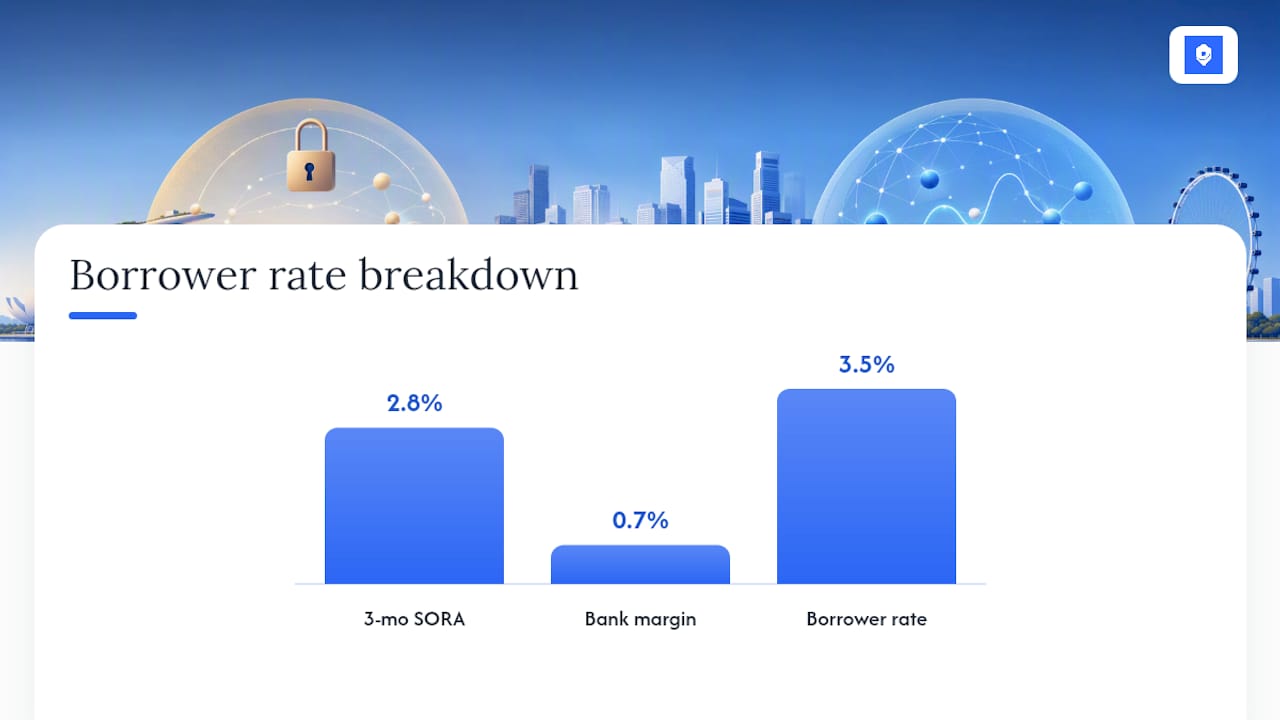
The mechanics are simple once you see the formula: borrower rate = reference rate + bank margin. If 3-month compounded SORA sits at 2.8% and your bank adds a margin of 0.7%, your effective rate is 3.5%. That margin is fixed for the life of the loan (or the package tenure), but the reference rate itself moves with market conditions, sometimes monthly, sometimes quarterly, depending on how the package is structured.
HDB loans work differently again. The HDB concessionary loan rate is pegged at 0.1 percentage points above the prevailing CPF Ordinary Account interest rate, and it has stayed at 2.6% for a long stretch, reviewed quarterly by HDB. It is neither a bank fixed package nor a market-linked floating one. It sits in its own category, and eligible flat buyers often treat it as the default comparison point against any bank loan they're offered.
What actually distinguishes the two mainstream options in practice:
- Fixed packages offer a locked rate for the fixed period, typically with a lock-in of two to five years and early-exit penalties.
- Floating packages move with SORA (or occasionally SIBOR/FHR) plus a margin, and often carry shorter or no lock-ins.
- HDB loans track the CPF Ordinary Account rate plus 0.1 percentage points, reviewed quarterly, and are only available to eligible flat buyers.
- Bank loans are open to both HDB and private property buyers, but come with commercial pricing and lock-in structures.
MoneySense sets out these mechanics in more detail for anyone comparing packages side by side, and it's worth reading before you sign anything.
Pros and cons of fixed vs floating rates for Singapore homeowners
Fixed-rate loans deliver one thing floating loans cannot: certainty. Your monthly instalment stays identical for the entire fixed period, which makes household budgeting straightforward and removes the anxiety of watching rate announcements. That predictability comes at a price, usually a modest premium over the floating equivalent, and it comes with strings attached in the form of lock-in periods.
Floating-rate loans usually start cheaper and can stay cheaper if benchmark rates fall or hold steady. They also tend to offer more flexibility, since many floating packages carry shorter lock-ins or none at all, letting you refinance or reprice without penalty if a better deal appears. The trade-off is exposure: if SORA climbs, your instalment climbs with it, sometimes within a single review cycle.
Fixed-rate packages rose by roughly 0.1 to 0.2 percentage points in early 2026, even as some floating packages became cheaper thanks to lower 3-month compounded SORA, according to reporting in The Straits Times.
Despite that cost gap, most Singaporean homeowners still choose fixed. Banking commentary quoted in that same coverage suggests the preference is driven less by pure cost calculation and more by a desire to hedge against macro uncertainty, families and long-term owners are often willing to pay a premium simply because they know their instalment won't move for the next few years.
The trade-offs, laid out plainly:
- Fixed rates protect against sudden rate spikes but lock you in, sometimes for years, with penalties for early exit.
- Floating rates track the market, so they can fall as easily as rise, rewarding borrowers who can absorb short-term volatility.
- HDB concessionary loans avoid market volatility entirely but come with eligibility restrictions and lower loan quantum limits than bank loans.
- Borrowers who refinance often, or who expect to sell within a few years, generally gain more from floating flexibility than fixed certainty.
Behaviourally, fixed-rate loans tend to suit people who find rate uncertainty stressful enough to affect other financial decisions. If you already track your CPF usage carefully or run a tight household budget, a fixed instalment removes one variable from the equation entirely.
Lock-in, repricing and refinancing: the costs that decide the outcome
Headline rates get the attention, but lock-in terms often decide whether a loan was actually a good deal. A lock-in period restricts you from redeeming, refinancing, or making large prepayments without triggering a penalty, commonly between 1.5% and 2% of the outstanding loan amount. If you break a fixed package two years into a three-year lock-in because a cheaper floating deal appeared, that penalty can wipe out every cent you'd have saved.
Repricing (switching to a different package with your existing bank) is usually cheaper than refinancing (moving to an entirely new bank), but it still isn't free. Banks typically charge an administrative fee for repricing, and the timing matters: most lenders only allow a repricing request within a specific window before your lock-in or fixed period ends, often 30 to 90 days out.
Refinancing to a new bank brings its own cost stack: legal fees, valuation fees, and sometimes a "clawback" of subsidies the previous bank gave you at the start of the loan (subsidies for legal or valuation costs usually come with a claim-back clause if you exit within three years). Lock-in periods often matter more than the headline rate difference between two packages; an early break can quietly erase any saving a lower rate promised.
A practical process for weighing a switch:
- Add up all exit costs on your current loan, including lock-in penalties and any subsidy clawback.
- Add the fees on the new loan, including legal, valuation and administrative charges.
- Calculate the monthly saving from the new rate and divide your total switching cost by that saving.
- If the result is longer than the time you realistically plan to keep the loan, the switch likely isn't worth it.
Pro Tip: Ask your bank for the exact repricing window in writing before your lock-in ends. Missing that window by even a week can force you onto a much less favourable reverted rate for months.
How SORA moves change your monthly instalment
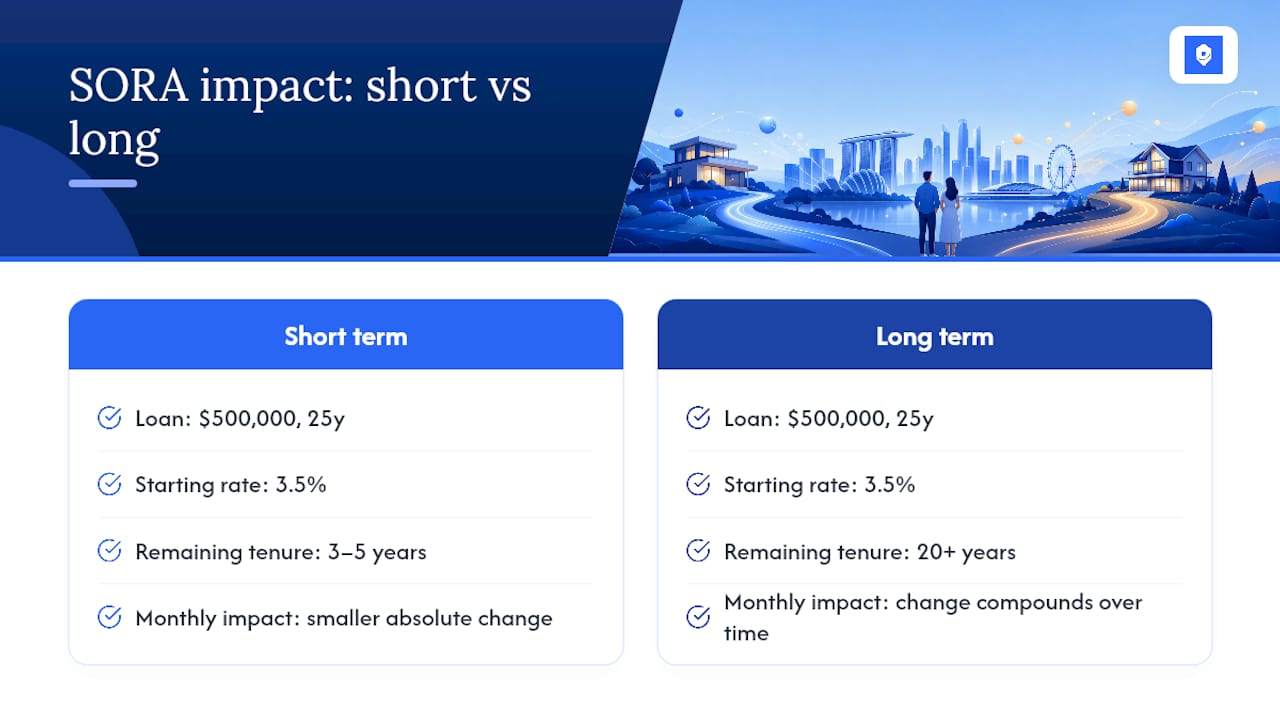
Small shifts in SORA translate into real money, and the effect compounds over a longer loan tenure. A small percentage point rise on a $500,000 loan over 25 years adds a modest amount to the monthly instalment, depending on the remaining tenure and current rate level. A larger increase roughly doubles that impact.
The table below illustrates this on a representative $500,000 loan at an assumed starting rate of 3.5%, over a 25-year tenure. These figures are illustrative only, actual numbers depend on your bank's exact compounding method and remaining loan term.
For a borrower with a short ownership horizon of three to five years, a rate move like this matters less in absolute terms since the total interest paid over that window is smaller, but it still affects monthly cash flow and any resale calculations. For a long-term owner with 20 or more years remaining, the same 0.25 point move compounds across hundreds of repayment cycles, and even a "small" shift becomes a meaningful lifetime cost difference.
These numbers are a starting point, not a substitute for running your own figures. Loan size, remaining tenure, and the specific compounding convention your bank uses all shift the result, so it's worth modelling your own loan through a calculator, such as the affordability tools on haio, before deciding.
How to choose between fixed and floating: a decision checklist
Four questions determine which rate type actually fits your situation, more reliably than comparing headline rates alone.
Ownership horizon. If you plan to sell or upgrade within three to five years, floating flexibility and shorter lock-ins usually serve you better than a long fixed commitment.
Income stability. Fixed income earners with limited buffer benefit from the predictability of a locked rate. Borrowers with variable income or strong savings can absorb floating volatility more comfortably.
Buffer size. A rule of thumb worth following: if a 0.50 percentage point rate rise would strain your monthly budget, lean fixed. If you could absorb it without adjusting your lifestyle, floating's lower starting cost may suit you.
Refinancing appetite. If you're the type who tracks rates and is willing to switch packages every two to three years, floating packages with shorter lock-ins reward that behaviour.
Bring this checklist of questions to any lender meeting:
- What is the exact lock-in period, and what is the early-exit penalty?
- Is there a repricing window before the lock-in ends, and what does repricing cost?
- Does the package offer a conversion option between fixed and floating mid-tenure?
- Is there a rate cap on the floating package, and if so, what triggers it?
- What subsidies come with this loan, and is there a clawback clause if I exit early?
Red flags to watch for in the loan documents themselves:
- A lock-in period that extends well beyond your realistic ownership horizon.
- Vague or missing language around how the reference rate is compounded or reset.
- No stated repricing window, which can leave you stuck on a reverted rate with no clear exit point.
- Subsidy clawback clauses that aren't clearly disclosed upfront.
Practical tips to cushion repayment shocks
Rate volatility is manageable with the right buffer in place, and most of the practical work happens before you sign, not after.
Build an emergency fund covering at least six months of mortgage instalments, separate from your CPF Ordinary Account savings. CPF sets specific limits on how much OA savings you can apply to a property purchase, so don't assume CPF alone covers a rate shock, it's meant for the purchase itself, not ongoing volatility absorption.
A few concrete moves worth considering:
- Make voluntary partial prepayments when you have surplus cash, which reduces the principal that future rate rises apply to.
- Ask your bank about temporary hardship relief options if a rate spike genuinely strains your budget, most banks have some provision for this.
- Hold off switching packages purely because a new rate looks attractive; run the break-even calculation from the costs section first.
- Act on switching when your lock-in has genuinely ended and the new package's total cost, fees included, beats your current one.
Pro Tip: Set a personal "trigger rate," the SORA level at which you'd seriously consider switching, before you're emotionally reacting to a rate announcement. Deciding in advance removes the panic factor.
haio's tools for comparing fixed and floating scenarios
Comparing loan packages by memory or spreadsheet gets unreliable fast, especially when SORA shifts monthly and every bank prices its margin slightly differently. haio pulls together mortgage rate feeds, personalised affordability checks, and scenario modelling in one place, so you can see how a fixed package and a floating package actually compare against your specific loan size and tenure, not a generic example.
Run your numbers through an affordability check first, then take that output into your lender conversations as a reference point. It won't replace the lock-in and repricing questions you still need to ask directly, but it gives you a grounded starting figure before you're sitting across from a loan officer. Pairing up rate data with the checklist earlier in this guide covers most of what a first-time buyer needs before committing.
Which loan fits which Singapore borrower?
If you're risk-averse, income is fixed, or you're settling into a home for the long haul, fixed suits you, accept the small premium for the certainty. If your horizon is short, your buffer is solid, or you actively track rates, floating's lower starting cost and flexibility usually win out. HDB-eligible buyers should compare the concessionary loan rate against both before assuming a bank offers better value.
Next steps: run an affordability check on haio, pull quotes from at least two lenders, ask the lock-in and repricing questions from the checklist above, and model a 0.50 percentage point rate move against your own loan size before signing anything.
Why this guide leans on modelling over prediction
Nobody can call SORA's direction with confidence this year, and pretending otherwise does readers a disservice. What's changed in 2026 is that more borrowers are questioning the fixed-rate premium as floating packages have occasionally undercut it, yet the preference for certainty remains strong. That's precisely why this guide pushes buffers and scenario modelling over trying to time the market. Test your own numbers on haio before deciding; the right answer depends on your situation, not the headline rate.
— HAIO
Try haio's mortgage tools before you commit
Comparing fixed and floating quotes by hand means chasing rate updates across multiple bank websites and guessing at your own affordability. haio puts mortgage rate comparison, personalised affordability checks, and scenario modelling in one app, so you can test how a 0.25 or 0.50 percentage point SORA move actually hits your specific loan before you're locked into a package for years. It's built for exactly the decision this guide walks through, not a generic calculator. Head to Haio and run your own affordability check before your next lender meeting, it takes minutes and gives you a real number to negotiate against.
Sources
For official mechanics on how loan types differ in Singapore, MoneySense offers the clearest consumer-facing explainer. HDB buyers should check HDB's own interest rate page for concessionary loan rules directly from source. The Straits Times covers current borrower sentiment and market shifts. For CPF's role in financing, CPF's guidance page sets out usage limits clearly.
- Most S'pore home owners still prefer fixed home loans although floating rates now cheaper
- How home loans work - Singapore - MoneySense
- CPF — How much CPF savings can I use for my property purchase
FAQ
Is a fixed or floating home loan better?
Neither is universally better. Fixed suits borrowers who want payment certainty or plan to stay long-term; floating suits those with strong buffers, shorter horizons, or appetite to track SORA movements for a lower average cost.
Is a floating rate better than a fixed rate?
Floating rates are often cheaper at the outset and can stay cheaper if SORA falls or holds steady, but they carry the risk of instalments rising if rates climb, unlike a fixed rate's locked payment.
Which is better, floating or reducing rate loans?
In Singapore, home loans are calculated on a reducing (amortising) balance regardless of whether they're fixed or floating, so this isn't really a competing choice; the real decision is between fixed and floating pricing structures, both applied to a reducing balance.
How do I know if my home loan is floating or fixed?
Check your loan letter of offer: it will state either a fixed percentage for a defined period, or a reference rate (SORA, SIBOR, or FHR) plus a margin that resets periodically. If your rate has changed since you took the loan, it's floating.
Can haio help me compare fixed and floating loan options?
Yes, haio provides mortgage rate feeds and affordability checks that let you model both fixed and floating scenarios against your specific loan size before approaching a lender.