
Freehold, or a 999-year lease functioning as its equivalent, tends to justify its price for holds of 20 years or longer, generational transfers, and buyers less reliant on CPF or long loan tenures. The right answer depends on how long you plan to hold, how much you need to borrow, and how much of that mortgage you intend to fund through CPF.
TL;DR:
- The freehold premium in Singapore ranges from 15% to 25% over comparable leasehold properties, but this varies by region and specific estate conditions.
- Leasehold value drops significantly once remaining lease falls below 60 years, especially from 40 to 20 years, impacting resale and financing options.
- Financing becomes more restrictive as lease remaining drops under 40 years due to MAS loan limits and CPF usage rules, requiring careful lease and age assessment.
- For holding periods under 15 years, leasehold tends to offer similar or better returns due to lower entry costs, while freehold is more advantageous for long-term or generational ownership.
- A 999-year lease effectively functions as freehold for financing and resale, making it a virtually perpetual tenure for practical purposes.
Table of Contents
- Freehold vs leasehold: the data-backed takeaways
- What "freehold" and "leasehold" actually mean in Singapore
- Market data: the freehold premium and lease decay curve
- How MAS and CPF rules change the real cost of leasehold
- How your holding horizon flips the tenure decision
- A decision framework for comparing two listings
- Practical checks before you make an offer
- Haio's view on running the freehold vs leasehold numbers
- Sources
- FAQ
Freehold vs leasehold: the data-backed takeaways
Before the detail, here is what the numbers consistently show across Singapore's private residential market.
- Freehold property typically commands a 15–25% premium over comparable 99-year leasehold stock, though the gap narrows or widens depending on the planning region.
- Lease decay is not linear. Value holds up reasonably well above 60 years remaining, then falls away faster once a lease drops below that mark.
- CPF and bank financing rules bite hard once remaining lease falls under roughly 40 years, restricting both loan tenure and how much CPF you can use.
- For holds under 10 to 15 years, leasehold often delivers a similar or better return, since the entry price is lower and the premium rarely recovers within that period.
- For holds of 20 years or more, or where the property is meant to pass down a generation, freehold's resilience against lease decay tends to offset the higher entry cost.
Pro Tip: *Never treat the freehold premium as a fixed cost.
What "freehold" and "leasehold" actually mean in Singapore
Freehold ownership means the land itself belongs to the owner indefinitely, subject to ordinary planning law. There's no expiry date, no lease countdown, and no reversion to the state.
A 99-year leasehold property gives the owner the right to use the land for a fixed term starting at 99 years, after which title reverts to the state (or, for HDB flats, to the Housing & Development Board) unless government policy intervenes. A 999-year lease, seen in a handful of older private estates, is legally leasehold but functionally indistinguishable from freehold for any buyer's realistic planning horizon; nobody alive today will see it expire.
A few structural points worth understanding:
- Most new private launches are 99-year leasehold because many sites released through the Government Land Sales (GLS) programme carry that tenure, as URA's market information shows.
- Freehold supply concentrates in older districts and estates, particularly parts of the city fringe and traditional landed enclaves, where land was privately held before modern land-use planning took shape.
- HDB flats sit outside this comparison entirely: they carry a 99-year lease from HDB, with no freehold equivalent available.
Market data: the freehold premium and lease decay curve
The freehold premium isn't a myth dreamed up by agents pushing older stock. URA's transaction data consistently shows freehold projects trading above comparable leasehold projects in the same micro-location, and the gap tends to move with the planning region.
- Core Central Region (CCR): premiums often sit at the lower end of the 15–25% band, since prime-location freehold and leasehold both draw strong demand.
- Rest of Central Region (RCR): premiums can widen, partly because freehold stock is scarcer relative to the volume of leasehold GLS launches.
- Outside Central Region (OCR): freehold examples are rarer still, and premiums vary widely depending on the specific estate and its redevelopment potential.
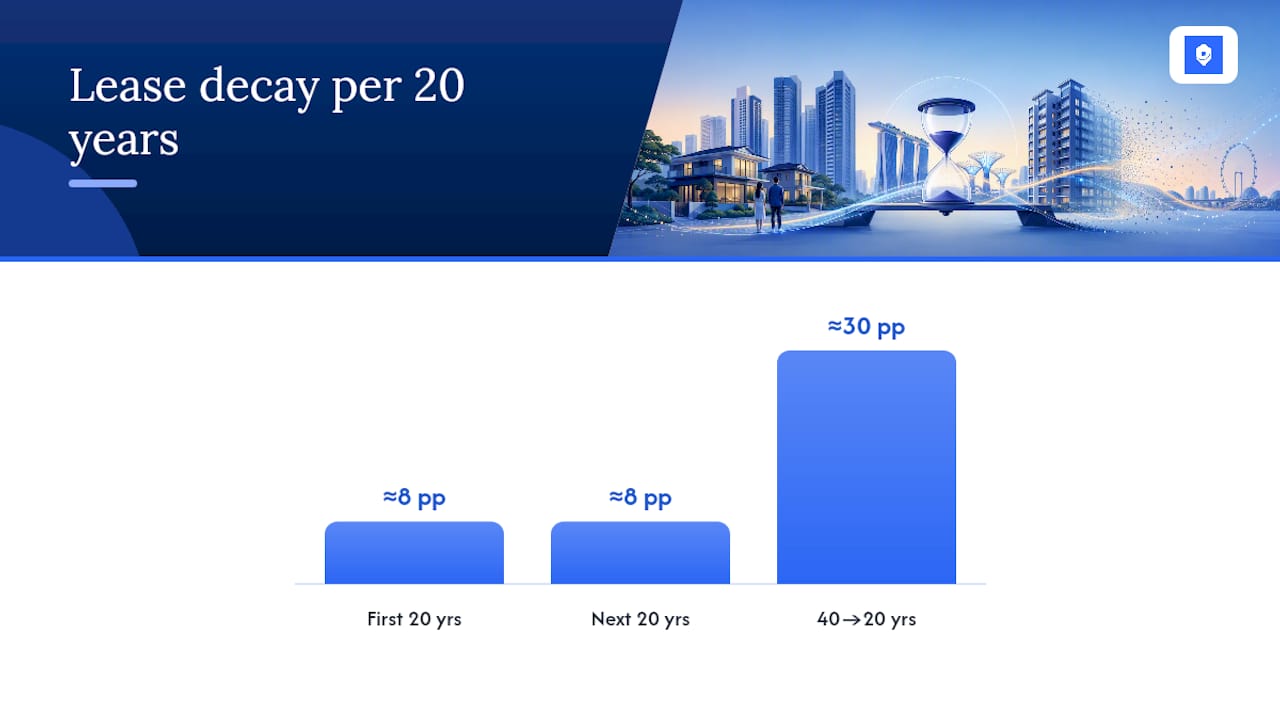
The clearest evidence for how leasehold value erodes over time comes from Bala's curve, a widely referenced lease-relativity model that expresses remaining lease as a percentage of fresh-lease value.
The curve isn't linear, and that's the point buyers miss most often. Losing the first 20 years costs roughly 8 percentage points of value; losing the next 20, from 80 down to 60 years, costs a similar amount. But the drop from 40 to 20 years wipes out 30 percentage points, almost four times the rate. PropKaki's lease-decay tracker confirms the same pattern in HDB resale data, showing median PSF falling faster once remaining lease drops below the 60-year mark. These figures are indicative, not a valuation tool: actual pricing still depends on the specific project, unit condition, and micro-location.
How MAS and CPF rules change the real cost of leasehold
Financing rules, more than the lease document itself, decide how a shortening lease hits your wallet. Two sets of rules matter most.
- MAS loan tenure limits. MAS guidance caps loan tenure relative to the borrower's age and, for older properties, the remaining lease. A shorter remaining lease can force a shorter maximum loan tenure, which pushes up monthly instalments even if the purchase price is lower.
- CPF's age-95 rule. The CPF Board requires the remaining lease to cover the youngest buyer to age 95 for full CPF usage on the purchase. Fall short of that, and CPF usage gets prorated, meaning you fund a larger share of the purchase in cash.
Consider a 40-year-old buyer looking at a property with 55 years remaining on its lease. That lease covers the buyer only to age 95 exactly (40 plus 55), sitting right at the CPF threshold rather than comfortably above it. Any co-borrower older than 40, or a lease with even a few years less, would trigger prorated CPF usage, forcing more cash into the deal and tightening the affordability sums considerably.
Pro Tip: Always check remaining lease against the youngest borrower's age before you fall in love with a unit. A property that looks affordable on price can become considerably less affordable once CPF proration limits how much of your CPF savings you can actually deploy.
How your holding horizon flips the tenure decision
Lease decay doesn't hurt every buyer equally; it depends almost entirely on how long you intend to hold.
- The 10-year investor: a fresh 99-year lease barely decays in a decade, so leasehold's lower entry price usually wins on both yield and total return, echoing the pattern in the Bala's curve data above.
- The 15-year upgrader: the premium on freehold rarely gets recouped in this window either, though the margin narrows if the leasehold property sits in a location prone to en bloc redevelopment.
- The 25-year-plus or generational owner: here the calculus reverses. A 99-year lease bought fresh today will have roughly 65 to 70 years left after 30 years of ownership, comfortably inside safe financing territory, but a buyer planning to pass the property to children needs to think two generations ahead, where freehold's lack of an expiry date carries real weight.
Resale liquidity differs too. Leasehold properties, especially newer ones, tend to have a deeper buyer pool because financing is straightforward and CPF usage is unrestricted. Freehold properties attract a narrower but often more committed pool, buyers specifically seeking tenure security, who may pay up for it but take longer to find.
A decision framework for comparing two listings
When you're weighing a specific freehold unit against a specific leasehold one, work through this sequence rather than comparing price per square foot alone.
- Define your horizon and financing reliance. A cash-heavy buyer with a 25-year plan reads the data differently to a mortgage-dependent buyer flipping in under a decade.
- Compute the price premium, then run affordability. Check the CPF age-95 test and MAS loan tenure limits for the leasehold option specifically.
- Check remaining lease and en bloc history. Older leasehold estates with strong en bloc precedent in the surrounding area carry different upside than isolated ones.
- Weigh liquidity against your exit plan. If you might need to sell quickly, factor in the wider buyer pool that leasehold properties usually command.
Three red flags should make you pause: a remaining lease too short to clear the CPF age-95 test, a bank valuation that haircuts the asking price by a wide margin, or a lease timeline that runs out around your own planned retirement age. Ask the seller or agent for the lease commencement date, the latest MAS-compliant loan-tenure indication from a bank, and any en bloc committee activity on record. For the financing mechanics specifically, KAPVOY Advisory's guide to property financing walks through how loan tenure and LTV limits interact in practice, and buyers planning generational transfer should also read Elite Legacy Planning's guide to property inheritance before committing to either tenure.
Practical checks before you make an offer
A handful of verification steps separate an informed tenure decision from a guess.
- Confirm the lease commencement date and exact years remaining, not the marketing "99-year lease" shorthand.
- Search URA's transaction records for comparable sales in freehold and leasehold projects nearby.
- For HDB comparisons, cross-check PropKaki's lease-decay data against the official HDB resale dataset on data.gov.sg.
- Run a CPF eligibility test against the youngest borrower's age before you get attached to a unit.
- Request service-charge history and recent strata AGM minutes; maintenance costs often diverge more between individual developments than between tenure types.
- Ask your bank directly what loan tenure it will offer against the specific remaining lease, since this varies by lender even within MAS's limits.
Haio's view on running the freehold vs leasehold numbers
The freehold vs leasehold decision is really an affordability calculation wearing a legal-tenure costume. The premium, the CPF proration, and the loan tenure cap all move together, and getting one number without the others gives a false picture of value.
Haio's valuation analysis tool pulls transaction comparables so you can see the actual premium a specific freehold listing carries over nearby leasehold stock, rather than relying on the 15–25% range as a blunt average. Pair that with the affordability check, which factors in CPF usage and loan tenure against your age and the property's remaining lease, and you get a realistic monthly servicing figure for each option side by side. For deeper feature access, including saved valuation reports and Master Plan overlays, haio+ is available from S$49 a month or S$499 a year.
Freehold and leasehold each solve a different problem, not a better or worse one. The mistake most buyers make is comparing sticker price instead of comparing what the tenure does to their financing capacity and their realistic exit timeline. Run both scenarios through an affordability lens before the premium, not after, and the decision usually becomes obvious rather than emotional.
— HAIO
This article is general information, not a substitute for advice from a qualified financial advisor. Consult a qualified financial professional about your own circumstances before acting on anything here.
Sources
- MAS – loan tenure and loan-to-value limits
- CPF Board – using your CPF to buy a home
- Freehold vs 99 Year Leasehold Singapore | Winfred Quek
FAQ
Is it better to have leasehold or freehold in Singapore?
It depends on your holding horizon. Leasehold usually wins for holds under 10 to 15 years because the 15–25% freehold premium rarely gets recovered that quickly, while freehold tends to justify itself over 20-plus years or generational ownership.
What happens after a 99-year lease expires in Singapore?
For private leasehold property, the land reverts to the state once the lease ends, and owners have no automatic entitlement to compensation. For HDB flats specifically, the flat reverts to HDB at lease expiry, and government redevelopment schemes such as VERS are not guaranteed for every flat.
Are there disadvantages to leasehold property?
Yes: value decays as the lease shortens, and financing tightens well before expiry. Once remaining lease drops toward 40 years, both CPF usage and bank loan tenure become restricted, which can shrink the buyer pool at resale.
Is a 999-year lease as good as freehold?
Practically, yes. A 999-year lease won't expire within any realistic planning horizon, so it behaves like freehold for financing, resale, and generational transfer purposes, even though it remains technically a leasehold tenure.