

Yes, HDB enforces ethnic quotas through the Ethnic Integration Policy (EIP), and if the quota for your ethnic group is full at either the block or neighbourhood level, a resale transaction can only proceed between a buyer and seller of the same ethnicity. This is not a theoretical risk. Two things to do before you go further:
- Check the HDB e-service quota for the specific block, ideally on or after the 1st of the month, since figures refresh monthly.
- If you belong to a mixed-ethnicity household, confirm which ethnicity classification applies to you under NRIC rules, because this affects which quota category you fall under.
Everything below explains why the policy exists, how the mechanics actually play out on a live transaction, and what sellers and buyers can realistically do when a block is constrained.
Key Takeaways
HDB's Ethnic Integration Policy can legally block a resale transaction unless the buyer matches the seller's ethnicity once a block or neighbourhood quota is full.
| Point | Details |
|---|---|
| Quotas apply at two levels | Both block and neighbourhood limits must have room for your ethnic group before a resale purchase can proceed. |
| Figures refresh monthly | Quotas update on the 1st of every month, so recheck before making or accepting any offer. |
| Sellers have official support | HDB can grant extra time, and buyback assistance introduced in 2022 helps owners genuinely unable to sell. |
| Mixed households have flexibility | Ethnicity classification for quota purposes follows NRIC records, and spouses can sometimes choose which applies. |
| Model the numbers alongside the quota | Use haio to run valuations and affordability checks so your decision reflects both quota status and market value. |
This article is general information, not a substitute for advice from a qualified financial advisor. Consult a qualified financial professional about your own circumstances before acting on anything here.
Table of Contents
- What the ethnic integration policy and SPR quota actually cover
- How EIP quotas work in practice: block and neighbourhood limits
- How to check current EIP and SPR quotas before you commit
- What EIP means for buyers and sellers in real terms
- Seller protections and official assistance when a quota bites
- Using haio to check listings, valuation and quota risk together
- Historical background and rationale behind implementing the EIP
- How EIP has shaped social integration and public housing demographics
- Criticisms and controversies surrounding the EIP
- Recent and potential changes to EIP under government review
- Exemptions and appeals: what flexibility actually exists
- How EIP interacts with resale eligibility and loan rules
- HAIO's perspective: balancing social purpose with practical market effects
- Check your next move before the quota changes again
- Sources
What the ethnic integration policy and SPR quota actually cover
The Ethnic Integration Policy was designed to prevent the formation of ethnic enclaves and to keep HDB estates broadly reflective of Singapore's racial makeup. It is not a cosmetic guideline. It sets hard ceilings on how many households of a given ethnic group can live in a block or neighbourhood at any time.
The policy applies across three transaction types:
- New flat allocations from HDB's Build-To-Order and sales exercises.
- Resale flat transactions, where a buyer must fit within the prevailing quota for the block and neighbourhood.
- Rental flat allocations under HDB's rental schemes.
Separately, non-Malaysian Singapore Permanent Resident (SPR) households face their own SPR quota, distinct from the ethnic quotas that apply to citizens. The Ethnic Integration Policy (EIP) and SPR Quota framework is administered by HDB under instruction from the Ministry of National Development (MND), and HDB's own published guidance remains the authoritative source for any specific block or unit. A significant portion of HDB blocks currently sit at their EIP limits for at least one ethnic group, according to reporting on how the Ethnic Integration Policy works, so the odds of encountering a constrained block are far from negligible for anyone shopping the resale market today.
How EIP quotas work in practice: block and neighbourhood limits
Every resale purchase has to clear two separate checks, not one. A transaction only proceeds if both the block-level quota and the neighbourhood-level quota have room for the buyer's ethnic group.
- Block-level limit. This caps the proportion of households from a given ethnic group within a single HDB block.
- Neighbourhood-level limit. This sets a wider ceiling across the surrounding precinct, usually a looser threshold than the block figure but still binding.
- Combined effect. If either level is maxed out for your ethnic group, the purchase cannot go ahead unless you match the seller's ethnicity.
The tricky part is that these ceilings are not static. Quotas update on the 1st of every month, which means a block that looked open in February can tighten by March simply because other households moved in or out. HDB refreshes every quota figure across the island on a monthly cycle, so a snapshot taken a few weeks ago is not reliable evidence of today's position.
When a block or neighbourhood has hit its limit for a specific ethnic group, HDB's own rules state that the resale purchase can only proceed if the buyer belongs to the same ethnic group as the seller. That is the practical crunch point for most buyers who discover a quota problem partway through negotiations, and it is why timing a quota check matters as much as checking it at all.
How to check current EIP and SPR quotas before you commit
Checking a quota takes minutes, but getting the timing wrong can cost you a deposit or a wasted valuation report. Follow this sequence.
- Run the HDB e-service quota check for the specific block address, or look at the quota panel shown directly on the resale listing, since HDB resale listings display the prevailing EIP and SPR quota information alongside the unit details.
- Time your check to the 1st of the month or later, and take a dated screenshot. Because figures refresh monthly, a check performed on the 28th of a month can be out of date within days.
- Contact HDB directly if the figure shown seems inconsistent with what an agent or seller has told you, since discrepancies do happen and HDB's e-service is the definitive record.
Pro Tip: Screenshot the quota result the same day you submit an Option to Purchase or make an offer. If a dispute arises later over eligibility, a dated record of what the e-service showed at the time carries far more weight than a verbal recollection.
Agents sometimes underestimate how fast a quota can shift. A block sitting comfortably below its ethnic ceiling can hit the limit within weeks if several similar households move in during the same cycle, so treat any quota figure older than a few weeks as unverified.
What EIP means for buyers and sellers in real terms
A quota being full does not mean a flat becomes unsellable. It narrows the buyer pool to a specific ethnic group, which changes strategy rather than removing options entirely.
For sellers facing a constrained block, the realistic paths are:
- Market specifically to buyers of the same ethnicity as yourself, since that transaction remains fully permitted regardless of quota status.
- Adjust timing, since quotas refresh monthly and a neighbouring block or the same block might loosen the following month as other households move.
- Explore HDB assistance schemes where genuine hardship in selling can be demonstrated, covered in detail in the next section.
For buyers, the priority is sequencing: confirm the quota before making a firm offer, not after. Mixed-ethnicity households have some flexibility here, since HDB rules allow households to choose which spouse's ethnicity classification applies for quota purposes, based on NRIC records. That choice can occasionally open a block that would otherwise be closed to one partner's ethnic category alone.
Pro Tip: If you are part of a mixed-ethnicity household and a block shows as full under one classification, check whether adopting your spouse's NRIC classification changes your eligibility. It sometimes does.
On pricing, government commentary is consistent: EIP limits can shrink the pool of eligible buyers, but saleability and price remain shaped by broader market fundamentals, including location, flat condition, and prevailing resale demand.
Seller protections and official assistance when a quota bites
Sellers who genuinely cannot find a matching buyer are not left without recourse. HDB has built specific support into the system for exactly this scenario.
- HDB may grant sellers additional time to complete a sale if they have already committed to another flat and can show genuine difficulty finding an eligible buyer under the prevailing quota.
- The government introduced buyback assistance in 2022 as a safety net for EIP-constrained owners struggling to sell at a reasonable price, giving affected households a route out that does not depend on finding a same-ethnicity buyer.
- Keep dated records of your marketing activity, including listing dates, agent communications, and quota screenshots, since evidence of genuine effort strengthens any application for extra time or buyback support.
Enquiries for buyback assistance and extended timelines start directly with HDB, and given that quotas move monthly, delaying the enquiry rarely helps. A seller who waits three months hoping a block will reopen risks losing ground on their own next purchase deadline, since HDB's discretionary support is generally easier to secure early, while a genuine and documented struggle is still evident, rather than after a listing has gone stale for the better part of a year.
Using haio to check listings, valuation and quota risk together
Quota status is only half the picture when you are deciding whether to sell now, wait, or make an offer on a constrained block. The other half is whether the numbers still work financially, and that is where combining HDB's quota data with market tools pays off.
- Run an instant valuation on haio to see where a flat sits against comparable resale transactions in the same block or neighbourhood, so you understand your negotiating position alongside the quota constraint.
- Use haio's affordability checks and mortgage-rate comparisons to confirm your real financial standing before making an offer that could later be blocked by a quota you did not verify.
- Track neighbourhood-level price and demand trends on haio to judge whether an EIP-constrained block is likely to attract same-ethnicity buyers quickly or whether you are looking at a longer marketing period.
The practical workflow is simple: check the HDB e-service for quota status first, then use haio to model what that block or unit is actually worth and what it would cost you to buy or hold. Doing both together avoids the common mistake of falling in love with a valuation before discovering the quota rules out most buyers.
Historical background and rationale behind implementing the EIP
Singapore introduced the Ethnic Integration Policy in 1989, decades after HDB had already reshaped the housing landscape through large-scale public housing estates. Before EIP, some blocks and precincts had begun drifting towards informal ethnic concentration, with certain estates skewing heavily towards one racial group as buyers and renters gravitated towards neighbours who shared their language, food habits, or community networks.
Government planners viewed this drift as a long-term risk to national cohesion. Singapore's founding generation had witnessed racial tension in the 1960s, and policymakers were determined that public housing, which by the late 1980s already housed the vast majority of citizens, would not become a vehicle for segregation by default. The EIP was the direct policy response: a deliberate mechanism to keep the ethnic composition of each block and neighbourhood broadly proportional to national demographics.
The rationale has held steady across successive governments. Ministerial statements have repeatedly framed the policy as one of the load-bearing pillars of Singapore's approach to multiracialism, arguing that daily proximity between different ethnic groups in shared corridors, void decks and lift lobbies builds familiarity that formal integration programmes cannot replicate on their own.
What has changed is the population EIP has to work with. Singapore's ethnic mix has shifted gradually over three decades, and the SPR quota was layered on top of the original EIP framework specifically to manage the growing non-citizen resident population without diluting the policy's original racial balance goals.
How EIP has shaped social integration and public housing demographics
Public housing in Singapore is not just where most citizens live. It is where roughly four in five citizens live, which means EIP's effects ripple across the vast majority of the population's daily social environment, not a niche segment of it.
The clearest demographic outcome is dispersion. Without EIP, resale market dynamics alone would likely have produced far more ethnic clustering, since buyers naturally gravitate towards areas where friends, family, and community institutions already exist. EIP interrupts that natural clustering by hard-capping how concentrated any single group can become in a given block, forcing a level of racial mixing that market forces alone would not have produced.
That mixing shows up in everyday estate life: shared void deck events, mixed-race school catchments tied to specific blocks, and multiracial resident committees that reflect the block's actual composition rather than a self-selected majority. Government explainers on why the policy still matters point to this daily proximity as the mechanism through which EIP is meant to build familiarity and reduce racial friction over successive generations.
The trade-off is one of constrained choice for individual households in exchange for a more evenly distributed demographic outcome across the entire public housing stock. Whether that trade-off remains the right balance as Singapore's population continues to diversify is a live policy question, addressed more directly in the section on criticisms below.
Criticisms and controversies surrounding the EIP
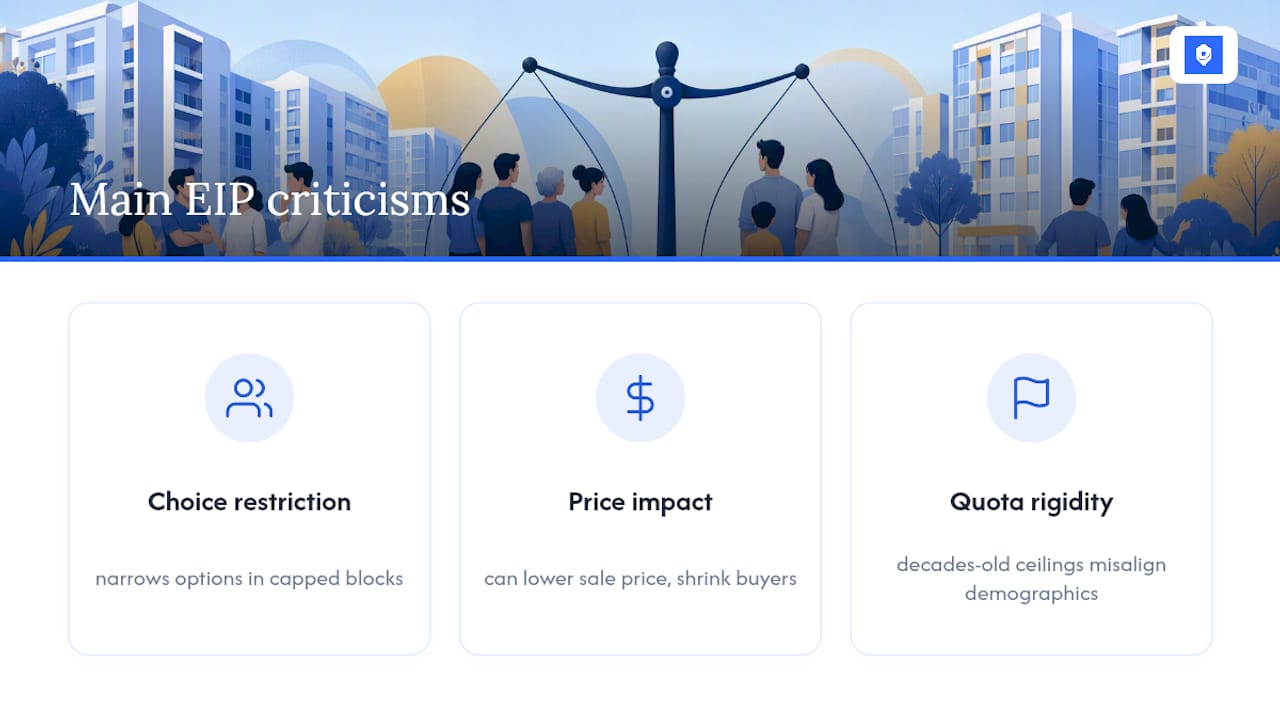
EIP has never been free of controversy, and the criticisms tend to cluster around three recurring themes.
The most common complaint is choice restriction. A buyer from a numerically larger ethnic group can find their options meaningfully narrowed in blocks that are already near their ceiling, sometimes ruling out a flat they would otherwise have bought purely on the basis of ethnicity rather than price, condition, or location. Critics argue this is an uncomfortable position for a housing system to put citizens in, even when the underlying policy goal is defensible.
The second theme is price and saleability. Sellers in EIP-constrained blocks sometimes argue the policy suppresses their sale price by shrinking the buyer pool at the exact moment they need to sell. Government sources acknowledge this effect exists but stress that saleability and price remain driven primarily by broader market fundamentals such as location, flat type and general resale demand, not by EIP status alone.
The third theme is transparency and rigidity. Some commentators have questioned whether block-level quotas, set decades ago against a different demographic baseline, still reflect Singapore's current racial composition accurately, or whether the ceilings have become a blunt instrument that occasionally produces unfair edge cases for individual households caught at the margins of a quota threshold.
None of these criticisms have led to the policy's removal, but they do explain why buyback assistance and discretionary extensions exist. Those measures are, in part, the government's answer to the fairness concerns EIP's toughest critics have raised for years.
Recent and potential changes to EIP under government review
MND has periodically signalled openness to reviewing EIP's mechanics without abandoning its underlying goal. The most concrete recent development is the introduction of buyback assistance, which directly addresses the criticism that EIP-constrained sellers had no formal safety net beyond waiting or lowering their asking price indefinitely.
Public statements from MND ministers have consistently reaffirmed EIP's necessity while acknowledging that its implementation needs periodic recalibration as Singapore's demographic profile shifts. This is a deliberate balancing act: loosening quotas too far risks reviving the ethnic clustering the policy was built to prevent, while leaving them untouched risks growing friction as more blocks hit their ceilings simultaneously across the resale market.
The Straits Times' reporting on the policy's mechanics notes that a meaningful share of blocks and neighbourhoods are already at or near their limits, which puts practical pressure on policymakers to keep monitoring whether the current thresholds still fit the population they were designed around decades ago. Whether that translates into formal threshold adjustments, additional SPR quota changes, or simply more support schemes like buyback assistance remains an open question that hinges on future ministerial reviews rather than anything confirmed to date.
For buyers and sellers, the practical takeaway is to treat EIP as a policy in continuous, incremental adjustment rather than a fixed rulebook, and to rely on HDB's own current guidance rather than assumptions carried over from a previous purchase years earlier.
Exemptions and appeals: what flexibility actually exists
EIP is a hard rule, not a discretionary guideline, which means true exemptions are narrow. There is no general appeals process that lets a buyer or seller argue their way around a quota that has genuinely been reached, and HDB does not entertain case-by-case waivers simply because a buyer prefers a particular block.
The flexibility that does exist sits in a few defined areas. Mixed-ethnicity households can select which spouse's ethnicity classification, as recorded on NRIC, applies to the household for quota purposes, which occasionally reopens a block that would otherwise be closed. This is not an appeal so much as a built-in classification choice available to every eligible household from the outset.
Beyond that, the closest thing to relief for sellers is the discretionary support HDB offers rather than a formal appeal against the quota itself. Sellers who have already committed to another flat and can demonstrate genuine, documented difficulty finding a same-ethnicity buyer may be granted additional time to complete their sale. Separately, buyback assistance exists specifically for owners in genuine hardship, functioning as a safety valve rather than a quota exemption.
Malaysians are worth flagging specifically here, since they are excluded from the separate SPR quota that applies to other non-Malaysian Permanent Resident households, which is a genuine carve-out rather than a discretionary appeal outcome. Anyone unsure whether their specific circumstances qualify for extended time or buyback support should raise the enquiry with HDB directly rather than assuming eligibility either way.
How EIP interacts with resale eligibility and loan rules
EIP does not operate in isolation. It sits alongside, and sometimes intersects awkwardly with, other HDB resale requirements that buyers and sellers must also satisfy.
Resale eligibility rules such as the Minimum Occupation Period still apply regardless of quota status, meaning a seller can be fully eligible to sell on ownership grounds while still facing a quota-constrained buyer pool. The two systems are checked independently: passing the Minimum Occupation Period test does not soften or bypass the ethnic quota requirement, and vice versa.
Loan eligibility introduces a subtler interaction. A buyer who has already secured an HDB Flat Eligibility letter or bank loan approval based on a specific unit can find that approval effectively wasted if the quota changes between application and completion, since financing is tied to a specific transaction that cannot proceed if the ethnic quota closes in the interim. This is precisely why checking the quota early, and rechecking it close to the point of exercising an option, matters more than a one-off check at the start of a search.
There is no formal linkage where an EIP rejection triggers a loan rejection or vice versa. They are separate approval tracks that happen to run in parallel, and a transaction only completes when both clear at the same time. Buyers juggling loan approval timelines alongside a quota check should treat the quota as the more time-sensitive of the two, given its monthly refresh cycle, and sequence their loan paperwork accordingly rather than assuming both will remain valid on the same schedule.
HAIO's perspective: balancing social purpose with practical market effects
EIP does what it was built to do: it keeps public housing estates mixed rather than segregated, and that social outcome is worth the friction it occasionally creates for individual transactions. The practical advice does not change with policy debates. Check quotas monthly, keep dated records of every check and every marketing effort, and treat any figure older than a few weeks as unreliable. Data tools help you move faster once you know the quota picture, but they never replace it. HDB's own e-service remains the only authoritative source for a specific block's current status, and no third-party estimate should override it.
— HAIO
Check your next move before the quota changes again
Quota status is only useful if you pair it with an honest read of what a flat is actually worth and what it will cost you to buy or hold. Haio gives Singapore buyers and sellers instant property valuations, neighbourhood trend tracking, and affordability checks against current mortgage rates, all in one place, so you are not making decisions on a quota figure alone. If you are weighing whether to list an EIP-constrained flat or make an offer on one, start with a valuation on haio to see where the numbers actually stand, then run an affordability check before you commit to anything. Heavier market monitoring, including deeper neighbourhood analytics through haio+, is there for buyers and investors tracking multiple constrained blocks at once. Run your first check on haio before your next quota screenshot goes out of date.