

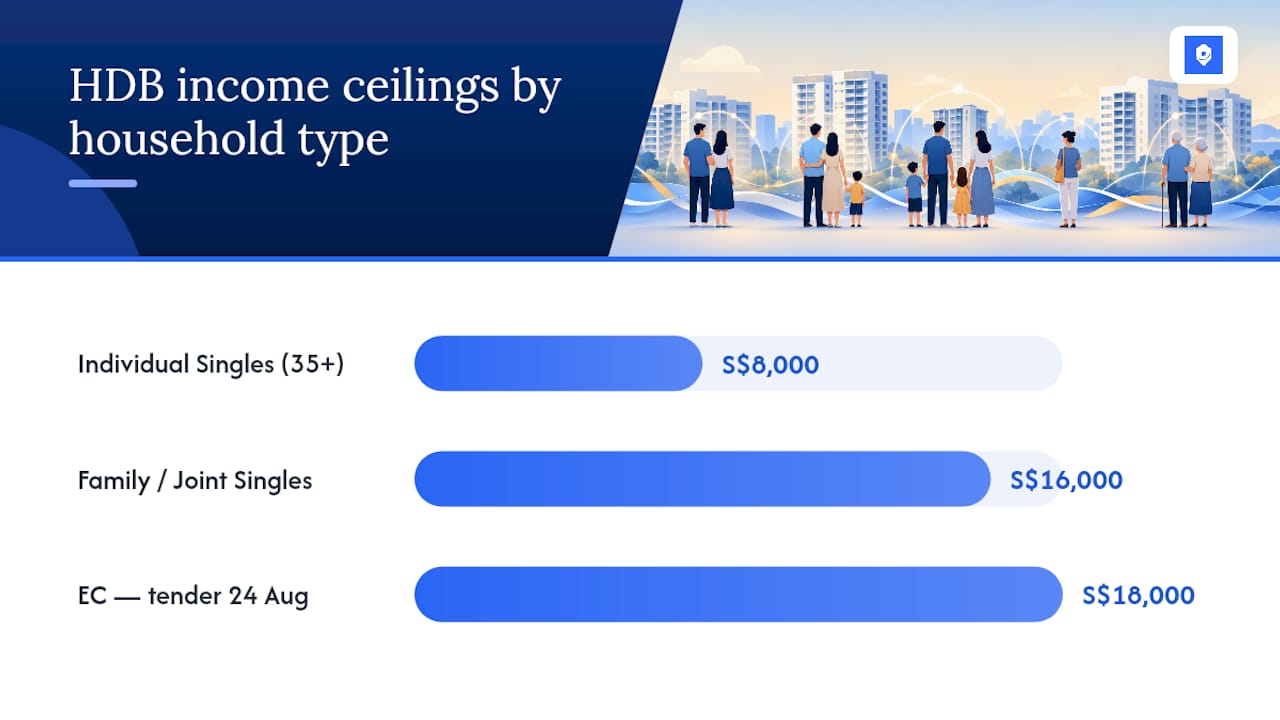
From 24 August 2026, HDB has raised the income ceiling for families buying a new subsidised flat to S$16,000, the ceiling for singles aged 35 and above to S$8,000, and the Executive Condominium ceiling to S$18,000. The new limits apply to HDB Flat Eligibility (HFE) letter applications submitted from that date, though resale purchases and CPF Housing Grant eligibility follow separate rules.
TL;DR:
- The new household income ceiling for BTO and resale flats is S$16,000 for families and S$8,000 for singles aged 35 and above, effective from August 24, 2026.
- Executive Condominium eligibility now requires a land tender closing date on or after August 24, 2026, with a ceiling of S$18,000.
- Household income includes all occupiers’ earnings and is based on a 12-month average, ending two months before application.
- Income assessments are separate from CPF grant eligibility, which has lower thresholds, and from housing loan requirements.
- Applicants should accurately calculate their household income using HDB’s methodology to avoid rejection or misjudgment of eligibility.
Table of Contents
- What changed in the NDR 2026 income ceiling adjustment?
- Who does the income ceiling apply to?
- How does HDB calculate your average monthly income?
- Does the income ceiling affect CPF Housing Grants and loans?
- How do you apply for an HFE letter?
- How can you check affordability before you apply?
- How has the HDB income ceiling changed over time?
- Do the new ceilings apply to joint singles and other flat types?
- What if your income exceeds the ceiling or you dispute the calculation?
- What does the higher ceiling really mean for buyers?
- How haio helps you plan around the new income ceiling
- Sources
What changed in the NDR 2026 income ceiling adjustment?
The government announced the increase during the National Day Rally 2026, and the Ministry of National Development confirmed the detail shortly after in an official HDB press release. The family ceiling rises from its prior level to S$16,000, while the singles (35 and above) ceiling climbs to S$8,000. Both take effect for HFE applications made from 24 August 2026 onward.
The Executive Condominium ceiling moves to S$18,000, but this one carries a catch: it only applies to EC projects where the land sale tender closed on or after 24 August 2026. Buy into an EC launched under an earlier tender and the older ceiling still governs your eligibility.
The policy objective is straightforward. Household incomes in Singapore have climbed steadily, and without periodic adjustment, more middle-income families would find themselves priced out of subsidised housing on paper even while genuinely needing it. HDB and the Ministry of National Development also pushed the next BTO sales exercise to November 2026, giving buyers extra weeks to reassess their eligibility before applying.
Key figures at a glance:
- Family ceiling (BTO/Sale of Balance): S$16,000, effective for HFE applications from 24 August 2026
- Singles ceiling (aged 35 and above): S$8,000, same effective date
- EC ceiling: S$18,000, but only for projects with land tenders closing on or after 24 August 2026
Who does the income ceiling apply to?
The income ceiling that governs your application depends on your household composition, not just your own paycheque. Married or engaged couples, and families forming a household, use the S$16,000 family ceiling. A single applicant aged 35 or older buying alone uses the S$8,000 threshold. Two single applicants buying together under the Joint Singles Scheme are assessed against the family ceiling, since HDB treats their combined household income as the relevant figure.
Occupiers listed on your application matter too, even if they are not the flat's owners.
- Occupiers' incomes count towards the household ceiling for eligibility purposes, even though they are not applicants.
- A parent or sibling with a substantial income listed as an occupier can push a household over the ceiling despite the applicants themselves earning well under it.
- EC buyers eyeing balance units from an earlier, undersold launch should check the original tender date rather than assume the new S$18,000 ceiling applies.
- Divorced or widowed applicants under 35 generally fall under different eligibility schemes rather than the standard singles ceiling.
How does HDB calculate your average monthly income?
HDB does not simply ask what you earn today. It calculates your average gross monthly household income over a defined assessment period, and getting this wrong is one of the most common reasons applicants misjudge their own eligibility before applying.
The assessment period runs for 12 months, ending two months before the month you submit your HFE application. Apply in October 2026, for instance, and HDB looks at income earned between roughly August 2025 and July 2026.
Worked example: A couple earning a combined S$180,000 gross over that 12-month period, with no unpaid leave, would show an average gross monthly household income of S$15,000. That sits comfortably under the new S$16,000 family ceiling, whereas it would have breached the previous threshold.
What counts and what does not:
- Included: basic salary, allowances, overtime pay, commissions, bonuses and most other employment income.
- Excluded: employer CPF contributions and certain forms of passive income are not counted towards the ceiling.
- No-pay leave: months on unpaid leave are treated as unemployment for that period, which lowers the divisor and can shift your average significantly.
- Self-employed applicants: HDB assesses income over the full 12 months, or from business commencement if the business is younger than a year.
Pro Tip: Work out your figure the same way HDB does: sum every listed person's income across the months they actually worked in the assessment period, then divide by those months worked, excluding any no-pay leave. This is exactly how a practitioner-level calculation should be done, and it often produces a very different number from a simple current-salary estimate.
Does the income ceiling affect CPF Housing Grants and loans?
Passing the income ceiling gets you through the door for an HFE application, but it does not automatically unlock CPF Housing Grants. This is where many applicants trip up: the ceiling and the grant thresholds are two separate tests.
- The Enhanced CPF Housing Grant, for example, uses its own S$9,000 family income threshold, well below the S$16,000 eligibility ceiling.
- A household earning S$14,000 a month could qualify to apply for a flat under the new ceiling yet miss out on the largest grant tier entirely.
- HDB housing loans carry their own condition: applicants must be in employment or trade at the point the loan is disbursed, regardless of how income was assessed earlier.
- Resale flat purchases follow different grant rules again, so a household ineligible for a BTO grant under one set of thresholds may still find options in the resale market.
Run your own numbers before assuming a grant amount. The ceiling tells you whether you can apply; the grant thresholds tell you what you can actually claim.
How do you apply for an HFE letter?
An HFE letter is the gateway document for any BTO, Sale of Balance, or EC application, and preparing the right paperwork in advance saves weeks of back-and-forth.
- Gather your Notice of Assessment (NOA) from IRAS covering the relevant assessment years.
- Collect payslips and employment letters for every applicant and occupier listed on the application.
- If self-employed, prepare business registration documents and income declarations covering the assessment period.
- Submit statutory declarations where HDB requests them, typically for irregular or undocumented income.
- Apply through HDB's online system, checking that your assessment end date (two months before your application month) aligns with the payslips you have gathered.
- Time your application to line up with the November 2026 BTO sales exercise if you want the new ceilings to apply from the outset.
Missing documents are the single biggest cause of delayed HFE processing, so assembling this checklist before you start the online form is worth the extra hour.
How can you check affordability before you apply?
Knowing the ceiling is one thing. Knowing whether a specific flat, at a specific price, fits your finances is another problem entirely, and it is where most applicants get stuck.
- Calculate your household's average gross monthly income using the 12-month method described above, before you even open the HFE application form.
- Simulate which CPF Housing Grants you are likely to receive, since the S$9,000 Enhanced Grant threshold and other tiers sit well below the eligibility ceiling itself.
- Check your loan servicing ratio against current mortgage rates, factoring in the requirement to be employed at disbursement.
- Use a tool like haio to run an affordability check that combines your income, likely grant tier and current mortgage rates into a single estimate before you commit to an application.
Pro Tip: Run the affordability check twice: once using your current salary, and once using your actual 12-month average. The gap between the two numbers is often where applicants get an unwelcome surprise at the HFE stage.
Haio's tools help with planning and estimation, not the final decision. HDB alone determines actual eligibility once your HFE application is submitted.
How has the HDB income ceiling changed over time?
Singapore has adjusted the income ceiling for subsidised flats several times over the past two decades, generally in response to wage growth rather than any single policy shock. Each revision has followed a similar pattern: incomes rise across the resident workforce, more middle-class households find themselves technically priced out of a scheme designed to serve them, and the ceiling gets nudged upward to compensate.
The 2026 increase to S$16,000 for families and S$8,000 for singles follows this same logic, timed to the National Day Rally rather than a routine Budget announcement, which signals how central housing affordability has become to the broader policy conversation. Earlier revisions tended to arrive with less fanfare and smaller increments.
What is notable about the current adjustment is the parallel move on Executive Condominiums, where the ceiling rose to S$18,000 but with the tender-date restriction attached. That structural detail matters more than it might first appear: it prevents a sudden re-rating of every EC project already in the pipeline, and it means two nearly identical EC launches, tendered a few months apart, could sit under two different income rules entirely.
For families tracking these shifts, the practical lesson is that ceilings tend to move in the same direction as median household income, roughly every few years rather than annually. That makes it worth checking your eligibility freshly each time you plan to apply, rather than assuming a figure you memorised two or three years ago still holds.
Do the new ceilings apply to joint singles and other flat types?
The 2026 changes reach further than the standard family and individual-singles categories most coverage focuses on. Two singles applying together under the Joint Singles Scheme are assessed against the family ceiling of S$16,000, not the S$8,000 individual singles threshold, since HDB treats their combined household income as the relevant test once they apply as a pair.
This distinction catches some applicants off guard. A pair of single applicants each earning S$7,500 a month might assume they qualify comfortably under the singles ceiling, only to discover their combined income of S$15,000 is instead measured against the family threshold, which they still pass, but by a narrower margin than either expected.
Multi-generation households applying together, such as a married couple buying with a parent listed as an occupier, also fall under the family ceiling, but with the added complication that the occupier's income counts towards the ceiling test even though that person is not an applicant. This is a distinct calculation from the credit assessment HDB runs for loan purposes, where occupier income is typically excluded.
For Executive Condominiums, the S$18,000 ceiling applies uniformly to family and joint-application households buying together, subject to the same tender-date caveat that governs the rest of the EC ceiling change. There is no separate joint-singles EC ceiling; EC purchases generally require a family nucleus or an eligible scheme such as the Fiancé/Fiancée Scheme rather than the standalone Joint Singles route used for BTO flats.
What if your income exceeds the ceiling or you dispute the calculation?
Households whose average gross monthly income sits above the relevant ceiling are not eligible to apply for a new subsidised flat under that scheme, full stop, at least for that application cycle. The resale market remains open regardless of income, since resale flats carry no income ceiling, though CPF Housing Grants for resale purchases still apply their own separate thresholds.
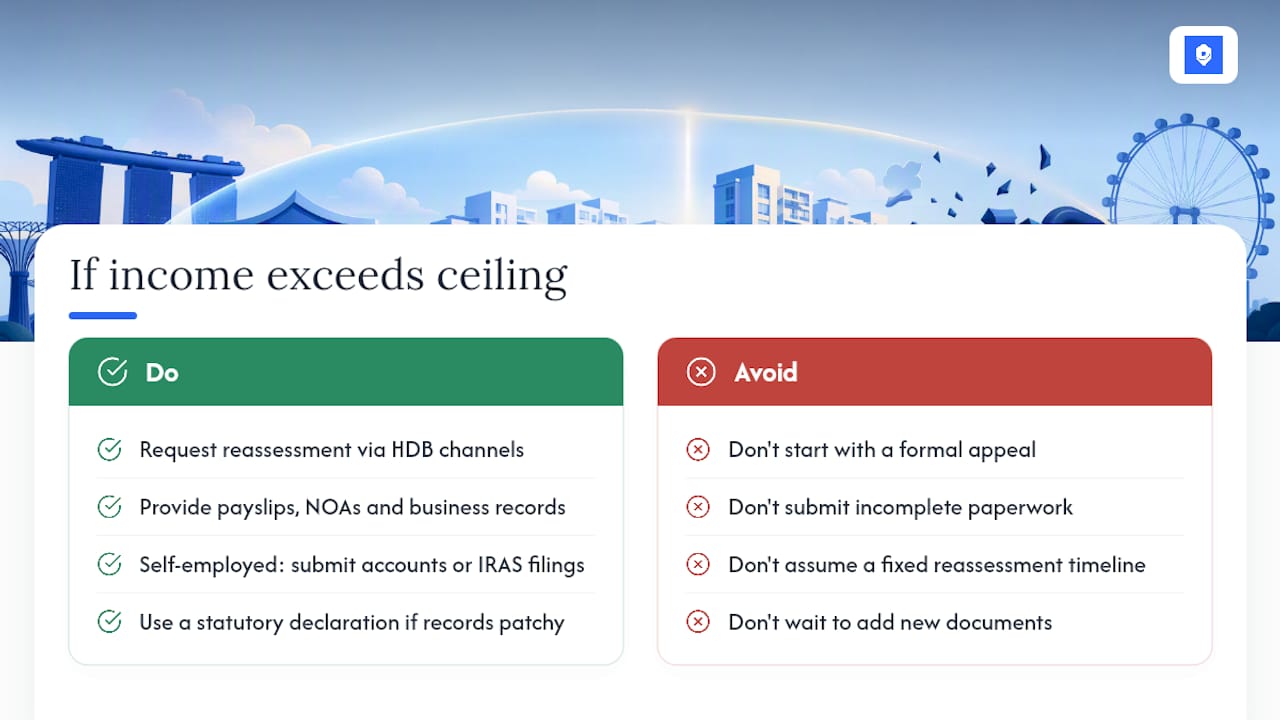
If you believe HDB has miscalculated your household income, the first step is not a formal appeal but a request for reassessment through HDB's own application channels, typically triggered when new documentation becomes available. Common disputes involve unpaid leave being excluded incorrectly, bonus income being counted in the wrong assessment month, or an occupier's income being attributed to the wrong household.
Self-employed applicants face the most frequent disputes, largely because business income fluctuates and documentation can be incomplete. HDB's guidance allows assessment over the full 12-month period or from business commencement, whichever is shorter, but applicants need to submit clear business records, such as accounting statements or IRAS filings, to support their declared figures. Where records are patchy, HDB may request a statutory declaration to formalise the applicant's own account of their income.
There is no fixed public timeline for a reassessment decision, and outcomes depend on the documentation supplied. Applicants close to the ceiling, whether just under or just over, should gather every available payslip, NOA and business record before submitting, since a marginal case decided on incomplete paperwork is harder to correct after the fact than to get right the first time.
What does the higher ceiling really mean for buyers?
The S$16,000 family ceiling brings a meaningful slice of higher-earning households back into the subsidised flat market, households that would have been shut out entirely under the previous threshold. That is likely to sharpen competition for popular BTO projects in mature estates, even as it widens access overall.
For most families, the sensible move is to run the numbers properly before the November 2026 exercise rather than assume last year's figures still apply. If your average income sits close to either the old or new ceiling, resale may still be the faster, more certain route while you wait to confirm your standing. Always verify edge cases directly with HDB rather than relying on a general estimate.
— HAIO
How haio helps you plan around the new income ceiling
Haio gives you a faster way to work out where you actually stand before you touch an HFE form. Its affordability checks translate your household's 12-month average income into a realistic view of loan servicing and likely CPF Housing Grant tier, so you are not guessing at numbers HDB will calculate differently later. The platform also tracks current mortgage rates and flags upcoming BTO and EC launches, which matters given the November 2026 sales exercise timing.
Getting started takes a few minutes: visit the haio landing page, run an affordability check against your household's income and target flat type, and set alerts for the projects you are watching. Haio's tools are built for planning and comparison, not the final word on eligibility. HDB remains the sole authority on whether your household qualifies once you submit an HFE application.