
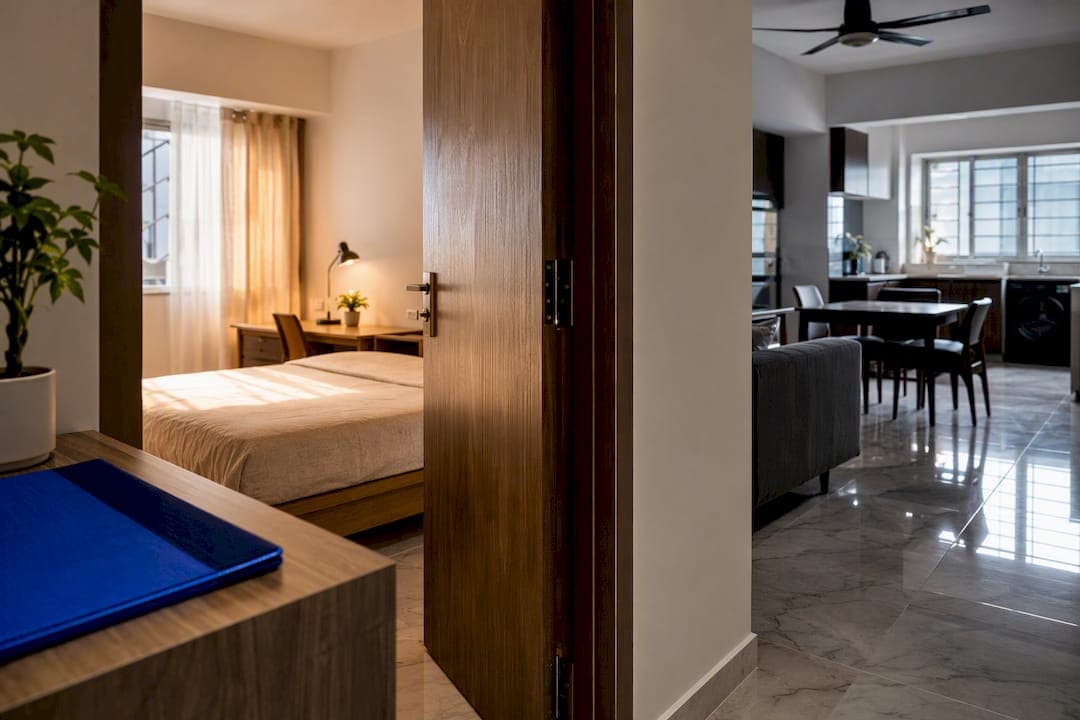
Yes, you can rent out a spare bedroom in an HDB flat, but only if you own a 3-room or larger flat, continue to live there yourself, and secure HDB approval before the tenancy begins. The minimum tenancy length is six months, and unauthorised arrangements, including the common trick of locking one room and renting out the rest, carry real penalties.
TL;DR:
- Only owners of 3-room or larger flats can rent out spare bedrooms, and they must continue to reside in the flat throughout the tenancy; renting out smaller flats is not permitted.
- Tenants must have valid passes with at least six months of validity remaining at the time of application, with restrictions for certain work permit sectors and tourist visitors.
- Owners must apply for approval before tenancy begins, pay a fee of $9 per bedroom, and keep records of tenant changes to avoid penalties or loss of rental privileges.
- The minimum tenancy period is six months, and flats cannot be rented out for less or extended beyond 36 months without re-application, with occupancy caps of six persons for 3-room and eight for larger flats.
- Renting out common areas or partitioned living spaces is illegal, and ownership must remain resident; unauthorised tenancy can lead to fines, revocation, or compulsory flat acquisition.
Table of Contents
- HDB room rental rules for flat types and owners
- Who qualifies as an HDB tenant
- How to apply for HDB approval and the fees involved
- Tenancy length and occupancy limits under HDB rental guidelines
- Owner responsibilities and penalties for breaking HDB tenant regulations
- How to verify HDB approval before signing a lease
- Practical checklist and common pitfalls for owners
- Subletting the living room and other common areas
- Renting to family members versus unrelated tenants
- Resolving disputes between owners and tenants
- Does renting out a room affect resale or upgrading eligibility?
- Balancing rental income with compliance and neighbourliness
- Preparing your room rental the right way
- Where to confirm the official rules
- Sources
- FAQ
HDB room rental rules for flat types and owners
Bedroom rental hinges on flat size. Owners of 3-room or larger HDB flats may rent out spare bedrooms, while 1- and 2-room flats are excluded entirely, since HDB considers them too small to house both an owner-occupier and a paying tenant without overcrowding.
Ownership status matters too. Singapore Citizen owners generally face fewer restrictions than those still within the Minimum Occupation Period, though MOP concerns typically apply to renting out the whole flat rather than a single bedroom. The number of bedrooms available to rent depends on flat configuration, not a fixed quota per household.
- 3-room and larger flats: bedroom rental permitted
- 1- and 2-room flats: no bedroom rental allowed
- Owner must retain the flat as a residence throughout the tenancy
- The number of biddable bedrooms follows the flat's actual layout, not partitioned subdivisions
Who qualifies as an HDB tenant
HDB rental eligibility for tenants is narrower than most owners expect. Acceptable tenants include Singapore Citizens, Permanent Residents, and non-citizens holding valid passes: Employment Pass, S Pass, Work Permit, Student Pass, Dependant Pass, or Long-Term Social Visit Pass. Tourists cannot rent HDB bedrooms under any circumstance.
Statistic: Every applicant's pass must have at least 6 months of validity remaining on the date the owner submits the application to HDB, a rule that catches out many first-time landlords who check validity too late.
Certain Work Permit holders face additional sector caveats. Those from the construction, marine, and process or manufacturing sectors are typically restricted to employer-provided dormitory housing rather than HDB bedrooms, depending on nationality and work pass conditions. Owners should verify a prospective tenant's pass category and sector before drafting a tenancy agreement, not after.
- Singapore Citizens and PRs: no pass validity restriction
- Employment Pass, S Pass, Student Pass, Dependant Pass, Long-Term Social Visit Pass holders: minimum 6 months validity required
- Work Permit holders: subject to sector and nationality caveats
- Tourists and short-term visit pass holders: not eligible under any HDB room leasing rules
How to apply for HDB approval and the fees involved
Owners apply through Mobile@HDB or the HDB e-Service portal, accessible via My HDBPage, and the process must be completed before the tenancy starts, not retroactively.
- Gather tenant particulars, including full name, NRIC or pass number, and a copy of the relevant pass.
- Confirm the tenancy start and end dates, the agreed rent, and the number of bedrooms being let.
- Submit the application via Mobile@HDB or My HDBPage before the tenant moves in.
- Pay an administrative fee per bedroom as required by HDB.
- Ensure the rental commences by the end of the next calendar month after approval, or the approval lapses.
- For renewals, reapply ahead of expiry rather than waiting until the current approval runs out.
Pro Tip: Submit your application at least a week before the intended move-in date. HDB's e-Service typically updates tenant particulars within two days of approval, but leaving no buffer means a delayed pass copy or a missing detail can push your tenant's start date back by weeks.
Tenancy length and occupancy limits under HDB rental guidelines
The minimum tenancy per tenant is 6 months, a rule enforced specifically to prevent short-term subletting that could disrupt estate stability. The maximum period per application generally runs up to 36 months, but drops to 24 months where any named tenant is a non-Malaysian non-citizen, a distinction that trips up owners renting to a mixed household of PRs and foreign pass holders.
Occupancy caps apply on top of tenancy length. A 3-room flat may house up to six persons in total, while 4-room and larger flats may house up to eight persons, including owners and tenants, counting owners, family, and tenants together. Only the flat's original bedrooms count toward rentable space; partitioned or converted rooms carved out of a living or dining area do not qualify.
- Minimum tenancy: a period of at least six months per tenant is required
- Maximum tenancy: up to 36 months generally, 24 months if any tenant is a non-Malaysian non-citizen
- 3-room flats: 6 occupants maximum
- 4-room and larger flats: 8 occupants maximum
- Any tenancy extending beyond the approved period requires a fresh application
Owner responsibilities and penalties for breaking HDB tenant regulations
HDB requires owners to physically and continuously occupy the flat for the entire duration bedrooms are rented out. Locking a spare room and renting out the remainder of the flat while the owner lives elsewhere is not a workaround. HDB treats this as unauthorised whole-flat rental, regardless of how the arrangement is described in a private agreement.
Owners also carry responsibility for what their tenants do inside the flat. If a tenant breaches residential-use conditions, runs an unauthorised business, or overcrowds the unit, HDB holds the owner accountable, not just the tenant. Approval can be revoked automatically the moment an owner stops living in the flat, and repeated or serious breaches can lead to compulsory acquisition of the flat under the Housing and Development Act.
- Owner must remain resident in the flat throughout the rental period
- Owner is liable for tenant conduct and residential-use compliance
- Any change in tenant particulars, including a tenant moving out, must be reported to HDB within 7 days
- Unauthorised rental risks fines and, for repeat cases, compulsory acquisition
Pro Tip: Keep a simple log of every tenant's move-in date, pass expiry, and any changes reported to HDB. If an enforcement query ever arises, a clear paper trail is the fastest way to demonstrate you have followed HDB rental guidelines in good faith.
How to verify HDB approval before signing a lease
Tenants are not powerless in this process. Before signing anything, a prospective tenant can check authorised tenant status directly through HDB's e-Service enquiry portal, commonly referenced by its system name, BR12AWPortal.
- Ask the owner for a copy of the HDB approval letter or confirmation before paying any deposit.
- Cross-check the tenancy details against HDB's e-Service portal, since particulars are typically updated within two days of approval being granted.
- Insert a clause into the tenancy agreement stating the contract is conditional on valid HDB approval, protecting the tenant if the arrangement is later found unauthorised.
- If a rental turns out to be unauthorised after moving in, report it to HDB and seek guidance on next steps rather than continuing to pay rent into a void arrangement.
Practical checklist and common pitfalls for owners
Before listing a room, confirm your flat type qualifies, verify each tenant's pass validity on the actual application date, and submit through HDB e-Service before the tenancy starts. Keep records and report any tenant change within 7 days.
The most frequent pitfalls are avoidable: locking a room to fake occupancy, undercounting occupants against the 6 or 8 person caps, and letting approval lapse without reapplying at renewal.
- Confirm flat type (3-room or larger) before advertising a room
- Check pass validity against the application date, not the listing date
- Apply via HDB e-Service before the tenant moves in
- Log tenant changes and report them within 7 days
Subletting the living room and other common areas
HDB's rental framework is built around bedrooms, not shared spaces. A living room, kitchen, or dining area cannot be sublet as separate accommodation under standard HDB room leasing rules, because these spaces are classified as common areas intended for use by the whole household, not as lettable units.
This distinction catches out owners who assume that partitioning a living room with a temporary divider creates a new "bedroom" they can register. HDB's occupancy and rental rules apply to the flat's original layout as approved at construction or renovation, and converting communal space into an ad hoc sleeping area does not change its classification for rental purposes. An owner who rents out a partitioned living room corner is, in HDB's eyes, still renting an unapproved space, which falls outside the approval process entirely and exposes both parties to the same enforcement risk as an unauthorised whole-flat rental.
The practical implication is straightforward: only the flat's genuine, HDB-recognised bedrooms can go through the application and approval process. If a flat has three actual bedrooms, only those three rooms are eligible for individual rental listings, regardless of how much additional floor space the living or dining area might offer. Owners looking to maximise rental income within the rules should focus on how many legitimate bedrooms their flat has, not on creative subdivisions of shared space. Tenants, for their part, should treat any offer to rent a "converted" living room with caution, since it almost certainly cannot be registered through HDB's approval system.
Renting to family members versus unrelated tenants
HDB draws a meaningful line between renting to immediate family and renting to unrelated tenants, though the distinction is often misunderstood. Letting a spare room to a spouse, child, parent, or sibling for free, without any rental income changing hands, generally falls outside the formal bedroom rental approval process, since HDB's rental rules are designed to regulate paid tenancy arrangements rather than family living arrangements within the same household.
The moment money changes hands, however, the picture shifts. If an owner charges a family member rent, even a modest, below-market amount, the arrangement can fall under the same approval requirements as renting to an unrelated tenant, because HDB's rules are triggered by the existence of a rental relationship rather than the closeness of the relationship between the parties. Owners assuming that family ties automatically exempt them from needing approval are taking on unnecessary risk.
There is also a common but mistaken belief that letting a friend or relative stay for free carries zero obligations. While no HDB approval is typically needed for a genuine no-rent arrangement with family, the flat's occupancy caps still apply, and the owner remains responsible for ensuring the flat is not effectively being used as an unauthorised rental under a different label. If in doubt, the safest approach is to treat any arrangement involving payment, formal or informal, as a rental requiring the standard application process, and to keep the distinction between hosting family and renting to tenants clearly documented.
Resolving disputes between owners and tenants
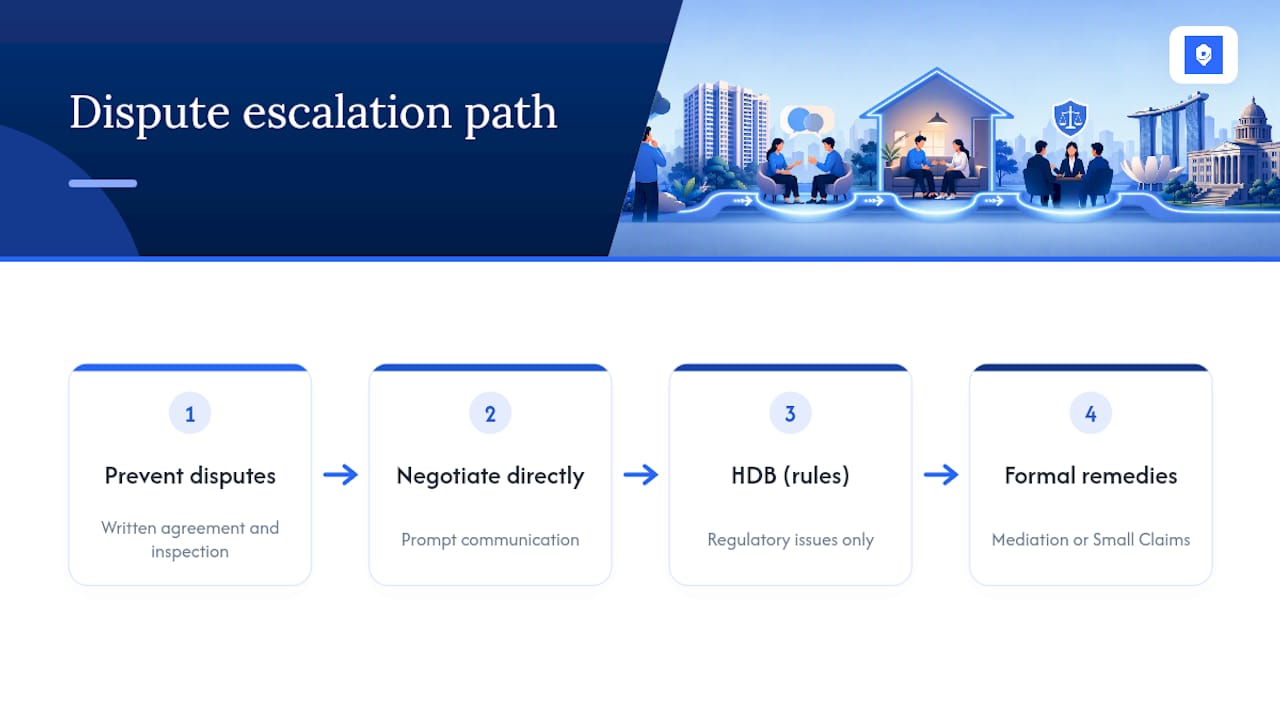
Disputes over rent arrears, deposit deductions, or early termination fall largely outside HDB's direct jurisdiction, since HDB's role centres on approving and monitoring the tenancy's compliance with occupancy and eligibility rules rather than adjudicating contractual disagreements between owner and tenant.
That said, HDB rental agreement terms still shape how disputes should be handled. A written tenancy agreement, ideally covering rent amount, payment dates, notice periods, and deposit conditions, is the first line of defence for both parties. Without one, disagreements over what was verbally agreed become far harder to resolve, and neither owner nor tenant has a clear reference point.
Where a dispute touches on HDB's own rules, such as a tenant remaining in the flat after approval has lapsed, or an owner attempting to evict a tenant without proper notice while the tenancy is still within its approved period, HDB can be contacted directly for guidance on the regulatory position. For matters purely about money or damages, owners and tenants in Singapore can turn to the Small Claims Tribunals for claims within the prescribed limit, or seek mediation through community mediation services before matters escalate further.
The practical lesson is to prevent disputes rather than manage them after the fact. Clear tenancy agreement terms, a documented move-in inspection, and prompt communication when issues arise resolve the vast majority of owner-tenant friction long before either party needs to consider a report to HDB or a claim elsewhere. Owners who treat the tenancy agreement as a formality rather than a working document tend to be the ones facing the messiest disputes later.
Does renting out a room affect resale or upgrading eligibility?
Renting out a spare bedroom under an approved HDB arrangement does not, by itself, disqualify an owner from reselling the flat or applying for a new BTO or resale flat later, provided the owner has met the Minimum Occupation Period and continued to satisfy the physical occupation requirement throughout the rental period.
The connection owners should watch closely is between bedroom rental and MOP status. Renting out bedrooms is only permitted once MOP conditions relevant to the flat have been satisfied for the specific rental scenario, and continuing to live in the flat while renting rooms does not extend or reset the MOP clock. Owners planning to sell or upgrade shortly after their MOP ends should factor in that any active bedroom tenancy will need to be properly concluded, or transferred with HDB's knowledge, before a resale transaction completes.
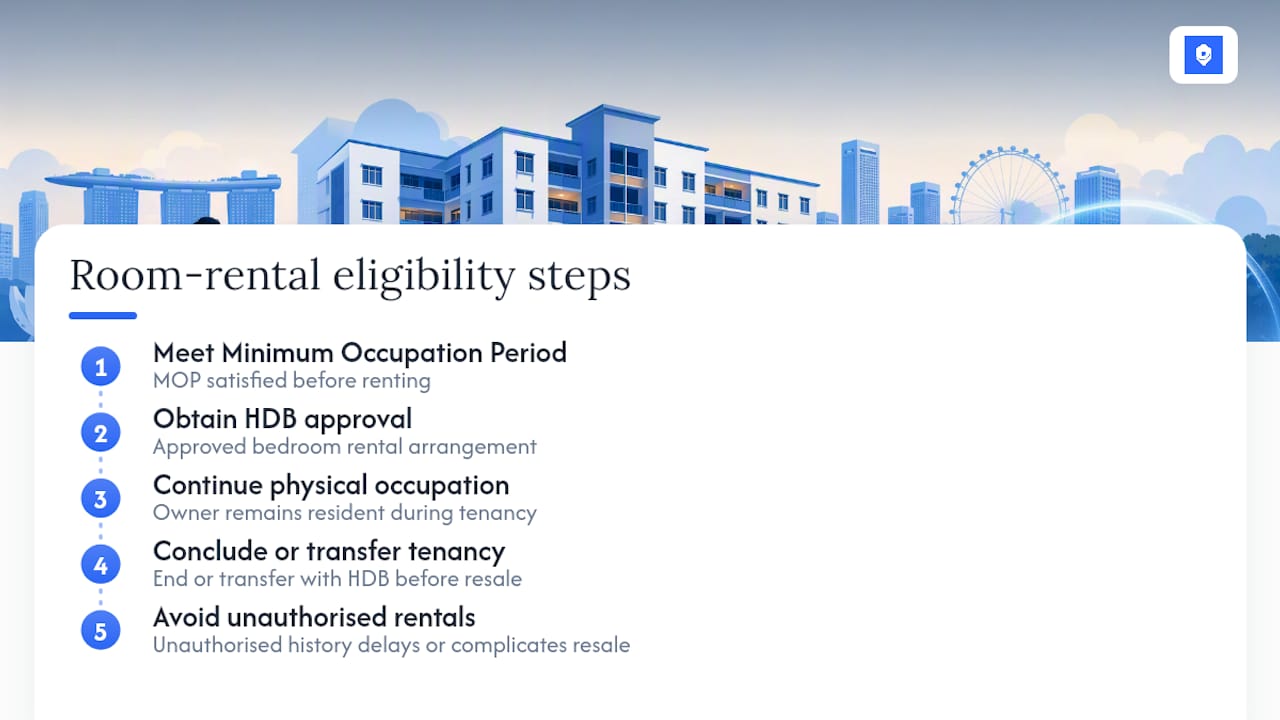
There is a common misconception that having tenants in the flat at the point of sale creates complications for the buyer or for HDB's approval of the resale. In practice, as long as the rental was properly approved and the owner remained a resident, an active or recently ended bedroom tenancy does not create a resale obstacle. What does create problems is an unauthorised rental history, since HDB's records of past enforcement action or unresolved compliance issues can surface during the resale approval process and delay or complicate a transaction. Owners considering a future upgrade should keep every bedroom rental fully documented and properly closed out well before listing the flat, precisely because a clean compliance record protects both the sale timeline and the flat's standing with HDB.
Balancing rental income with compliance and neighbourliness
Rules around HDB room rental exist for a reason beyond paperwork: they preserve the character of public housing estates as places people live in, not investment stock. Compliance protects estate harmony, and it reduces the odds of a dispute escalating into an HDB enforcement matter months later.
Good recordkeeping and transparent listings serve both sides of a tenancy. An owner who documents pass validity, approval letters, and tenant changes has little to fear from a compliance check, and a tenant who insists on seeing that paperwork before signing protects their own tenancy.
— HAIO
Preparing your room rental the right way
Getting HDB approval sorted is the legal foundation, but pricing the room correctly and keeping tenant records straight is where owners either save time or create future headaches. Some platforms provide owners with access to market-based rental data and property valuation tools, so a bedroom can be priced against genuine neighbourhood comparables rather than a guess pulled from a classifieds site.
Beyond pricing, certain tools help owners maintain the kind of tenant and renewal records that make HDB's 7-day reporting rule easy to follow rather than easy to forget. If you are preparing to list a spare bedroom and want a clearer read on what it should rent for in your estate, check current market data on Haio before you set a figure and submit your HDB application.
Where to confirm the official rules
For the definitive word on eligibility, applications, and regulations, go directly to HDB's bedroom rental eligibility page and the approval application page. For rental income tax questions, consult IRAS directly.
Sources
- Renting out bedrooms – HDB
- HDB tenant enquiry portal (BR12AWPortal)
- Inland Revenue Authority of Singapore (IRAS)
FAQ
Can I let my friend stay in my HDB for free?
Yes, hosting a friend without charging rent generally falls outside HDB's formal bedroom rental approval process, but the flat's occupancy limits still apply and the arrangement must not function as disguised paid rental.
Can an HDB utility room be rented out?
No, only the flat's original bedrooms qualify for rental under HDB room rental rules; utility rooms, storerooms, and partitioned common areas cannot be registered as rentable space.
Can I rent a HDB room for 3 months?
No, HDB enforces a strict minimum tenancy of 6 months per tenant specifically to prevent short-term subletting, so a 3-month arrangement would not meet approval requirements.
Is it illegal for an HDB owner to lock one room and rent out the rest without staying in the flat?
Yes, HDB treats this as unauthorised whole-flat rental rather than a legitimate bedroom tenancy, since the owner is not fulfilling the physical occupation requirement, and it can lead to penalties including compulsory acquisition for repeated breaches.
How much does it cost to apply for HDB bedroom rental approval?
The administrative fee is $9 per bedroom, payable when submitting the application through Mobile@HDB or the HDB e-Service portal before the tenancy begins.