

If you are buying an HDB resale flat and plan to use CPF savings or a housing loan, you must submit a Request for Value. This is the process HDB uses to set the official valuation figure that governs how much CPF you can withdraw, and the reference amount your lender uses for the loan quantum. Cash-only buyers do not need to submit one, since no CPF or loan financing depends on it.
The submission carries a fee of $120 (inclusive of GST), and it must go in by the next working day after the Option Date named on your Option to Purchase (OTP). Miss that window and you complicate your own financing timeline.
- Fee: $120, GST inclusive
- Deadline: next working day after the Option Date
- Turnaround: typically 10 working days
- Validity: valid for 3 months from the date the result appears in My Flat Dashboard
Quick fact: the entire process, from submission to a usable valuation figure, is designed to run in under two weeks, but the 3 month clock starts ticking the moment that figure lands in your dashboard, not the day you applied.
Key Takeaways
The HDB valuation, obtained through a Request for Value, is the single figure that governs CPF withdrawal and loan quantum for a resale flat purchase.
| Point | Details |
|---|---|
| Who must submit | Buyers using CPF or a housing loan must submit a Request for Value; cash-only buyers are exempt. |
| Cost and deadline | The fee is $120 (GST inclusive), due by the next working day after the Option Date. |
| Timeline to plan around | Expect an outcome within 10 working days, valid for 3 months from when it appears in your dashboard. |
| Financing consequence | CPF usage and loan quantum are both capped by the valuation, not the agreed price. |
| COV must be cash | Any gap between agreed price and valuation, the Cash Over Valuation, must be settled entirely in cash. |
| Estimate before you commit | Use block-level and storey-band comparables via a tool like haio to set realistic expectations ahead of the official valuation. |
Table of Contents
- What is an HDB valuation and why does HDB issue one?
- How do you submit a Request for Value?
- How long does the valuation take and how long does it last?
- How does the HDB valuation affect your CPF and housing loan?
- What happens if the valuation comes in below the agreed price?
- How can you estimate the valuation before you submit?
- What should you do after the valuation comes through?
- What the process actually rewards, and what it punishes
- Get a realistic valuation estimate before you commit to an OTP
- Frequently asked questions
- Sources
What is an HDB valuation and why does HDB issue one?
An HDB valuation, formally triggered through a Request for Value, is the figure HDB assigns to a resale flat for financing purposes. It is not a market opinion or an agent's estimate. It is the number CPF and most lenders treat as authoritative when calculating how much CPF savings you can use and what loan quantum a bank or HDB itself will extend against the property.
HDB retains full discretion over whether a physical inspection is needed. In many cases, HDB relies on recent transaction data for similar units and skips an on-site visit entirely. Where HDB does decide a physical check is warranted, it assigns a valuer from its own panel, and the seller is obliged to grant access. Buyers have no say in which valuer is appointed, and neither party can commission their own valuer as a substitute.
A few points worth flagging early:
- The valuation exists purely for CPF and loan reference, not for setting the transaction price. Buyer and seller agree the price independently, usually before or during OTP negotiation.
- Cash-only purchases skip this step altogether, since there is no CPF or loan quantum to calculate against.
- The seller's cooperation is mandatory once HDB requires an inspection, not optional or subject to negotiation.
How do you submit a Request for Value?
The process runs through My Flat Dashboard on the HDB Flat Portal, and it is more time-sensitive than most buyers expect.
- Log in to My Flat Dashboard using your Singpass, then locate the Request for Value section under your active resale transaction.
- Attach page 1 of your signed OTP as proof that a transaction is underway.
- Pay the $120 processing fee online at the point of submission.
- Submit by the next working day after the Option Date. Either the buyer or an appointed property salesperson can do this on the buyer's behalf.
- Wait for HDB's decision on whether a physical inspection is necessary. If it is, HDB appoints a valuer, who then contacts the seller directly to arrange access.
Pro Tip: Confirm with your agent or the seller, before you exercise the option, that they understand a valuer may need entry within a tight window. Sellers caught off guard sometimes delay access, and that delay pushes back your entire financing timeline.
Buyers occasionally assume the seller submits the Request for Value since the flat is theirs. That is incorrect. The financing party, the buyer, initiates it, because the valuation exists to serve the buyer's CPF and loan needs.
How long does the valuation take and how long does it last?
HDB typically returns an outcome within 10 working days of your submission. You will get an email notification, and the result appears directly in My Flat Dashboard.
Key numbers to plan around:
- Turnaround: around 10 working days
- Validity: valid for 3 months from the date the outcome appears in the portal, not from your submission date
That 3 month window is a hard administrative deadline. Both buyer and seller must submit their respective portions of the resale application within it. Miss it, and you cannot simply extend the old valuation. You must submit a fresh Request for Value and pay the $120 fee again, and the new figure could come back higher or lower than the first. HDB also restricts submitting a second Request for Value while an OTP is still active on the same flat, so there is no route to "shop" for a better number mid-transaction.
How does the HDB valuation affect your CPF and housing loan?
The valuation is not a formality tucked away in the paperwork. It directly determines two numbers that matter to your wallet: how much CPF you are permitted to withdraw, and the loan quantum a bank or HDB will lend against the flat.
For CPF, the valuation sets the ceiling for withdrawal tied to the purchase, on top of any Valuation Limit and Withdrawal Limit rules that apply based on the flat's remaining lease. For a housing loan, whether from HDB or a bank, the lender calculates the maximum loan amount against whichever figure is lower: the agreed price or HDB's valuation.
That second point is where buyers get caught out. If the agreed price sits above the HDB valuation, CPF and the loan only stack up against the valuation, not the price you agreed to pay. The gap has to be plugged another way.
- CPF usage is capped by the official valuation, not by the price you negotiated.
- Loan quantum from banks or HDB references the lower of price and valuation.
- A valuation shortfall means finding more cash for the downpayment, or covering the difference separately.
Pro Tip: Run the numbers through the CPF housing usage calculator before you commit to an OTP, not after. Banks may offer their own in-principle approval figures, but for CPF withdrawal and HDB loans specifically, the HDB valuation is the number that governs, and no amount of bank flexibility changes that.
What happens if the valuation comes in below the agreed price?
This is the scenario every resale buyer dreads, and it has a name: Cash Over Valuation, or COV. If your agreed price is $650,000 and HDB values the flat at $620,000, that $30,000 gap is COV. It must be paid entirely in cash. Neither CPF nor any housing loan can touch it, because both are calculated against the valuation figure, not the price you agreed.
Faced with a valuation below the agreed price, you have a few paths:
- Renegotiate the price with the seller, bringing it closer to or in line with the valuation.
- Exercise your right to withdraw, if your OTP terms permit it, though this typically forfeits your option fee.
- Prepare the cash, if you are committed to the flat and the seller will not budge.
Private portal estimates and agent guesses are useful for setting rough expectations before you commit, but they carry no weight with HDB, CPF, or your lender. Treat them as a starting point for conversation, never as a number to plan your actual cash position around.
How can you estimate the valuation before you submit?
National price indices tell you almost nothing useful about a specific unit. What actually predicts an HDB valuation is comparable transactions in the same block, at a similar storey band, with a similar remaining lease. Two units in different blocks on the same street can carry meaningfully different valuations once floor level and lease decay are factored in.
A sensible estimation workflow looks like this:
- Pull recent transacted prices for the same block first, before looking anywhere else.
- Widen the search to neighbouring blocks or a longer time window only if your block has too few recent transactions to work with.
- Adjust your expectation for storey band and remaining lease, since both move the number materially even within the same block.
This is precisely the gap Haio's instant valuation tools are built to close. Haio pulls block-level transaction data, affordability checks, and current mortgage-rate visibility into one view, so you can sanity-check a seller's asking price before you ever pay for an official Request for Value. For buyers who want a more granular read, haio+ offers paid valuation reports with deeper comparable analysis.
Pro Tip: Never treat a national or town-level average as your benchmark. A flat on the 15th floor of a block with 70 years left on its lease and one on the 3rd floor with 55 years remaining, even on the same street, can differ in valuation by tens of thousands of dollars.
What should you do after the valuation comes through?
Once the outcome lands in My Flat Dashboard, a short list of actions determines whether the rest of the transaction runs smoothly.
- Confirm your financing mode in My Flat Dashboard, whether that is CPF, an HDB loan, a bank loan, or a mix.
- Check your CPF balance against what the valuation permits you to withdraw.
- Verify your loan pre-approval still holds against the valuation figure, not just the agreed price.
- Prepare cash for any COV, and speak to the seller promptly if renegotiation is on the table.
- Submit the resale application, buyer and seller portions both, within the 3-month validity window.
If HDB assigns a valuer for a physical inspection, the seller must permit access within three working days of being notified. A seller who delays that access risks pushing the entire resale timeline past the 3-month mark, forcing a fresh request and another $120 fee.
What the process actually rewards, and what it punishes
The Request for Value system is unforgiving of poor timing but fairly generous with information, if you know where to look for it. Most of the anxiety buyers feel around HDB valuation comes not from the process itself but from entering it blind, having negotiated a price with no block-level comparable data to test it against.
The conventional advice, "check recent resale transactions in the area," undersells the precision this actually needs. Area-level averages hide the exact variables, storey band and remaining lease, that HDB's own valuers weigh most heavily. A buyer who checks only town-wide medians is essentially guessing.
What should come first, before the OTP is even signed, is a genuine attempt to model the specific unit against its closest comparables. That is not a luxury step for cautious buyers. It is the difference between walking into a Request for Value with a realistic number in mind and being blindsided by a COV bill you have thirty days to fund in cash.
Get a realistic valuation estimate before you commit to an OTP
Haio gives you the block-level and storey-band comparable data that HDB's own valuers rely on, before you ever pay the $120 fee or sign an Option to Purchase. Where most resale buyers are working from an agent's verbal estimate or a town-wide average, Haio's instant valuation tool pulls transaction history down to the specific block and floor band, paired with affordability checks and live mortgage-rate comparisons in one place.
That combination matters most in the window between agreeing a price and submitting your Request for Value, when a realistic number saves you from either overpaying or facing an unexpected COV bill. For buyers who want deeper comparable analysis, haio+ offers paid valuation reports with more granular detail than the free tool provides. Head to Haio to run a valuation check on the block you are considering before your next OTP conversation.
Frequently asked questions
Do I need an HDB valuation if I am paying entirely in cash? No. The Request for Value exists solely to set the basis for CPF withdrawal and loan quantum. Cash-only buyers can skip it entirely.
Can I choose my own valuer instead of the one HDB assigns? No. HDB has sole discretion over whether a physical inspection is needed and, if so, appoints the valuer from its own panel. Buyers and sellers cannot substitute a private valuer.
What happens if my HDB valuation expires before I submit the resale application? You will need to submit a new Request for Value and pay the $120 fee again, and the resulting figure may differ from the first.
Is the HDB valuation the same as the flat's market value? Not necessarily. Market value reflects what a buyer is willing to pay, which is the agreed price. The HDB valuation is a separate figure used strictly for CPF and loan purposes, and the two can differ, which is exactly how Cash Over Valuation arises.
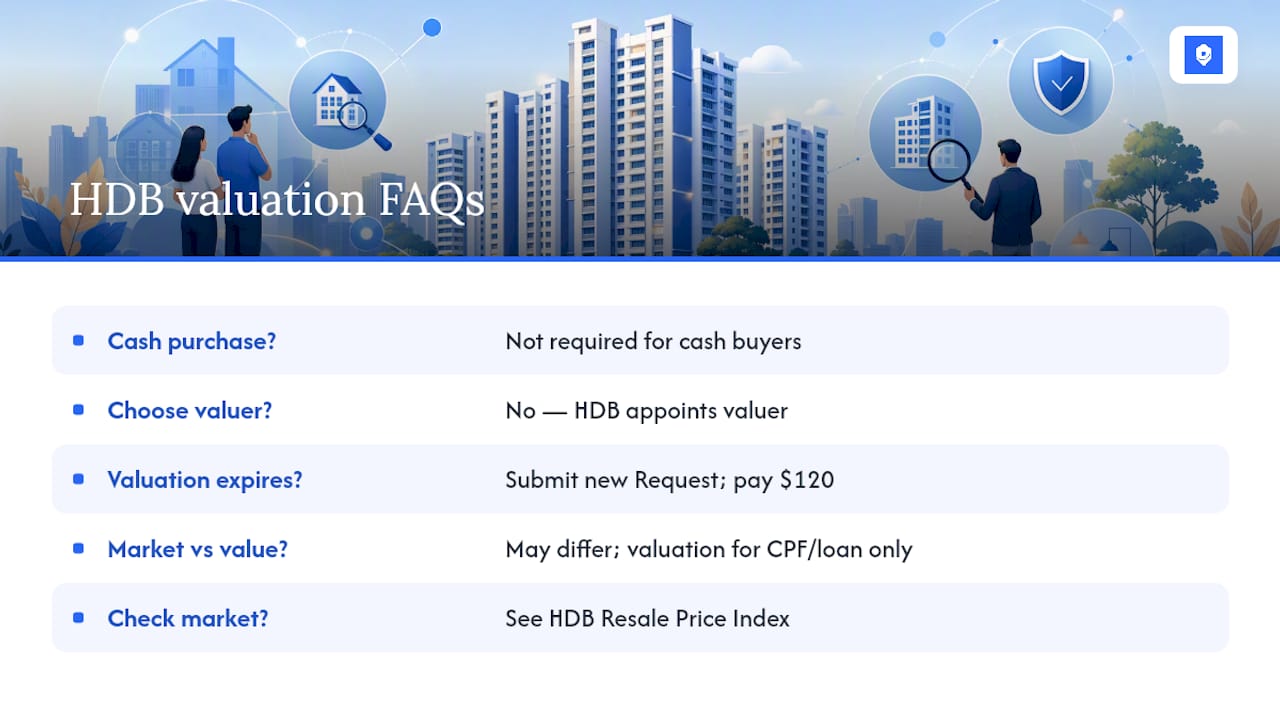
Where can I check current market trends before negotiating a price? HDB's own Resale Price Index is the official indicator of resale market movement. Treat it as broad context, not a substitute for block-level comparable data.