

For most first-time HDB buyers, the HDB concessionary loan is the safer default. It is pegged to the CPF Ordinary Account rate plus 0.1 percentage point and has held at 2.6% per annum for years, while bank packages move with the Singapore Overnight Rate Average (SORA) and market conditions, the Monetary Authority of Singapore (MAS) monitors closely. The practical recommendation: take the HDB loan first, since it lets you use CPF-OA savings for the full 25% downpayment, and reassess a bank refinance closer to key collection once fixed-rate offers are visible. HDB, CPF and MAS between them set almost every rule that governs this decision, so understanding their positions matters more than comparing marketing rates.
Key Takeaways
The HDB concessionary loan offers first-time buyers rate stability and full CPF-OA usage, making it the safer starting point before considering a bank refinance later.
| Point | Details |
|---|---|
| HDB rate stability | The HDB loan tracks CPF-OA plus 0.1 percentage point and has held near 2.6% for years. |
| CPF-OA covers full downpayment | Only HDB loans allow the entire 25% downpayment to be paid using CPF-OA savings. |
| Switching is one-way | You can move from HDB to a bank loan, but never back again, so sequence carefully. |
| Refinancing needs a break-even check | Legal, valuation and lock-in costs can erase apparent savings from a lower bank rate. |
| Haio supports the decision | Haio's affordability check and mortgage rate comparison tool help verify break-even numbers locally. |
Table of Contents
- HDB vs bank loan: a side-by-side comparison
- How do HDB and bank interest rates actually work?
- Downpayment, CPF and cashflow: BTO vs resale
- Eligibility, paperwork and timing: HFE, pre-approval and application windows
- What does it cost to refinance from HDB to a bank loan?
- A step-by-step checklist for choosing your loan
- Frequently asked questions
- Sources
HDB vs bank loan: a side-by-side comparison
The two loan types diverge across seven areas that actually affect your monthly cashflow and long-term flexibility.
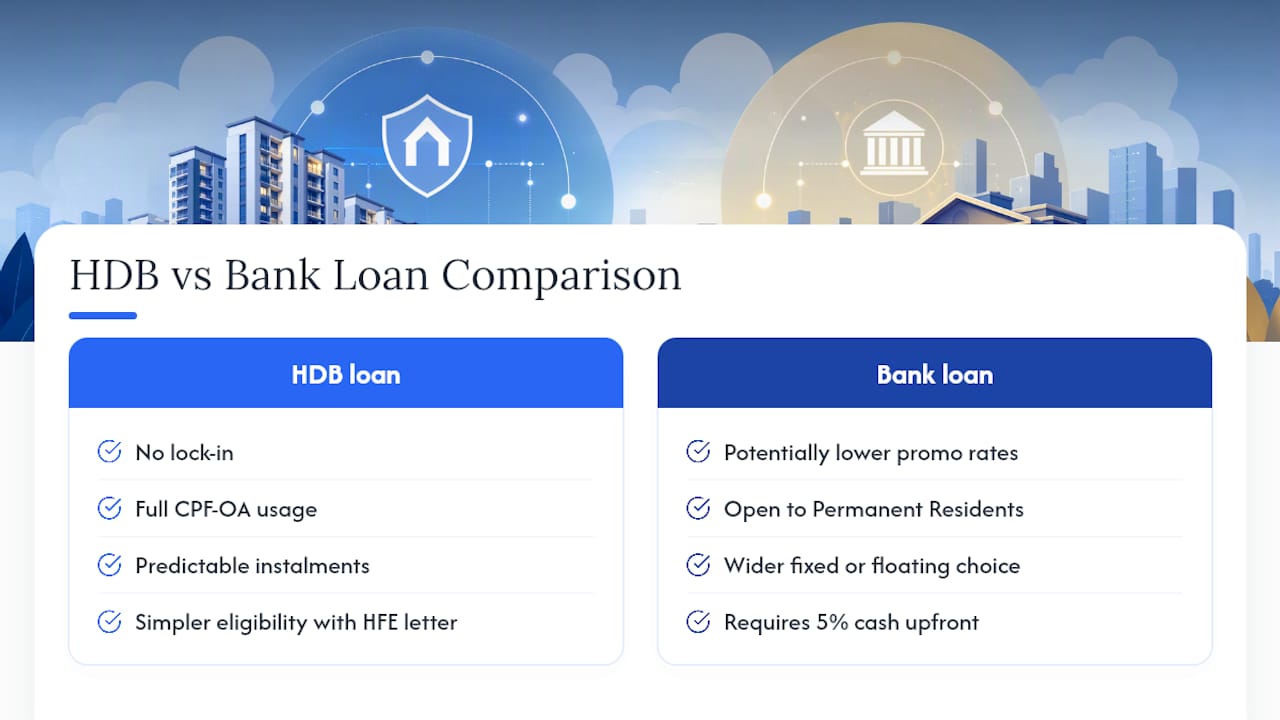
HDB loan pros: no lock-in, full CPF-OA usage, predictable instalments, simpler eligibility once you hold an HFE letter.
HDB loan cons: only open to citizens, subject to household income ceilings, generally a higher headline rate than the cheapest bank packages.
Bank loan pros: potentially lower rates during promotional periods, open to Permanent Residents, wider choice of fixed or floating structures.
Bank loan cons: requires 5% cash upfront, rates can rise with SORA, lock-in penalties apply if you exit early, and you cannot switch back to HDB once you have left.
How do HDB and bank interest rates actually work?
The HDB concessionary rate is mechanical, not market-driven. It tracks the CPF-OA rate plus 0.1 percentage point, which is why it has sat at 2.6% for a long stretch even as global rates swung sharply. Bank loans work differently: lenders price fixed packages for two to five years, or float against SORA plus a spread the bank sets based on its funding costs and risk appetite. MAS treats SORA as the reference benchmark for Singapore's floating-rate mortgage market, and it resets regularly rather than staying fixed like the CPF-OA peg.
Consider a $500,000 loan over 25 years. That gap looks attractive, but it depends entirely on the bank rate holding steady, which floating SORA packages rarely do for long.
- HDB rate: mechanical, tied to CPF-OA, changes rarely.
- Bank fixed rate: locked for 2 to 5 years, then reverts to a floating spread.
- Bank floating rate: moves with SORA, reviewed regularly by MAS.
Downpayment, CPF and cashflow: BTO vs resale
Both loan types require a 25% downpayment, but the source of that money differs sharply.
Resale buyers face an added risk: Cash Over Valuation, where the agreed price exceeds the flat's valuation and the gap must be paid entirely in cash, on top of any downpayment. BTO buyers pay their downpayment at key collection, years after booking, giving time to build CPF-OA balances. Resale buyers must have funds ready at the point of purchase.

Pro Tip: If you're eyeing a resale flat, keep a cash buffer of at least $10,000 to $20,000 set aside specifically for a possible COV gap, since this cannot be covered by CPF savings.
Eligibility, paperwork and timing: HFE, pre-approval and application windows
An HFE letter is now mandatory before applying for an HDB loan, and it confirms whether your household income falls within HDB's eligibility ceilings. Bank loans have no such income cap and remain open to Permanent Residents, but every application is checked against MSR and TDSR limits that cap how much of your income can service debt.
- Apply for your HFE letter first, before booking a flat or engaging a bank.
- Gather income documents, CPF statements and identity papers for either loan type.
- For resale purchases, secure a bank's Approval-in-Principle before committing to an Option to Purchase.
- BTO buyers should revisit their loan choice only closer to key collection, when actual disbursement is due.
What does it cost to refinance from HDB to a bank loan?
Switching is a one-way street. You can move from an HDB loan to a bank loan whenever you like, but once you leave the HDB loan scheme, you cannot return to it. That permanence is exactly why sequencing matters more than chasing the lowest headline rate.
Recent reporting on falling home loan rates shows some fixed and SORA-pegged packages have undercut the HDB rate, prompting a wave of refinancing enquiries, but the real saving only materialises after these switching costs are covered.
- Legal and valuation fees: typically some thousands of dollars combined.
- Subsidy clawback: applies if CPF grants were used on the flat.
- Lock-in penalty: often around 1.5% of the outstanding loan if you exit early.
Pro Tip: Work out your break-even point by dividing total switching costs by your monthly interest saving. If that break-even period is longer than the time left on your loan, refinancing is unlikely to be worth it.
A step-by-step checklist for choosing your loan
- Apply for your HFE letter to confirm HDB loan eligibility and income ceiling status.
- Use the CPF housing usage calculator to see how much CPF-OA can cover your downpayment.
- Take the HDB loan to secure your flat if cash is limited.
- Closer to key collection, compare bank fixed packages against the 2.6% HDB benchmark.
- Refinance only if a bank's fixed rate is meaningfully below 2.6% for a sustained period and switching costs are covered within a reasonable break-even window.
The pragmatic rule many first-time buyers adopt
Take the HDB loan first, then reassess a bank refinance nearer key collection. Rate certainty, unrestricted CPF-OA usage, and the one-way nature of switching all favour starting conservative and moving only once the maths clearly works in your favour.
How haio helps you run the numbers
It shifts every time SORA moves, so the real question isn't which loan is cheaper today, but which one you can verify is cheaper for your specific numbers, right now. Haio's personalised affordability check maps your income and CPF-OA balance against MSR and TDSR limits before you commit to either route.
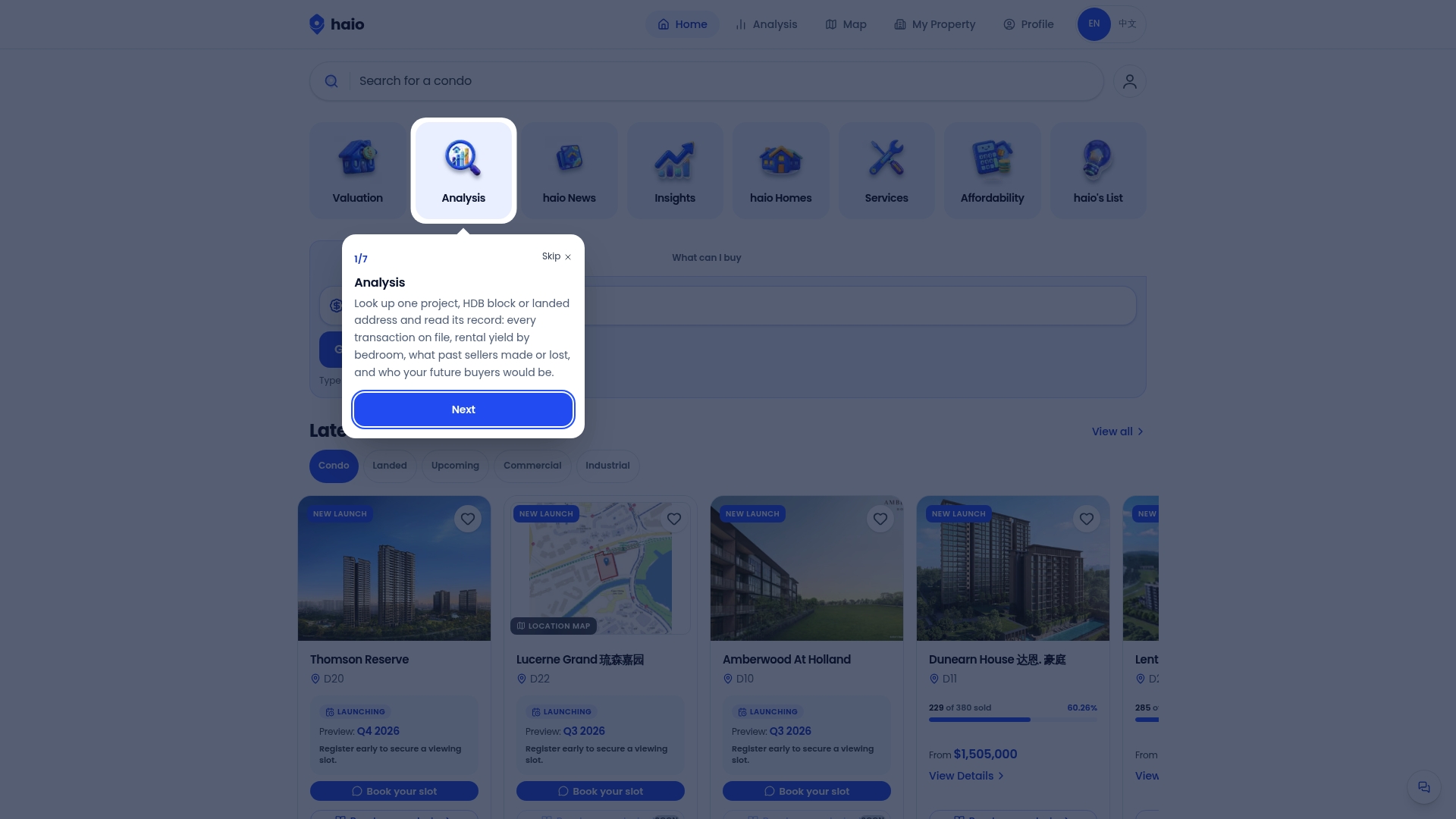
Haio's mortgage rate comparison tool tracks current bank fixed and SORA-pegged packages against the HDB benchmark, so you can spot when a refinance genuinely clears your break-even threshold rather than guessing from headlines. Market alerts flag rate movements as they happen, which matters given how often bank packages reprice. Run your own affordability and break-even check at haio before you decide, using figures specific to your household and flat, with guidance built around Singapore's HDB, CPF and MAS rules.
Frequently asked questions
Is an HDB loan better than a bank loan for first-time buyers? For most first-time buyers with limited cash, yes, because it allows full CPF-OA usage for the downpayment and carries no lock-in or early repayment penalty.
Can I switch from an HDB loan to a bank loan later? Yes, at any time, but the reverse is not possible once you leave the HDB loan scheme, so treat the decision as effectively permanent.
What income ceiling applies to HDB loans? HDB loans require an HFE letter, which confirms whether your household income falls within HDB's eligibility ceiling for concessionary financing.
Do bank loans require CPF-OA and cash both? Yes.
How do MSR and TDSR affect my loan quantum? MAS caps how much of your income can go towards mortgage repayments under MSR and TDSR rules, which limits the maximum loan a bank will offer regardless of the rate.
This article is general information, not a substitute for advice from a qualified financial advisor. Consult a qualified financial professional about your own circumstances before acting on anything here.