

Cost-conscious first-timers and long-term savers are usually better served by an HDB flat, given the access to CPF housing grants, lower downpayments and a Housing & Development Board (HDB) concessionary loan. Households with higher income, a preference for facilities, or a need for immediate rental flexibility tend to lean towards a condo, though upgraders should watch the Additional Buyer's Stamp Duty (ABSD) timing closely before committing.
TL;DR:
- First-time buyers should prioritize HDB flats due to lower upfront costs, CPF grants, and their eligibility for concessionary loans, especially if on a tight budget.
- Private condos require a minimum 25% downpayment, higher monthly costs, and potentially significant stamp duties, including ABSD if upgrading or second property ownership.
- Rental flexibility favors condos, which can be rented out immediately after purchase, whereas HDB flats have a five-year MOP before full rental rental is permitted.
- Long-term appreciation is more variable, with condos sometimes offering stronger gains in certain regions but facing lease decay, while HDBs tend to show steadier, lower-volatility growth.
- Using affordability tools and understanding timing, especially for ABSD, is crucial to avoid costly mistakes when upgrading or investing in Singapore's property market.
Table of Contents
- HDB vs condo: comparing the core numbers
- Costs and financing: downpayment, loans, CPF grants and stamp duties
- Lifestyle, amenities and rental rules
- Investment outlook: appreciation, lease decay and resale value
- How to decide: a step-by-step checklist
- Testing your own numbers with Haio's tools
- An editor's view on the HDB vs condo decision
- Model your own HDB vs condo numbers
- Sources
- FAQ
HDB vs condo: comparing the core numbers
The decision rarely hinges on taste alone. It hinges on what a buyer can afford upfront, what they can service monthly, and how much flexibility they need over the following decade.
An HDB resale flat financed through the HDB concessionary loan typically demands a lower downpayment, and eligible buyers can draw on CPF housing grants that reduce the effective purchase price. A private condo, by contrast, requires bank financing regulated by the Monetary Authority of Singapore (MAS), a larger minimum downpayment, and carries recurring costs that HDB owners simply don't face, such as management and maintenance fees.
| Factor | HDB resale flat | Private condo |
|---|---|---|
| Entry cost/downpayment | 10% via HDB loan (grants may offset further) | Minimum 25%, at least 5% in cash |
| Loan type & LTV | HDB concessionary loan, now aligned near 90% LTV | Bank loan, MAS-regulated, with minimum 25% downpayment |
| Monthly holding cost (est.) | Generally lower; no management fees, lower property tax | Generally higher; management fees plus higher property tax |
| Rental permission/timing | Full unit only after MOP (typically 5 years) | No MOP; rentable from purchase (subject to loan/CPF conditions) |
| Taxes & duties (BSD/ABSD) | BSD only for first property | BSD plus ABSD if a second property is retained |
| Tenure & lease implications | Mostly 99-year leases, lease decay applies | Freehold or 99-year leases available |
A few numbers stand out once you run them side by side. The gap between HDB and private financing can mean tens of thousands of dollars in upfront cash alone, before any grant is even factored in. Monthly holding costs on a condo, once maintenance fees and higher property tax are added, routinely run several thousand dollars above a comparable HDB flat. And the ABSD, when it applies, can add a fifth of a second property's price to the transaction, which changes the entire calculus for anyone thinking about upgrading rather than starting fresh.
Costs and financing: downpayment, loans, CPF grants and stamp duties
The financing structure is where HDB and condo ownership diverge most sharply, and it's worth understanding before comparing lifestyle factors, including how bridging finance options like a bridge loan in Las Vegas work for real estate purchases.
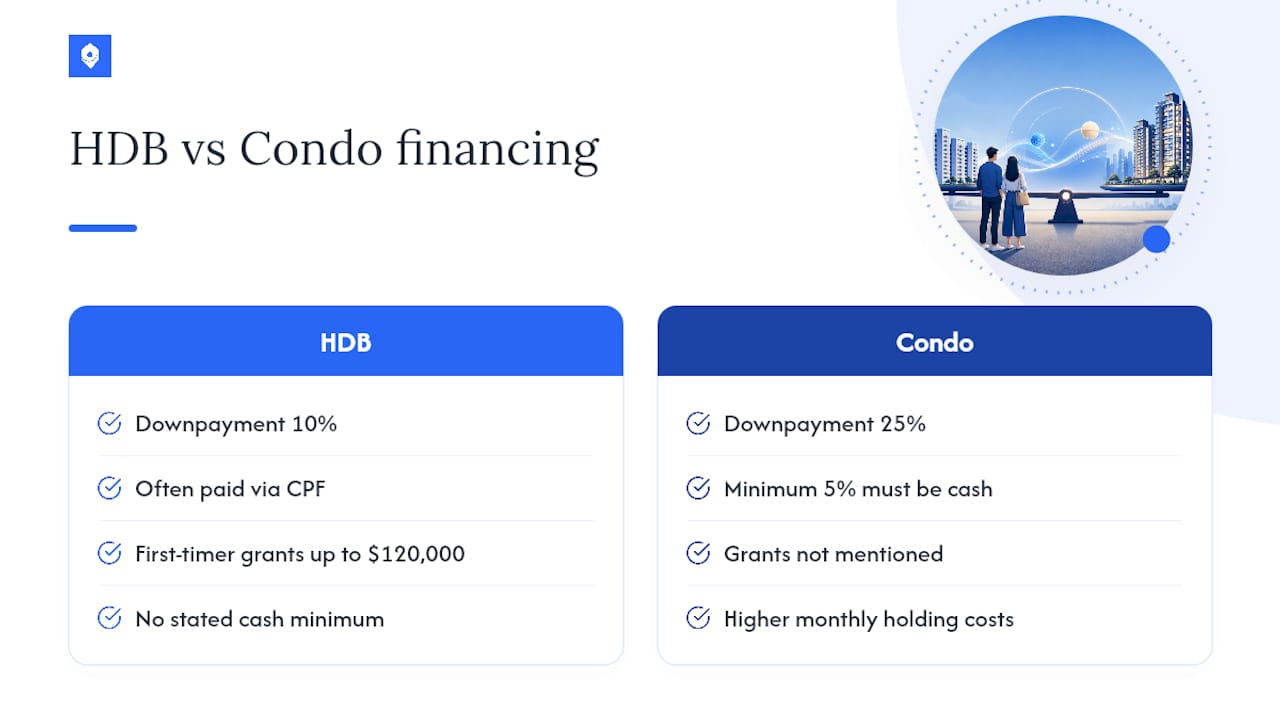
Buyers using an HDB concessionary loan generally need only a 10% downpayment, which can be paid fully through CPF savings in many cases. Eligible first-timer families can receive housing grants worth up to around $120,000 for new flats, with substantial grants also available for resale purchases. That grant money isn't a loan. It reduces the price you're actually financing.
Private condo buyers face a different structure entirely. The minimum downpayment sits at 25%, and at least 5% of that must be in cash rather than CPF.
Stamp duties add another layer. Buyer's Stamp Duty (BSD) applies to every purchase, but the Additional Buyer's Stamp Duty-for-residential-property) is where upgraders get caught out.
Pro Tip: If you're upgrading, selling your HDB flat before completing on a condo purchase, rather than after, usually avoids the ABSD altogether. Timing this correctly is often the single biggest lever in the whole transaction.
Consider a worked example. Monthly repayments and holding costs on the condo, once mortgage, maintenance fees and property tax are combined, routinely run several thousand dollars higher than the equivalent HDB repayment each month.
Lifestyle, amenities and rental rules
Money aside, the two housing types offer genuinely different day-to-day living, and this is where personal priorities start to override the spreadsheet.
Condos typically come with facilities that HDB estates don't: swimming pools, gyms, function rooms, sometimes tennis courts or barbecue pits. Those facilities aren't free. Monthly maintenance fees fund them, and fees climb with the size and age of the development, often landing well above what an HDB owner pays in service and conservancy charges.
Rental rules are where the two diverge most for landlords and tenants alike:
- HDB flats cannot be rented out in full until the Minimum Occupation Period (MOP), typically five years, has been served.
- Renting out individual bedrooms in an HDB flat while still living there is permitted earlier, subject to HDB approval and occupancy caps.
- Condos carry no MOP, so owners can rent from the day they complete the purchase, subject to any loan or CPF usage conditions.
- Tenant pools differ too: condos tend to attract a larger share of expat tenants drawn to facilities and central locations, while HDB tenants are more often local renters or budget-conscious expats.
Pro Tip: At a viewing, ask to see the last 12 months of maintenance fee statements for a condo, not just the current rate. Fees can jump sharply after a major facility upgrade or a lift replacement, and that history tells you more than the sales brochure ever will.
Investment outlook: appreciation, lease decay and resale value
Long-term value is where the HDB vs condo debate gets genuinely complicated, because raw appreciation numbers don't tell the whole story.
Decade-scale data from URA and HDB resale indices shows that Outside Central Region (OCR) condos and landed property have often posted stronger capital gains than Central Central Region (CCR) condos or HDB resale flats over many periods. But that headline figure needs adjusting for what it cost to get in: ABSD, higher stamp duty, and a much larger entry quantum all eat into the net return.
Lease tenure matters just as much as location. Both HDB flats and many condos in Singapore sit on 99-year leases, and lease decay becomes a real valuation drag once a property passes the halfway mark of its lease. A flat or condo with 60 years remaining commands a noticeably different price than an identical unit with 90 years left, and financing options narrow as the remaining lease shortens, since banks and HDB both cap loan tenures against the lease term.
| Segment | Typical decade-scale trend | Key adjustment needed |
|---|---|---|
| OCR condo | Stronger capital gains reported in many periods | Deduct ABSD and higher entry stamp duty for upgraders |
| CCR condo | More modest gains reported relative to OCR | Higher entry quantum limits net yield |
| HDB resale | Steadier, lower-volatility gains | Lease decay accelerates after the 50-year mark |
The most decisive variables in any of these outcomes are entry price, ABSD timing, and how long you actually intend to hold the property. Households planning a short holding period face more risk with private property, since acquisition costs take longer to recoup against price movement.
How to decide: a step-by-step checklist
Once the numbers are on the table, the decision usually comes down to a short sequence of checks rather than a gut feeling.
- Run an affordability check first. Know your maximum loan quantum under MSR (HDB) or TDSR (bank loan) before you fall in love with a listing.
- Confirm CPF grant eligibility. First-timer status, household income ceilings and flat type all affect how much grant money you can actually claim.
- Stress-test MSR/TDSR against a rate rise. Mortgage rates in 2026 sit within a range that can shift; model your repayment at a higher rate than today's quote.
- Plan ABSD timing if upgrading. Decide whether you're selling first or buying first, and get the sequence confirmed with your conveyancing lawyer.
- Keep an emergency reserve. Six months of mortgage and maintenance costs, held outside CPF, protects against income shocks.
Three scenarios cover most buyers. A first-time buyer on a tight budget should prioritise grant eligibility above all else; it can shift tens of thousands of dollars in effective price. An investor or landlord should prioritise MOP timing and tenant demand in the specific estate, since rental yield varies more by location than by property type alone.
Bring your latest payslips, CPF statements, and any outstanding loan details to a mortgage adviser before your first viewing. It saves a wasted afternoon chasing a unit you can't yet finance.
Testing your own numbers with Haio's tools
A checklist only gets you so far without your own figures plugged in, which is where a proper affordability tool earns its place.
An affordability check lets you enter your income, existing debt and target property type to see your realistic loan quantum under either MSR or TDSR, rather than relying on a generic rule of thumb. A valuation tool pulls recent transacted prices for both HDB resale flats and condos in the same estate, so you can sanity-check a listing price against genuine market data instead of an agent's asking figure. The mortgage rate comparison feature sits alongside these, letting you see current bank and HDB loan rates without hunting across multiple bank websites.
Running the worked example from earlier, a household comparing the S$650,000 HDB flat against the S$1.5 million condo, through an affordability check often clarifies which side of that gap actually fits comfortably within TDSR limits, before any offer is made.
- Personalised affordability checks against MSR/TDSR limits
- Property valuation using recent transacted data
- Mortgage rate comparison across lenders
- Scenario modelling for HDB vs condo trade-offs
An editor's view on the HDB vs condo decision
The conventional advice to "buy what you love" ignores how unforgiving ABSD and lease decay can be if the timing is wrong. Durable affordability should win by default unless household income comfortably clears the condo premium with room to spare, not just on paper today but under a higher rate scenario.
Sequencing into a condo makes sense when ABSD timing is aligned and the household has genuinely tested the numbers, not just the glossy showflat. Run the checklist above before signing anything, and treat the numbers as the deciding vote, not the view from the balcony.
— HAIO
Model your own HDB vs condo numbers
Every figure in this article is a starting point, not your personal answer. Haio's affordability check, property valuation tool and mortgage rate comparison let you plug in your own income, savings and target estate to see exactly where you land against MSR, TDSR and current grant eligibility. Instead of guessing whether an HDB resale flat or a condo fits your budget, you get a figure grounded in real transacted data and live lending rates. Head to Haio to run your own affordability check and compare listings before you commit to a viewing.
Sources
- Gov
- Condo vs HDB Singapore 2026: Complete Decision Guide | LovelyHomes
- HDB vs Condo in Singapore: The Full Financial Comparison — Karui Blog
FAQ
Is it better to buy an HDB flat or a condo?
For most first-time buyers, an HDB flat is the more affordable route thanks to CPF grants and a lower downpayment, while a condo suits households with higher income who want facilities or immediate rental flexibility.
Is it better to own a house or a condo in Singapore?
Landed property tends to show stronger long-term appreciation than condos in many periods, but it carries a much higher entry price and isn't accessible to most buyers without significant capital.
What happens after 50 years in a leasehold condo or HDB flat?
Once a 99-year lease passes the halfway mark, valuations tend to soften as remaining lease years shrink, and both bank and HDB financing options narrow because loan tenures are capped against the lease term.