

An in-principle approval (IPA) is a bank's non-binding assessment of how much you can borrow to buy a property in Singapore. It confirms your borrowing capacity against Monetary Authority of Singapore (MAS) rules before you commit to anything, and it speeds up the paperwork once you find a flat or a house you want to buy.
Get one before you start viewing units, and certainly before you sign an Option to Purchase (OTP). An IPA is not a loan offer. It is an indicative figure, and the final number can still shift once a bank runs full underwriting.
- Confirms roughly how much you can borrow under MAS lending rules
- Non-binding, so it carries no obligation on either side
- Speeds up the Letter of Offer stage once you have a property in mind
- Best obtained before house-hunting, not after you have already made an offer
Key takeaways
Getting an in-principle approval before house-hunting, and reconciling it against MAS lending limits and real market data, is what separates a smooth purchase from a stalled one.
| Point | Details |
|---|---|
| Apply before you commit | Request an IPA before viewing flats or signing an OTP, not after. |
| Know your MAS limits | TDSR caps debt at 55%, MSR caps HDB/EC mortgages at 30% of income. |
| Use the right channel | HDB buyers can apply via the Flat Portal's integrated loan service across six financial institutions. |
| Mind the validity window | IPAs typically last 30 to 90 days before requiring re-assessment. |
| Turn IPA into a shortlist | Use Haio's affordability check and rate feeds to match your IPA figure against real properties. |
Table of Contents
- How to apply for in-principle approval in Singapore
- What MAS rules determine your IPA figure?
- Step-by-step: applying for your IPA
- Converting an IPA into a Letter of Offer
- Why IPA applications get rejected, and how to fix it
- What to do the moment you receive an IPA
- How Haio helps you act on your IPA
- Why the IPA step gets rushed, and shouldn't
- Sources
How to apply for in-principle approval in Singapore
Banks and other participating financial institutions issue IPAs directly, and most homebuyers apply either through a bank's own channel or, for HDB purchases, through the HDB Flat Portal. Buyers applying for a Housing Development Board (HDB) flat can use the integrated loan application service to request an IPA from a participating financial institution at the same time as applying for an HDB Flat Eligibility (HFE) letter. That single flow saves a separate trip to each bank.
The financial institutions listed on the HDB's housing loan page are:
- DBS Bank Limited
- Hong Leong Finance Limited
- Maybank Singapore Limited
- Overseas-Chinese Banking Corporation Limited (OCBC)
- Sing Investments & Finance Limited
- United Overseas Bank Limited (UOB)
Once your flat purchase is confirmed, you convert the IPA into a Letter of Offer (LO), either through the HDB Flat Portal for HDB purchases or directly with the issuing financial institution for private property. MoneySense advises requesting an IPA before applying for an HFE letter, so you already have an indicative loan figure in hand when you start deciding on a flat.
What MAS rules determine your IPA figure?
Three MAS frameworks drive the number a bank hands back, and understanding them lets you influence your own outcome rather than just receiving it.
The Total Debt Servicing Ratio (TDSR) caps total monthly debt repayments, including the new mortgage, at 55% of gross monthly income. Existing car loans, credit card balances, or personal loans all eat into that ceiling before the bank even looks at your new mortgage.
The Total Debt Servicing Ratio (TDSR) means a household can only service a maximum portion of their gross monthly income across all debts combined, not just the new home loan.
The Mortgage Servicing Ratio (MSR) applies specifically to HDB flats and executive condominiums (ECs), capping mortgage repayments at 30% of gross monthly income. For most HDB and EC buyers, MSR is the tighter constraint and usually determines affordability before TDSR even comes into play.
Loan-to-Value (LTV) limits set the maximum loan quantum relative to the property's price or valuation, which in turn dictates how much cash and CPF you need upfront. MAS lending rules also shape how banks treat your income sources:
- CPF Ordinary Account (OA) balances count toward funding, not income capacity
- Self-employed applicants typically face an income haircut, often assessed on a multi-year average
- Commission and bonus income gets averaged over recent years rather than taken at face value
- Rental income is usually counted at a discounted percentage, not the full declared amount
Step-by-step: applying for your IPA
-
Choose your application route. Apply directly to a bank, use the HDB Flat Portal's integrated loan service if you are buying an HDB flat, or work with a mortgage adviser who can submit to several financial institutions at once.
-
Gather your documents. Most financial institutions ask for a consistent set: your NRIC, latest payslips, Notice of Assessment (NOA) from IRAS, CPF contribution history, recent bank statements, existing loan statements, and, if you are declaring rental income, tenancy agreements or commission records. Preparing this full set upfront is the single biggest lever you have over how quickly your IPA comes through.
-
Submit and wait for assessment. The bank runs your figures against TDSR, MSR (where applicable) and LTV limits, then returns an indicative loan amount, tenure and rate.
-
Note the validity window. IPAs typically remain valid for between 30 and 90 days, depending on the issuing institution. If your property search runs longer than that, expect to submit updated documents for a re-assessment, especially if your income or existing liabilities have changed.
-
Keep it live if your search drags on. A lapsed IPA is not a disaster, but it does mean repeating parts of the process just as you're ready to make an offer, which is the worst time to discover a shortfall.
Converting an IPA into a Letter of Offer
Validity windows exist because financial circumstances and property valuations shift. A bank that issued your IPA in January won't stand by it uncritically in July if your credit profile or the property market has moved.
Once you have a specific flat, converting the IPA into a binding LO happens either through the HDB Flat Portal's e-services (for HDB purchases already routed through the integrated loan service) or directly with the financial institution that issued your IPA. For resale flats, HDB requires a valid LO before you can exercise the OTP, so this conversion step cannot be skipped or left until after you've committed.
Three things can still change your final loan at this stage:
- Valuation. If the bank's valuation comes in below the agreed price, your loan quantum shrinks accordingly.
- Updated income or credit events. A new loan taken out, a missed payment, or a job change between IPA and LO can alter the outcome.
- Property characteristics. Remaining lease length on older HDB flats or leasehold private property can affect both LTV and CPF usage rules.
Why IPA applications get rejected, and how to fix it
Rejections and reduced offers usually trace back to the same handful of causes, all of which are fixable if caught early.
TDSR or MSR breaches are the most common issue.
Adverse credit information shows up more often than buyers expect, sometimes from an error rather than an actual missed payment. Pull your credit report and dispute inaccuracies before applying, not after a rejection.
Incomplete documentation causes delays that feel like rejections but are really just administrative gaps. Short remaining lease on the property, or a valuation that falls short of the agreed price, can also cap what a bank is willing to lend.
- Reduce outstanding liabilities before applying, particularly revolving credit
- Check your credit report for errors and dispute them early
- Document variable income (commission, bonus, rental) with clear, consistent records
- Apply to more than one financial institution to compare outcomes
- Submit a genuinely complete document set the first time
Pro Tip: If your income mixes salary with commission or rental earnings, prepare a simple one-page summary showing how each component averages over the past two years. It often resolves underwriting questions before they're even raised.
If your situation involves multiple income sources, prior credit issues, or you simply want a second read on your numbers, a mortgage adviser can apply across several financial institutions and interpret conditions that raw IPA letters rarely explain in plain terms.
What to do the moment you receive an IPA
-
Check the figure, the validity date and the issuing institution. Note any conditions attached, since some IPAs come with caveats tied to specific income documentation or property types.
-
If buying HDB, request conversion to LO once your flat purchase is confirmed, through the same portal you used for the IPA.
-
Accept only one LO when you're ready to proceed. Holding multiple live offers creates confusion and, in some cases, unnecessary administrative friction with the financial institutions involved.
-
Reconcile the IPA figure against your CPF OA balance and work out whether you need additional cash for the downpayment before you commit to an OTP.
How Haio helps you act on your IPA
An IPA gives you a number. What it doesn't give you is context: whether that number matches what similar properties are actually selling for, or whether current mortgage rates make one financial institution's offer meaningfully better than another's.

Haio's personalised affordability check puts your IPA figure alongside live property valuations and up-to-date mortgage rate feeds, so you can see straightaway whether your borrowing capacity matches the flats or units you're actually considering. The platform also flags potential financing bottlenecks, such as a TDSR ratio sitting close to its limit, and tracks your IPA validity window so you're not caught applying for a re-assessment at the worst possible moment, mid-negotiation.
For buyers weighing several properties against one IPA figure, that combination of affordability data, market insight and rate comparison turns a static bank letter into a working shortlist. Try an affordability check at Haio before you make your next move on a property.
Why the IPA step gets rushed, and shouldn't
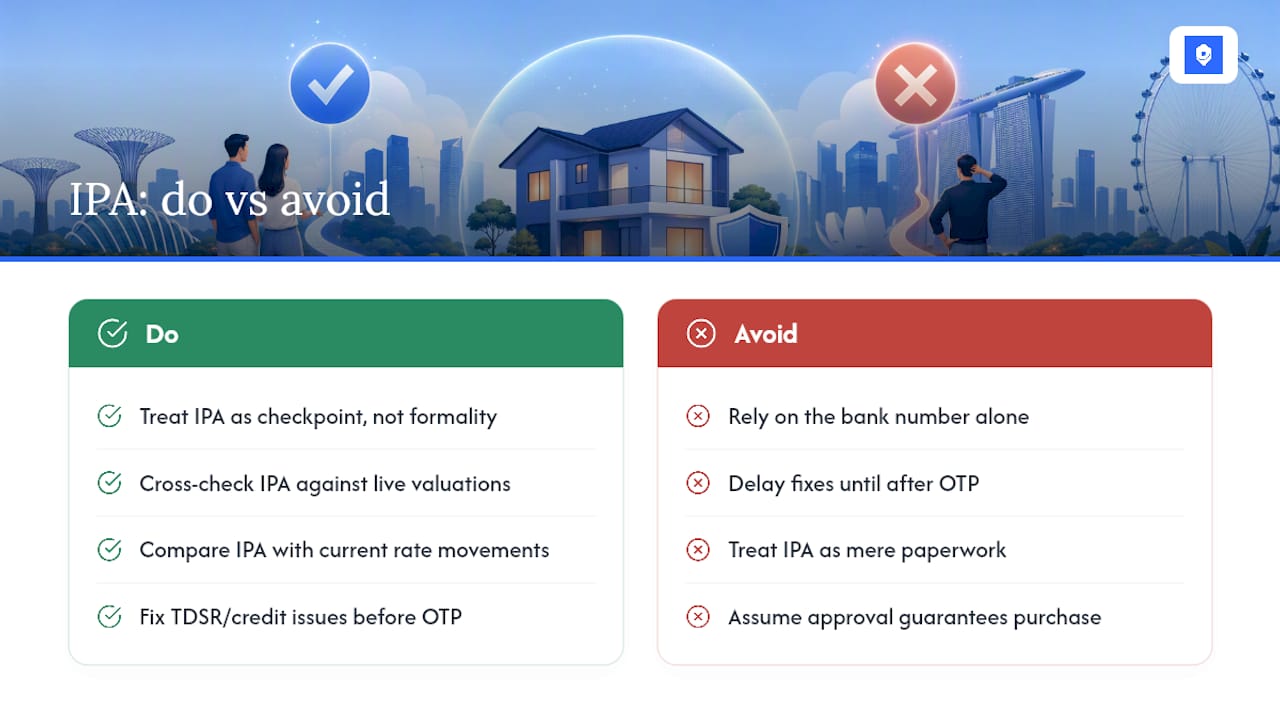
Homebuyers in Singapore tend to treat the IPA as a formality, something to tick off before the "real" work of house-hunting begins. That gets the sequence backwards. The IPA is where financing problems surface cheaply. Fixing a TDSR breach or a credit report error before you've signed an OTP costs you time. Fixing it after costs you the OTP fee and, often, the property.
Haio's view, built from watching how affordability data intersects with real transactions, is that the IPA stage deserves more scrutiny than most buyers give it, not less. A number from a bank is not the same as a number that fits your actual shortlist. Cross-checking that figure against live valuations and rate movements before you commit is what turns an IPA from a piece of paper into a genuinely useful planning tool.
— HAIO