
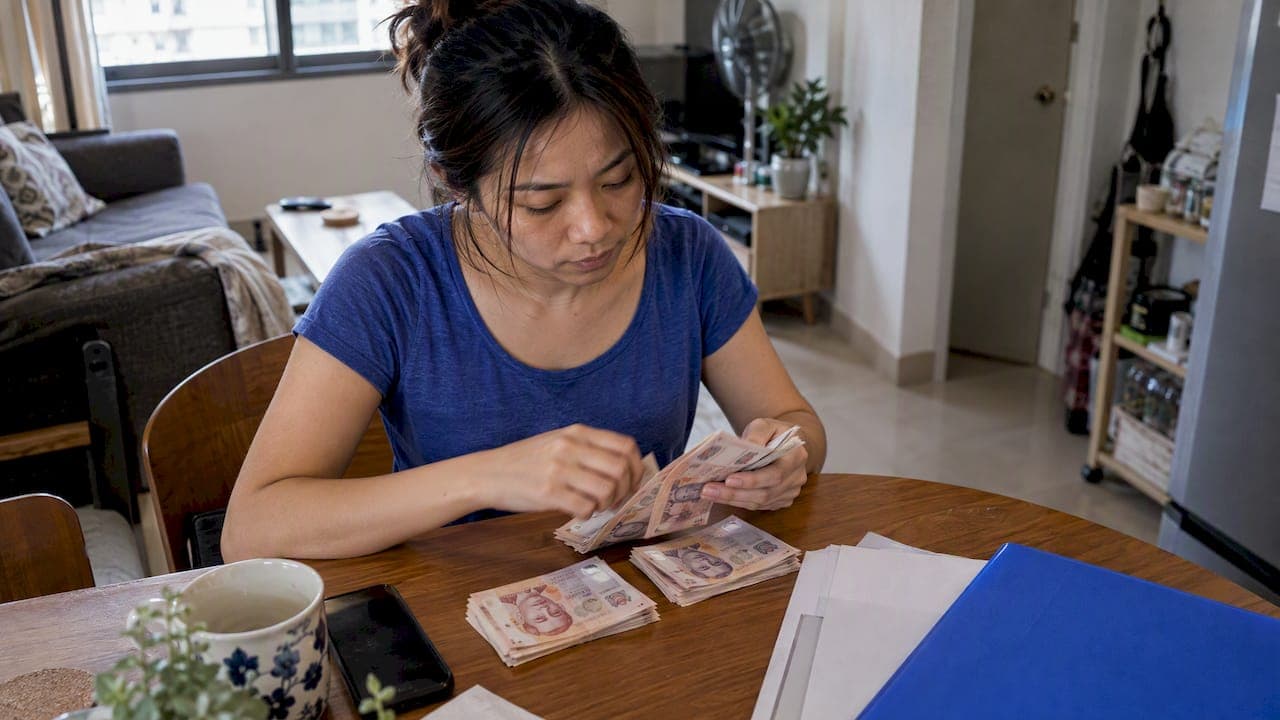
The standard LTV limit for most housing loans in Singapore is 75%, though HDB tightened this from 80% in August 2024. Loan tenure, your age at the end of the loan and any outstanding housing loans can push that percentage lower, and even where LTV allows a larger loan, MSR and TDSR limits may cap what you can actually borrow each month.
TL;DR:
- At a 75% LTV, buyers need at least 5% in cash and may use cash or CPF for the remaining down payment.
- A loan extending past age 65, or exceeding 30 years for private property or 25 years for an HDB flat, lowers LTV to 55%.
- One outstanding housing loan cuts the limit to 45%, while two or more reduce it to 35%; tenure or age triggers lower those ceilings further.
- Lenders calculate LTV using the lower of purchase price or valuation, and buyers must pay any amount above valuation entirely in cash.
- For bank loans, TDSR caps total monthly debt at 55% of gross income, so existing car, credit card, and personal loan payments reduce mortgage capacity.
Table of Contents
- Quick facts: current LTV, minimum cash downpayment and who is affected
- HDB vs bank loans: how each lender treats LTV and what that means for you
- How loan tenure, borrower age and existing housing loans lower your effective LTV
- Calculating your downpayment: cash, CPF OA and valuation shortfalls
- MSR and TDSR explained: why monthly limits often determine your borrowable amount more than LTV
- Who loses and who needs to plan differently: first‑timers, upgraders and investors
- A step‑by‑step checklist to prepare for mortgage application under current LTV rules
- How our tools help you model LTV, affordability and downpayment scenarios
- What the LTV tightening signals for buyers and the market
- Plan your next move with haio
- FAQ
- Sources
Quick facts: current LTV, minimum cash downpayment and who is affected
The remaining 25% is split between cash and CPF Ordinary Account savings, with a minimum cash component required before CPF can cover the rest.

HDB tightened its maximum LTV from 80% to 75% for complete resale applications received on or after 20 August 2024, with the change extending to certain new flat applications from October 2024. Buyers who submitted applications before that date generally remained under the previous rules, so the exact date your application was logged matters more than the date you started viewing flats.
The practical cash implications break down as follows:
- At 75% LTV, you need at least 5% of the purchase price or valuation in cash, with the remaining 20% payable in cash or CPF.
- At 55% LTV (where the lower limit applies due to tenure or age), the minimum cash requirement rises to 10%, with CPF covering the balance up to the lower valuation.
- If your purchase price exceeds the valuation, that gap must be paid entirely in cash, regardless of your LTV band.
- First-time buyers using HDB loans still face the 75% ceiling, but enhanced grants can offset part of the cash burden.
Everyone buying residential property in Singapore today, whether through an HDB loan or a bank loan, HDB or private, first home or second, is affected by these limits in some form. The scale of the effect, however, depends heavily on your personal circumstances, which the following sections unpack.
HDB vs bank loans: how each lender treats LTV and what that means for you
Both HDB loans and bank loans apply LTV against the lower of the purchase price or the property's valuation, never the higher figure. This matters because a buyer who agrees to pay above valuation, which happens often in a competitive resale market, must cover that difference entirely in cash, on top of the usual downpayment. A flat valued at $520,000 but purchased for $550,000 leaves a $30,000 cash gap that no LTV calculation will close.
Beyond that shared principle, the two loan types diverge in ways that shape your choice:
- HDB loans carry an income ceiling, require a completed HDB Flat Eligibility letter, and come with a customised financial plan that factors in your CPF usage and grant entitlements.
- HDB loan tenure is capped according to the flat's remaining lease and your age, which indirectly affects the LTV band you qualify for.
- Bank loans follow the same MAS rules on tenure and LTV, but individual lenders may impose their own restrictions on flats with short remaining leases, sometimes declining to lend at all if the lease will not outlast the borrower to a set age.
- HDB loans do not use TDSR, relying instead on MSR and HDB's own affordability assessment, while bank loans for private property are subject to both MSR (where applicable) and TDSR.
HDB's guidance on financing a flat purchase notes that a shorter remaining lease can pro-rate the LTV downward, which matters most for older resale flats. Choosing between an HDB loan and a bank loan often comes down to interest rate flexibility versus the structure and predictability HDB provides, and the right answer depends on your income profile and how long you intend to hold the flat.
How loan tenure, borrower age and existing housing loans lower your effective LTV
The 75% baseline only applies when your loan tenure and age fall within set thresholds. Step outside them and MAS rules reduce the allowable LTV to 55%, doubling your minimum cash requirement in the process.
- The lower LTV of 55% applies when your loan tenure exceeds 30 years for private property, or 25 years for an HDB flat, or when the loan period extends beyond age 65.
- For borrowers with no outstanding housing loans, the LTV limit is 75%, dropping to 55% if the tenure or age condition above is triggered.
- For borrowers with one outstanding housing loan, the LTV limit falls to 45%, or 25% where the tenure or age condition applies.
- For borrowers with two or more outstanding housing loans, the LTV limit drops further to 35%, or 15% under the tenure or age condition.
Consider a borrower aged 40 taking a 30-year loan on a $1,000,000 condominium with no existing housing loan. Tenure sits exactly at the 30-year threshold and the loan ends at age 70, past the age 65 marker, so the 55% LTV band applies rather than 75%. That caps borrowing at $550,000 instead of $750,000, pushing the minimum cash and CPF contribution up by $200,000.
Calculating your downpayment: cash, CPF OA and valuation shortfalls
Once you know your LTV band, the downpayment maths follows a fixed structure.
Two worked scenarios illustrate how this plays out:
- An HDB resale flat valued at $500,000 and purchased at the same price, financed at 75% LTV, needs $25,000 in cash upfront, with CPF OA able to fund the remaining $100,000 portion outside the loan.
- A private condominium valued at $1,200,000 but purchased at $1,250,000 faces a $50,000 valuation shortfall payable entirely in cash, on top of the standard 5% minimum cash payment calculated against the $1,200,000 valuation.
MAS and HDB guidance both confirm that LTV is always calculated against the lower of price or valuation, never the contract price alone. Banks sometimes apply slightly different rules on how much CPF can be used relative to cash, particularly for older properties or shorter remaining leases, so it pays to confirm the exact split with your lender or HDB before signing an Option to Purchase. Running a valuation check against recent transactions in the same development beforehand reduces the risk of an unexpected cash gap at the point of sale.
MSR and TDSR explained: why monthly limits often determine your borrowable amount more than LTV
LTV sets a ceiling on how much of a property's value can be financed, but it says nothing about whether your income can service that loan. That is where MSR and TDSR come in, and for many borrowers, these monthly ratios bite before LTV ever does.
Total Debt Servicing Ratio (TDSR), set out by MAS, applies more broadly and caps all debt obligations, mortgage plus car loans, credit cards and other commitments, at 55% of gross monthly income.
- Calculate gross monthly income, including any allowable variable income at a discounted rate, as lenders typically apply haircuts to bonuses and rental income.
- Add up existing monthly debt obligations: car loans, personal loans, credit card minimums and any other property loans.
- Apply the TDSR ceiling of 55% to find the maximum total monthly debt your income supports, then subtract existing debts to find headroom for a new mortgage.
- Stress-test the mortgage instalment using a conservative modelling interest rate, as MoneySense recommends, rather than today's promotional rate, since rates can rise over a 25 to 30 year tenure.
Our guide to MSR and TDSR walks through two full worked examples if you want to see the calculation applied to specific income levels.
Pro Tip: Run your numbers through the haio affordability checker before house hunting, since it models LTV, MSR and TDSR together rather than one ratio at a time.
Who loses and who needs to plan differently: first‑timers, upgraders and investors
The same LTV rules land very differently depending on where you sit in the property cycle; for those considering relocation, our complete guide to moving to Singapore from the US provides valuable tax and relocation context.

First-time buyers taking an HDB loan still face the 75% ceiling introduced in August 2024, which means a slightly larger minimum cash outlay than under the previous 80% limit. Enhanced housing grants can offset part of this gap for eligible applicants, but the cash buffer needed at exercise of the Option to Purchase has still increased for most resale buyers.
Upgraders and existing owners carrying one or more housing loans face a steeper climb:
- With one outstanding housing loan, your LTV limit drops to 45%, or 25% if tenure or age thresholds apply, which usually means selling or fully discharging the existing loan before the new LTV band improves.
- Check your outstanding loan balance and discharge timeline before committing to a new purchase, since the sequence of sale and purchase affects which LTV band applies at the point of application.
Investors and second-property buyers face the most restrictive combination of rules, since lower LTV bands stack with Additional Buyer's Stamp Duty obligations that do not apply to first properties.
- A first-time HDB buyer purchasing a $450,000 flat at 75% LTV needs roughly $22,500 in cash, before accounting for any grant offsets.
- An upgrader with one existing loan buying a $900,000 condominium at 45% LTV needs $90,000 in cash as the minimum cash payment, nearly double the proportion required at 75%.
- An investor buying a $1,000,000 second property at 45% LTV, plus ABSD, faces a combined cash and CPF outlay well above what a first-time buyer would need for a similarly priced home.
A step‑by‑step checklist to prepare for mortgage application under current LTV rules
Working through LTV, MSR and TDSR in the right order avoids most of the surprises that derail a purchase late in the process.
- Run an affordability check first, using your actual gross income and existing debts, to establish a realistic loan ceiling before you start viewing properties.
- Get a valuation estimate for any specific unit you are considering, since LTV is calculated against the lower of price or valuation, not your offer price.
- Prepare your CPF Ordinary Account statement and confirm your available cash, then map both against the minimum cash payment for your expected LTV band.
- Seek pre-approval from a bank, or request a customised financial plan from HDB, to confirm your tenure, age and existing loan status before signing an Option to Purchase.
- Confirm with your lender or HDB exactly which LTV band and minimum cash percentage applies to your specific tenure and age combination, since these figures determine your final cash requirement.
Ask your lender directly about remaining lease restrictions if you are considering an older resale flat, and ask HDB about the customised financial plan timeline if you are applying for an HDB loan, since processing can take longer than a bank's in-principle approval.
Pro Tip: Lock in a valuation estimate before you make an offer. Checking recent transactions in the same block or development gives you a realistic valuation band and reduces the risk of a late cash shortfall.
How our tools help you model LTV, affordability and downpayment scenarios
Translating LTV rules into a cash plan is easier with the right data in front of you, which is why we built our affordability and valuation tools around exactly these calculations.
- Our haio+ subscription adds deeper market analysis and mortgage rate tracking for readers modelling multiple scenarios before committing to a purchase.
A typical journey looks like running the affordability check first, adjusting tenure until the LTV band improves, then checking valuation data on the specific unit to confirm the minimum cash figure before approaching a lender.
What the LTV tightening signals for buyers and the market
It is a blunt instrument aimed at household balance sheets rather than listing prices, and it works precisely because it forces more cash upfront rather than restricting who can buy.
Our view is that the most useful response to a tightening like this is not to chase the old limit but to plan around whichever band genuinely applies to your tenure, age and loan history. Model the scenario honestly, verify the figures with MAS or HDB directly, and treat the extra cash requirement as a planning input rather than an obstacle to work around.
— HAIO
Plan your next move with haio
Working out your actual LTV band, minimum cash and monthly headroom is far easier with live data than with a spreadsheet and a set of assumptions. Our affordability checker models LTV, MSR and TDSR together against your real income and debts, and our haio+ subscription, from $49 a month or $499 a year, adds deeper valuation and market analysis for readers comparing several properties at once. Start with a free affordability check on Haio and see exactly what your current LTV band allows.
This article is general information, not a substitute for advice from a qualified financial advisor. Consult a qualified financial professional about your own circumstances before acting on anything here.
FAQ
What does LTV stand for?
LTV stands for loan-to-value ratio, which is the percentage of a property's purchase price or valuation, whichever is lower, that a bank or HDB can lend you. The remainder must be covered by cash, CPF savings, or a combination of both, depending on your applicable LTV band.
What is the maximum loan amount for a private property in Singapore?
For most borrowers with no outstanding housing loans and a tenure within standard limits, the maximum LTV is 75% of the purchase price or valuation, whichever is lower.
How much can I borrow on a second mortgage?
If you already have one outstanding housing loan, the LTV limit for a new property drops to 45%, or 25% if your tenure exceeds 30 years or the loan extends past age 65.
Is there a minimum amount for a home loan?
There is no fixed minimum loan amount stated in MAS or HDB rules, but every loan is subject to the minimum cash payment rules tied to your LTV band.
Sources
- Measures to cool the HDB resale market and provide more support for first‑time home buyers (HDB)
- Loan tenure and loan‑to‑value limits (MAS)
- Buying a property: How much can you afford? (MoneySense)