

MSR caps property loan repayments at 30% of gross monthly income and applies only to HDB flats and executive condominiums bought with a bank loan. TDSR caps all debt repayments, including the mortgage, at 55% of gross monthly income and applies across HDB, EC and private property. For most HDB and EC buyers, MSR often limits borrowing first because of its stricter ceiling; for private property buyers or those with significant other debts, TDSR usually becomes the binding constraint. The Monetary Authority of Singapore (MAS) sets and enforces both.
TL;DR:
- For HDB and EC buyers with no other debts, MSR typically limits mortgage borrowing before TDSR due to its lower 30% cap.
- Private property buyers with existing debts are mainly constrained by TDSR, which caps total obligations at 55% of gross monthly income, regardless of MSR.
- Both MSR and TDSR are stress-tested at higher-than-promotional interest rates, often resulting in lower loan eligibility than advertised.
- Using longer loan tenures, paying down high-cost debts, or applying with a co-borrower can significantly increase borrowing capacity.
- Most buyers should run multiple scenarios considering variable income and stress-test rates to accurately gauge their real loan limits before viewing properties.
Table of Contents
- What is MSR (mortgage servicing ratio) in Singapore?
- What is TDSR (total debt servicing ratio) in Singapore?
- How are MSR and TDSR calculated? Two worked examples
- When does each rule apply, and how do they interact?
- How banks stress-test income and interest rates
- How can Singapore buyers improve their loan eligibility?
- HAIO's perspective: reading MSR and TDSR correctly before you commit
- Check your borrowing power before you view a single flat
- Sources
- FAQ
What is MSR (mortgage servicing ratio) in Singapore?
MSR measures how much of your income goes toward property loan repayments alone.
The rule applies specifically to HDB flats and executive condominiums financed through a bank loan, not an HDB concessionary loan. It covers every property loan you hold, not just the one you are applying for, and it reaches further than most buyers expect.
- If you are a guarantor on someone else's property loan, at least 20% of that loan's monthly obligation counts toward your own MSR calculation.
- MSR covers only property loan repayments and does not consider other debts like car loans, credit cards, or personal loans.
- Because the ceiling sits at 30%, MSR often shrinks your eligible loan quantum well before TDSR's 55% limit comes into play.
This is why an HDB buyer with modest income and no other debt can still find their loan amount capped. MSR does the limiting, not affordability in the everyday sense.
What is TDSR (total debt servicing ratio) in Singapore?
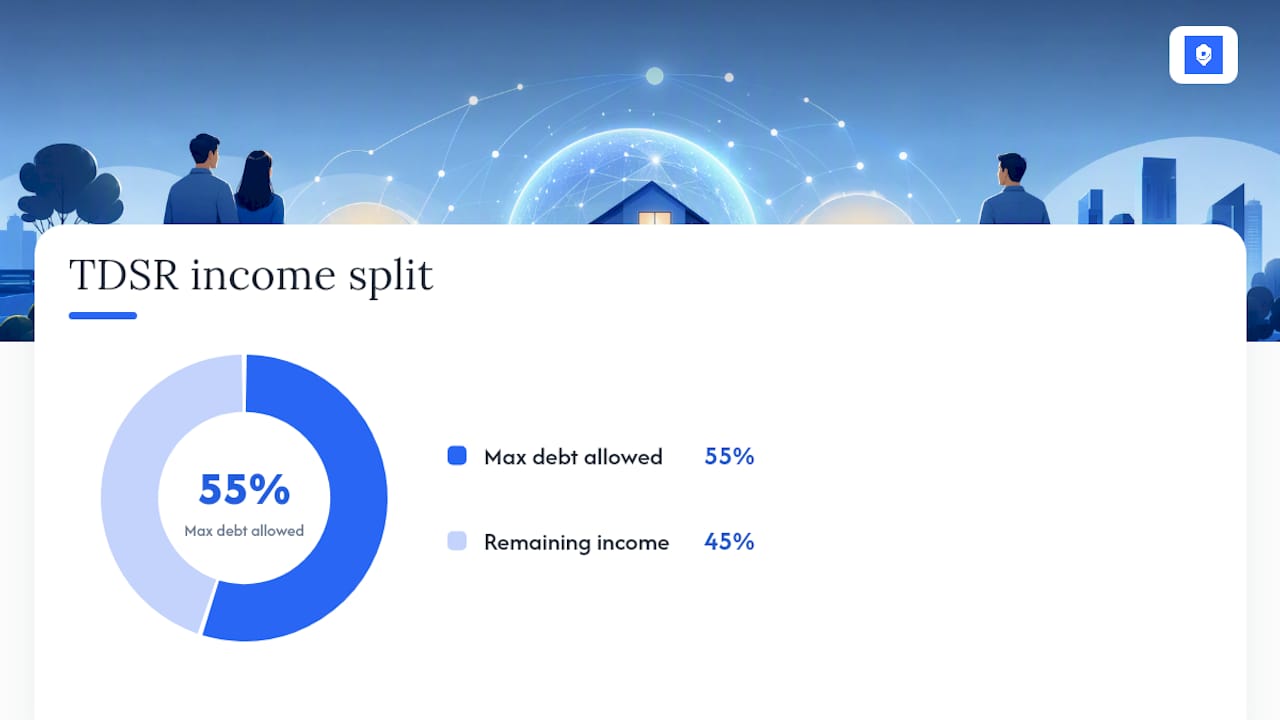
TDSR is the wider net. It caps total monthly debt obligations, mortgage included, at 55% of gross monthly income, and it applies across HDB, EC, and private property purchases alike.
The TDSR formula is: total monthly debt obligations divided by gross monthly income, multiplied by 100%, capped at 55%. What counts as a "debt obligation" is broader than many buyers assume:
- Housing loan instalments, including the one under application.
- Car loans and their monthly instalments.
- Personal loans and renovation loans.
- Minimum monthly payments on credit cards, even if you clear the balance in full each month.
Gross monthly income for this calculation excludes employer CPF contributions. Variable income, such as commissions or bonuses, gets a haircut before it counts. TDSR applies to new property loans and to most refinancing, though owner-occupiers refinancing under certain conditions may qualify for specific concessions.
How are MSR and TDSR calculated? Two worked examples
Numbers make the difference between MSR and TDSR obvious. Here are two scenarios that show which rule actually limits the loan.
- HDB buyer, no other debt. A couple earns a combined gross monthly income of $8,000 and has no car loan or personal loan. Their MSR ceiling is $2,400 a month (30% of $8,000). Their TDSR ceiling is $4,400 a month (55% of $8,000). Since MSR is the smaller number, it binds first, capping their monthly instalment at $2,400 regardless of what TDSR would technically allow.
- Private property buyer with existing debt. A single buyer earns $10,000 a month but pays $1,200 on a car loan and $300 in minimum credit card payments, totalling $1,500 in non-housing debt. TDSR allows total obligations up to $5,500 (55% of $10,000). Subtract the $1,500 already committed, and only $4,000 remains for the mortgage instalment. Because this buyer is purchasing private property, MSR does not apply, so TDSR alone decides the ceiling.
Variable income complicates both examples. If either buyer's income includes commission or bonus pay, only a portion of that income counts toward gross monthly income, commonly around 70%, which tightens the ceiling further before you even reach the interest-rate assumptions banks apply.
When does each rule apply, and how do they interact?
Whether you face MSR, TDSR, or both depends on the property type and loan structure you choose.
- HDB flats bought with an HDB concessionary loan are not subject to MSR or TDSR; a separate income and debt framework applies through HDB itself.
- HDB flats and ECs bought with a bank loan face both MSR (30%) and TDSR (55%) simultaneously, and the lower resulting loan quantum wins.
- Private property purchases, resale or new, are subject to TDSR only. MSR simply does not feature.
- Refinancing generally triggers a fresh TDSR check, though owner-occupiers refinancing existing loans may be exempted under specific conditions set by MAS.
Before applying, work out which category you fall into. HDB and EC buyers with a bank loan should assume both tests apply and calculate both; private property buyers can focus on TDSR alone.
How banks stress-test income and interest rates
Banks do not use today's mortgage rate to calculate your eligible loan amount. MAS requires financial institutions to apply the higher of a medium-term interest-rate floor or the loan's actual "thereafter" rate when converting your loan amount into a monthly instalment for TDSR purposes.
This stress-test rate matters because it is usually higher than the promotional rate advertised on the loan package, which means your qualifying instalment is calculated on a more conservative basis than your actual repayment might turn out to be.
- The medium-term floor is applied to the property loan under application; existing loans are not necessarily re-stressed at the same rate.
- Variable income, including commissions, freelance earnings, and bonuses, is typically counted at a discount rather than in full.
- This combination, higher assumed rate plus discounted income, is why two buyers with identical take-home pay can qualify for different loan amounts.
Pro Tip: Model your affordability using an interest rate a percentage point or two above the current package rate. If the numbers still work at that level, you have genuine buffer, not just a loan that looks affordable at today's promotional rate.
How can Singapore buyers improve their loan eligibility?
Small changes to your financial profile can shift both ratios meaningfully before you even walk into a bank.
- Clear or reduce high-cost revolving debt first. Credit card balances and personal loans count fully against TDSR, so paying these down often frees up more borrowing capacity than any other single step.
- Document variable income properly. Commission statements, employer letters, and at least a year of payslips help banks apply the correct haircut rather than discounting your income more heavily than necessary.
- Consider a joint application. Adding a co-borrower raises combined gross income, which lifts both the MSR and TDSR ceilings proportionately.
- Weigh tenure, downpayment, and loan type together. A longer tenure lowers the monthly instalment and eases both ratios, while choosing an HDB concessionary loan over a bank loan removes MSR from the equation entirely for eligible flats.
Pro Tip: Run your numbers through haio's affordability check before you commit to a viewing. Seeing both MSR and TDSR outcomes side by side, under a stress-tested rate, tells you your real ceiling rather than the one advertised in a bank's marketing.
HAIO's perspective: reading MSR and TDSR correctly before you commit
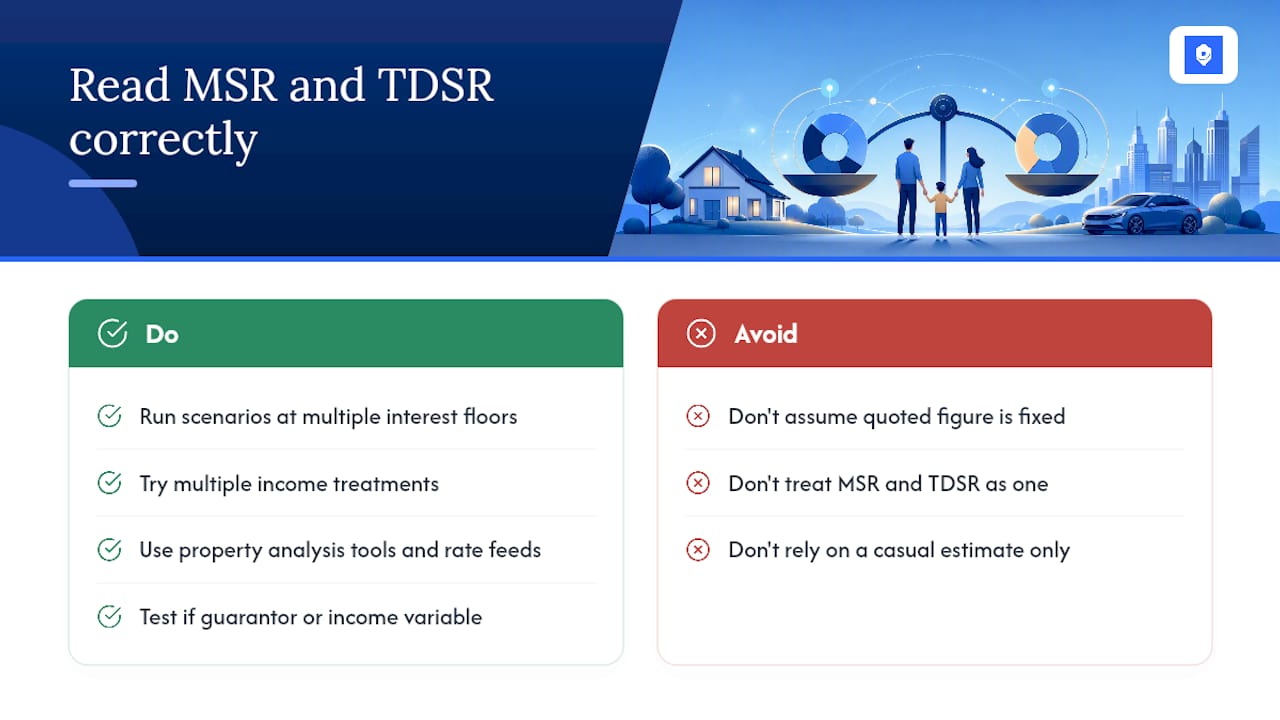
Most buyers treat MSR and TDSR as a single hurdle to clear once, at application stage. That is the wrong mental model. Both ratios respond to income composition, existing debt, and the interest-rate assumption a bank chooses to apply, which means your borrowing ceiling can shift meaningfully between a casual estimate and a formal in-principle approval.
Haio's affordability checks, valuation data, and mortgage-rate feeds exist precisely because that gap catches buyers off guard. We would encourage running scenarios at more than one interest floor and more than one income treatment before assuming a figure is fixed, particularly if any income is variable or you are a guarantor on another loan. Property analysis tools that combine transaction data with these ratios give a far more honest starting point than a single quoted number ever will.
— HAIO
Check your borrowing power before you view a single flat
Haio's affordability tool models MSR and TDSR together against the same stress-tested interest assumptions banks actually use, so the loan quantum it shows you is grounded in the same maths a bank will apply, not a rough estimate that falls apart at application stage. That is the practical advantage over working through the formulas manually or relying on a single advertised rate: you see both ceilings, HDB/EC and private, side by side, before committing to a viewing.
Start with the free affordability check to see your indicative loan quantum under current stress-test rates. Buyers who want deeper valuation reports and Master Plan analysis alongside their affordability figures can upgrade to haio+ for $49 a month or $499 a year. Either way, know your real ceiling before you fall for a flat you cannot finance.
Sources
Facts in this article draw on MAS's MSR and TDSR rules, its TDSR calculation guidance, and DBS's consumer explainer.
This article is general information, not a substitute for advice from a qualified financial advisor. Consult a qualified financial professional about your own circumstances before acting on anything here.
- Mortgage servicing ratio and total debt servicing ratio rules
- Mortgage servicing ratio and total debt servicing ratio explained
FAQ
Is the current TDSR limit 55% or 60% in Singapore?
The TDSR limit is 55% of a borrower's gross monthly income.
How is MSR calculated in Singapore?
The result must stay at or below the 30% cap set by MAS, and guarantor obligations on other property loans count toward this figure at a minimum of 20%.
Does MSR apply to resale HDB flats?
MSR applies to resale HDB flats only when financed with a bank loan, not an HDB concessionary loan. Buyers using an HDB loan for a resale flat fall under HDB's own income framework rather than the MAS MSR rule.
What is the TDSR in Singapore and who does it cover?
TDSR is the ceiling on all monthly debt repayments, mortgage included, relative to gross income, capped at 55%. It applies to new loans for HDB, EC, and private property, and to most refinancing, with limited concessions for owner-occupiers under specific conditions.
Which tool can help me check my MSR and TDSR before applying for a loan?
Haio's affordability check models both MSR and TDSR simultaneously using stress-tested interest assumptions, giving you an indicative loan quantum before you approach a bank. It is a practical way to test different income and debt scenarios without committing to a formal application first.