
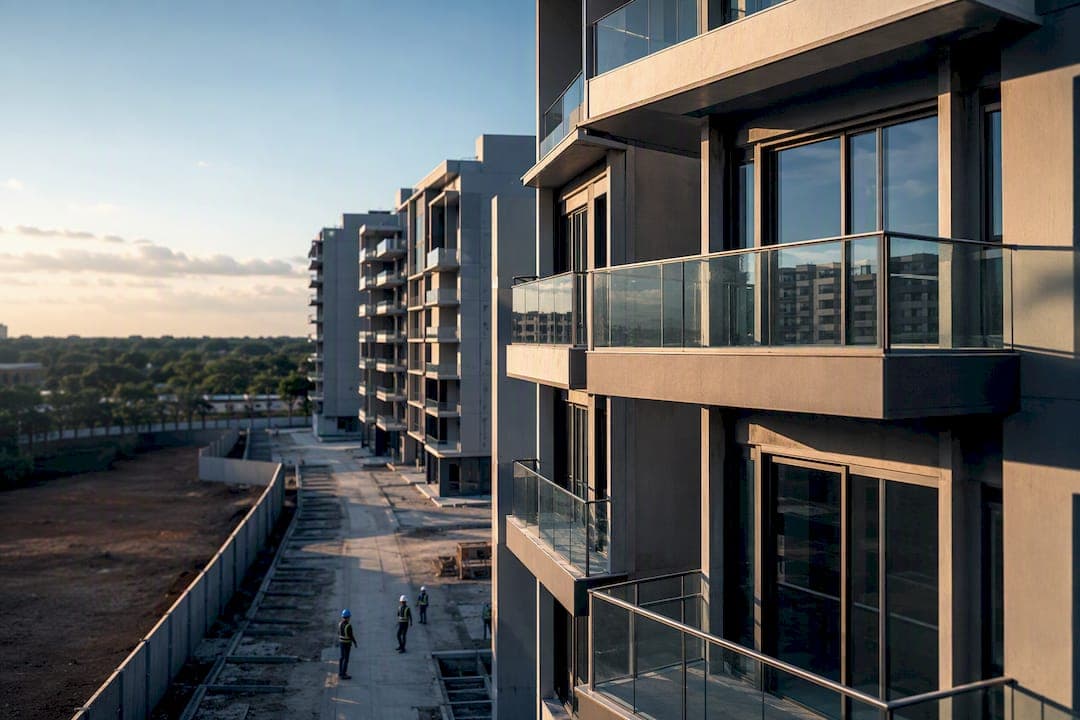
The progressive payment scheme (PPS) is Singapore's legislated staged payment system for new and under-construction private homes, and it governs how buyers pay for a Building Under Construction (BUC) unit against certified construction milestones rather than a lump sum at signing. Stamp duty falls due early too, so cash and CPF timing need planning from day one, not after the show flat visit.
TL;DR:
- Buyers must pre-arrange financing and account for stamp duty payments, which are due within 14 days of signing the Sale and Purchase Agreement, often coinciding with the first PPS installment.
- The staged payment schedule is fixed by regulation, with the largest payment of 25% at Temporary Occupation Permit and 15% at project completion, but timing varies based on construction speed.
- CPF Ordinary Account savings can be used for most PPS installments after booking, but these funds require refund with interest upon resale, affecting net proceeds.
- Banks disburse loans gradually aligned with project milestones, meaning initial repayments are small but increase sharply at TOP, requiring comprehensive cashflow planning.
- Using Haio's tools helps visualize monthly repayments and project pricing, but final financing and legal compliance depend on bank approval and conveyancer review.
Table of Contents
- How does the progressive payment scheme work?
- What are the standard PPS payment stages?
- Which funds pay for each PPS instalment?
- When are BSD and ABSD payable under PPS?
- How does PPS change your monthly loan repayments?
- What should you check before committing to a PPS purchase?
- How haio helps you plan around PPS
- Is PPS a flexible tool or a hidden trap?
- Plan your PPS numbers with haio
- Sources
- FAQ
How does the progressive payment scheme work?
PPS is not a developer convention. It is written into the Housing Developers Rules, and it exists because Singapore learned, decades ago, that unregulated staged payments left buyers exposed when developers ran into trouble mid-project. The Rules require every licensed housing developer to deposit buyer payments into a dedicated Project Account, and the developer can only withdraw from that account for certified project costs, such as paying contractors once a construction stage is verified. That ring-fencing is what makes PPS meaningfully safer for buyers than an informal instalment arrangement with a private seller.
Here is the practical mechanic behind each payment:
- A qualified person, usually the project's architect or engineer, certifies that a milestone (foundation work, structural framework, roofing and so on) has been completed.
- The developer's solicitor issues a payment notice to the buyer's conveyancing lawyer, stating the amount due and the stage it corresponds to.
- The buyer then has a statutory 14-day window from the date of that notice to make payment, whether by cash, CPF, or bank loan drawdown.
- Missing that 14-day deadline typically triggers interest charges under the Sale and Purchase Agreement, and persistent default can put the contract itself at risk.
That last point catches buyers off guard more often than any other part of PPS. Because instalments arrive unpredictably, tied to how fast the contractor works rather than a fixed calendar, a buyer who has not pre-arranged financing can find a notice sitting in their lawyer's inbox with the clock already running. The certification and 14-day mechanism together mean PPS moves at the pace of the construction site, not the pace of the buyer's convenience.
What are the standard PPS payment stages?
The milestone percentages in a private residential PPS are fixed by regulation and are the same across every licensed developer in Singapore, though the exact wording appears in your own Sale and Purchase Agreement and should always be checked there. The standard schedule runs as follows.
| Stage | Milestone | % of purchase price |
|---|---|---|
| 1 | Booking (Option to Purchase) | 5% |
| 2 | Signing Sale & Purchase Agreement | 15% |
| 3 | Completion of foundation work | 10% |
| 4 | Completion of reinforced concrete framework | 10% |
| 5 | Completion of partition walls | 5% |
| 6 | Completion of roofing/ceiling | 5% |
| 7 | Completion of electrical wiring, plumbing, internal plastering | 5% |
| 8 | Completion of car park, roads and drains serving the project | 5% |
| 9 | Temporary Occupation Permit (TOP) | 25% |
| 10 | Certificate of Statutory Completion (CSC) | 15% |
Timing between stages is not fixed by law. It depends entirely on how quickly the developer's contractor moves. Some projects clear stages 3 through 8 within 18 months of the S&P; others stretch to three years or more if construction hits delays. That variability is the single biggest reason buyers underestimate how much cash discipline PPS demands.
Take a S$1,200,000 unit as a worked example. Booking commits S$60,000 in cash. Signing the S&P adds S$180,000, payable via cash, CPF, or a mix. TOP alone brings a single S$300,000 instalment, the largest jump in the entire schedule, and CSC closes it out with a final S$180,000. Those last two milestones are where a poorly prepared buyer feels the real financial strain.

Which funds pay for each PPS instalment?
Not every instalment can be paid the same way, and mixing this up is one of the more common planning mistakes among first-time BUC buyers.
- The booking fee at Option to Purchase must be paid in cash. CPF cannot be used at this stage under any circumstances.
- The S&P downpayment (15%) can be paid in cash, CPF Ordinary Account savings, or a combination, subject to CPF rules on the property's remaining lease and the buyer's age.
- CPF OA usage for the remaining stages depends on the flat's valuation, remaining lease at the point of purchase, and the buyer's age relative to CPF withdrawal limits, as set out by the CPF Board.
- Bank loans are disbursed progressively, in step with each certified milestone, rather than as one lump sum at signing.
That progressive disbursement structure means your monthly loan repayments start small and climb as the building rises, since interest and principal are only charged on the portion the bank has actually released. It also means the amount you can eventually draw depends on qualifying for the full loan upfront, even though you will not touch most of it for months or years.
One detail buyers frequently miss involves CPF's long tail. Any OA savings used across the PPS stages must eventually be refunded to your CPF account, together with the accrued interest those savings would have earned, when the property is sold. That refund obligation does not show up on a monthly budget spreadsheet, but it materially affects your net proceeds at resale.
Pro Tip: Run your CPF OA balance projection alongside your PPS schedule before you commit. A shortfall two milestones from now is far cheaper to fix today than after you have exercised the Option to Purchase.
When are BSD and ABSD payable under PPS?
Stamp duty sits entirely outside the PPS schedule, and this is where many buyers get their cash planning wrong. Buyer's Stamp Duty, and Additional Buyer's Stamp Duty where it applies, must be paid within 14 days of signing the Sale and Purchase Agreement, as one lump sum rather than a staged amount. It lands at almost exactly the same time as your first PPS instalment, which means two large cash demands can hit within days of each other.
BSD is charged on a tiered basis. For residential property, from 15 February 2023 the current rates are 1% on the first S$180,000, 2% on the next S$180,000, 3% on the next S$640,000, 4% on the next S$500,000, 5% on the next S$1,500,000, and 6% on any remaining amount above S$3,000,000.
CPF can technically be used towards stamp duty, but processing timelines rarely align with the 14-day deadline, so most buyers pay cash upfront and arrange CPF reimbursement afterwards. Budget for these additional early costs alongside BSD:
- Conveyancing and legal fees for the Sale and Purchase Agreement
- Legal disbursements, including title searches and registration charges
- Administrative fees charged by the developer's solicitors for processing payment notices
How does PPS change your monthly loan repayments?
Your bank still assesses you for the full loan quantum before disbursing a single dollar, and that qualification does not get easier just because early instalments look small. The Monetary Authority of Singapore's Total Debt Servicing Ratio framework caps how much of your income can go towards debt repayments, and it applies to the loan you are approved for, not the fraction you have drawn down so far.
The repayment trajectory under PPS typically follows this pattern:
- Early stages (foundation through car park and drains) draw down small loan portions, so monthly repayments stay modest, sometimes just a few hundred dollars.
- As TOP approaches, the 25% milestone releases the largest single tranche of the loan, and your repayment jumps to close to its final level almost overnight.
- From TOP onward, you are servicing close to the full loan amount every month, whether or not you have moved in.
Loan-to-Value limits also shape how much of each stage the bank will actually fund, and tenure restrictions tied to your age can shrink the loan quantum available in the first place. Both factors interact with TDSR to determine your real borrowing ceiling, not just the headline interest rate.
Pro Tip: Budget for the post-TOP instalment amount from the day you sign the S&P, not the day it arrives. Treat the difference between your current instalment and the full amount as a forced savings target each month.
What should you check before committing to a PPS purchase?
A few checks before you exercise the Option to Purchase can save considerable stress later.
- Ask the developer for the exact PPS schedule embedded in the Sale and Purchase Agreement, evidence of the Project Account, and the projected TOP date.
- Confirm with your bank the Loan-to-Value ratio you qualify for, the loan tenure, and any conditions attached to progressive disbursement.
- Ask your conveyancing lawyer about stamp duty timing, whether CPF reimbursement is feasible in your case, and what happens contractually if a payment notice is missed.
- Build a staged cashflow forecast covering every milestone through to CSC, and hold a contingency fund equal to several months of your eventual full instalment.
- Re-check your forecast with your lawyer and bank if the developer signals any delay to the construction timeline.
How haio helps you plan around PPS
Turning a milestone table into a personal cashflow plan is where most buyers stall. Haio's affordability tool models how a given purchase price and loan structure translate into monthly repayments as PPS stages release, while Property Analysis and valuation data help you sanity-check whether a project's asking price sits in line with comparable transactions nearby. Haio's List adds visibility into comparable new-launch pricing, which is useful when you are weighing one project's PPS schedule against another's.
None of this replaces your conveyancing lawyer or your bank's loan officer. Treat these tools as the planning layer that gets your numbers ready before those professional conversations, not a substitute for them.
Is PPS a flexible tool or a hidden trap?
PPS spreads out a large purchase price in a way outright resale purchases never allow, and the Project Account rules give it real legal teeth compared with informal staged arrangements elsewhere. Weigh BUC timing against resale certainty honestly, verify the developer's track record on delivery timelines, and treat your bank and conveyancer as checkpoints, not formalities, at every stage.
— HAIO
Plan your PPS numbers with haio
Spreadsheets built from a generic milestone table rarely match your actual purchase price, loan terms, or CPF position, which is exactly the gap Haio's tools close. The Affordability calculator turns your income, loan tenure, and target property price into a realistic month-by-month repayment view, so the jump at TOP stops being a surprise. Start free with the affordability check and Property Analysis data to shortlist projects, then move to haio+ at S$49 a month, or S$499 a year, if you want downloadable valuation reports and deeper analytics for a shortlist of units. Whatever numbers Haio generates, treat them as planning support: your bank confirms loan approval, and your conveyancing lawyer confirms every legal and stamp duty detail before you sign.
Sources
- Housing Developers (Project Account) Rules — Singapore Statutes Online
- Using your CPF to buy a home — CPF Board
- TDSR for property loans — MAS
- Stamp duty for property — IRAS
FAQ
What is the progressive payment scheme in Singapore?
It is the legislated staged payment structure for new and under-construction private homes, requiring buyers to pay set percentages as construction milestones are certified rather than one lump sum. The schedule and its Project Account protections are set out under the Housing Developers Rules.
How much cash do I need at booking under PPS?
The following 15% due at the Sale and Purchase Agreement can be paid in cash, CPF, or a combination.
Can I use CPF for every PPS instalment?
CPF Ordinary Account savings can cover most PPS stages after the booking fee, subject to limits based on remaining lease, valuation, and your age, as set by the CPF Board. Any CPF used must be refunded with accrued interest when the property is eventually sold.
When are stamp duties due if I am on a progressive payment schedule?
Buyer's Stamp Duty and Additional Buyer's Stamp Duty must be paid within 14 days of signing the S&P, separately from your PPS instalments. This often lands close to your first staged payment, so both need cash ready around the same time.
Does haio help me calculate my PPS cashflow?
Haio's Affordability tool models how your loan and income translate into monthly repayments as each PPS milestone releases funds, and Property Analysis adds comparable pricing context. These are planning aids, and final loan approval and legal terms still rest with your bank and conveyancing lawyer.