

A property investor is anyone deploying capital into real estate for income or capital growth rather than to live in it, and the four realistic routes are buy-to-let, REITs or private funds, crowdfunding, and joint ventures. The immediate task, whichever route appeals, is to run an affordability check and underwrite one deal against rent, financing cost and reserves before doing anything else. Two checkpoints follow close behind: whether a lender will qualify the loan, and what stamp duty and transactional costs will do to the return.
TL;DR:
- Most property investors face higher interest rates, larger deposits, and stricter reserve requirements compared to owner-occupier mortgages, especially for DSCR loans.
- A thorough deal analysis should include calculating gross and net yields, effective rent with vacancy allowances, and stress testing for interest rate rises and extended vacancies.
- Property taxes like stamp duty and ABSD can significantly increase the purchase cost and should be incorporated early into the underwriting process.
- Diversification across locations, property types, and financing structures reduces risk and improves resilience against market downturns and interest rate hikes.
- Using data platforms can accelerate underwriting steps and improve decision accuracy, especially when evaluating valuation, affordability, and market trends before committing.
Table of Contents
- What are the main ways to become a property investor?
- How do investor loans differ from a normal mortgage?
- How do you evaluate whether a property deal is worth doing?
- What taxes and costs catch investors off guard?
- Where do most investors go wrong?
- How can a data platform speed up an investor's checklist?
- How do you build a diversified property investment portfolio?
- When should an investor plan to sell?
- What does the property investment timeline actually look like?
- What legal checks belong on a due diligence checklist?
- How do you choose a reliable property manager?
- A long horizon beats a clever trade
- Run your own numbers before you commit
- Where to verify rates, rules and your own numbers
- Sources
- FAQ
What are the main ways to become a property investor?
The route that suits a first-time buyer with S$150,000 in savings looks nothing like the one that suits someone with a S$2 million portfolio and a taste for renovation projects. Capital, time and appetite for risk decide the method more than any market forecast does.
- Buy-to-let. The most familiar route: buy a unit, rent it out, collect income and hope for capital growth over years rather than months. It suits investors who want a tangible asset and are prepared to deal with tenants, maintenance and financing directly. The main drawback is illiquidity. Selling a flat takes months, not days.
- Flip or renovation. Buying under market value, improving the property and selling quickly. This route rewards construction knowledge and a tight handle on costs, but timing risk is real. A renovation that overruns by three months can erase the entire profit margin.
- REITs and listed funds. Real estate investment trusts let investors buy a slice of a professionally managed portfolio through the stock exchange, with the trust distributing rental income to unit holders, as MoneySense explains. Liquidity is the appeal. Fees and market volatility are the trade-off.
- Private funds and crowdfunding. These platforms pool smaller amounts of capital into specific projects or portfolios. Access is easier than buying a whole property outright, but capital is often locked up for years with limited exit options.
- Joint ventures. Pooling capital with other investors to buy something none of you could afford alone. Governance and exit terms need to be agreed in writing before money changes hands, not after a dispute starts.
How do investor loans differ from a normal mortgage?
Lenders treat investment property loans as riskier than owner-occupied mortgages, and the pricing reflects that. Expect a higher interest rate, a larger deposit requirement, and a demand for cash reserves that sits well beyond what a first-time homebuyer would face. Some lenders also apply a rental income haircut, counting only a portion (commonly around 75%) of gross rent when assessing whether an applicant qualifies, according to Opendoor's guidance on investment property mortgages.
DSCR loans work differently. Instead of assessing the borrower's personal income, the lender qualifies the loan against the property's own cash flow, measured by the debt-service coverage ratio. This route tends to suit investors with multiple properties or irregular income who cannot easily document a high salary on paper. The cost is usually a higher interest rate than a conventional loan carries.
In Singapore, any loan against residential property also sits inside the Total Debt Servicing Ratio framework, which caps how much of a borrower's income can go towards debt repayments across all loans, not just the one being applied for. The Monetary Authority of Singapore's TDSR explainer sets out exactly how that calculation works and which income sources qualify.
Before approaching a lender:
- Gather two years of income documents, existing loan statements and bank records.
- Get quotes from at least three lenders and compare not just the rate but loan-level price adjustments (LLPAs) and prepayment penalties.
- Ask explicitly how much in reserves the lender expects held post-completion and for how long.
- Confirm whether the loan qualifies on personal income or property cash flow (DSCR) before committing time to an application.
Pro Tip: Ask each lender for their rental income haircut percentage in writing before comparing quotes. A lender counting 75% of gross rent versus one counting 100% can change your qualifying income by tens of thousands of dollars on the same property.
How do you evaluate whether a property deal is worth doing?
Underwriting a deal properly takes fifteen minutes with a spreadsheet and saves months of regret. Work through it in this order:
- Gross rental yield. Annual rent divided by purchase price. Useful for a first screen, useless for a final decision.
- Net yield. Subtract operating expenses, then divide by price, for a more honest comparison across properties.
- Effective rent. Apply a vacancy allowance and use rents from comparable leases, not the optimistic figure on a listing portal.
- PITI or PITIA. Principal, interest, taxes, insurance (and association fees where relevant). This is the true monthly cost of holding the loan.
- DSCR versus cash flow. DSCR tells a lender whether rental income covers the loan payment. It does not tell an investor whether the property is actually profitable once full operating costs are counted, a distinction ARVCalc's underwriting guide makes clearly. A deal can pass a lender's DSCR test and still lose money every month.
- Stress test. Rerun the numbers with a 0.5-percentage-point rate rise and two to three additional points of vacancy. If the deal survives both, it has some margin for error.
Experienced landlords tend to assume operating expenses eat roughly a quarter to a third of gross rent once maintenance, insurance and management are counted, treated as a working rule rather than a formal standard.
What taxes and costs catch investors off guard?
Buyer's stamp duty and the additional buyer's stamp duty (ABSD) apply on top of the purchase price, and rates vary by residency status, property count and entity type, so check the IRAS guidance on ABSD for the figure that applies to your own case rather than a headline rate quoted elsewhere.
Beyond stamp duty, budget for:
- Legal conveyancing fees
- Agent commission, usually paid by the seller but occasionally negotiated otherwise
- Valuation and building survey fees
- Rental income tax, which depends on personal circumstances and is worth checking with a tax adviser rather than assuming
A quick reality check: ABSD alone can add a substantial percentage to the purchase price depending on residency and how many properties you already own, which is exactly why it belongs in the underwriting spreadsheet before an offer, not after.
Where do most investors go wrong?
The same handful of mistakes recur across almost every failed property investment, and none of them are exotic.
- Using the asking rent from a listing portal instead of what comparable units actually leased for.
- Stretching leverage to the maximum a lender will offer, leaving no buffer for a bad quarter.
- Ignoring the possibility of a rate rise or a longer-than-expected vacancy when the numbers are first run.
- Managing a remote property personally instead of budgeting for a managing agent from day one.
- Treating reserves as optional rather than as a lender and practical requirement, since several months of PITI held in reserve, sometimes for a minimum seasoning period, is standard practice among cautious lenders.
Pro Tip: Pull three to five comparable leases, not listings, before you assume a rent figure. A unit sitting on a portal at S$3,200 might have leased at S$2,850 last month. That gap is where over-optimistic underwriting starts.
How can a data platform speed up an investor's checklist?
Running the checklist above by hand, property by property, is exactly the workflow a data platform is built to compress. Haio maps directly onto the steps that take investors the longest:
- Valuation Analysis gives an instant estimate to sanity-check an asking price before you spend money on a formal survey.
- Property Analysis surfaces comparable transactions and market trends for the yield and rent-comparable steps.
- Affordability checks run financing scenarios against income and existing debt before you approach a lender.
- haio News tracks policy and market shifts, including cooling measures, that change the numbers mid-deal.
Feeding these outputs into a lender conversation or a joint venture partner's due diligence pack turns a rough estimate into a documented case.
How do you build a diversified property investment portfolio?
Diversification in property investment works across three dimensions, not one. Geography matters first: concentrating every purchase in a single district or town leaves an investor exposed to one local employer closing, one planning decision, or one neighbourhood falling out of favour. Spreading across two or three distinct areas reduces that single-point risk considerably.
Property type is the second dimension. A portfolio built entirely from small apartments behaves differently in a downturn than one that mixes apartments with landed property, commercial units, or REIT exposure. Each responds to interest rates, tenant demand and liquidity constraints differently, so a mix smooths the ride.
Financing structure is the third, and the most overlooked. Investors who finance every property with maximum leverage on variable rates are making a single bet on interest rates staying low. Mixing fixed and variable terms, and holding at least one property with lower leverage, gives the portfolio room to absorb a bad financing year without forcing a sale.
Sequencing matters too. Most investors do better buying one property, letting it stabilise and prove its numbers over twelve to eighteen months, then using the equity and experience gained to fund the second, rather than acquiring two or three properties simultaneously on a thin cash buffer. Portfolio growth built on realised cash flow beats portfolio growth built on paper equity and optimism, particularly once rates move against a highly leveraged book. REITs and funds can sit alongside direct holdings as a lower-effort diversification layer, since they spread capital across dozens of properties an individual investor could never assemble alone.

When should an investor plan to sell?
Exit strategy should be decided before purchase, not after five years of drift. Three broad approaches cover most situations.
Hold for cash flow and appreciation suits investors targeting a ten-year-plus horizon, where the aim is rental income now and capital growth later, sold only when a life event, a portfolio rebalance, or a genuinely strong market prompts it. This is the default approach for buy-to-let investors and the one that tolerates the most market noise along the way.
Refinance and hold replaces a sale with pulling equity out through refinancing once a property has appreciated or the loan has amortised meaningfully, recycling that capital into the next purchase without triggering a taxable disposal or paying a second round of transactional costs. It works only when rental income comfortably covers the new, larger loan payment.
Sell on a defined timeline fits flips and renovation projects, where the entire underwriting assumed a sale within months, and holding longer than planned usually means the original numbers were wrong somewhere.
Timing a sale around the broader market matters less than timing it around personal financing and tax circumstances. A seller under no pressure who can wait for a stronger market has a structural advantage over one forced to sell during a downturn because reserves ran out. That advantage is built at the financing stage, long before the "sell" decision itself.
What does the property investment timeline actually look like?
A residential purchase in Singapore typically runs through a recognisable sequence, though timelines stretch or compress depending on financing complexity and whether the property is a resale or a new launch.
- Pre-approval and budgeting (one to two weeks): confirm what a lender will actually lend before viewing anything, using an affordability check rather than a rough mental estimate.
- Property search and shortlisting (two to eight weeks): narrow down using yield and comparable rent data rather than emotional appeal alone.
- Offer and Option to Purchase (days to two weeks): a deposit, typically 1% of the purchase price, secures the option period.
- Due diligence and legal review (two to three weeks): title checks, outstanding encumbrances and the sale and purchase agreement get reviewed by a conveyancing lawyer.
- Exercise the option and pay the balance deposit: this legally commits both parties and starts the countdown to completion.
- Loan disbursement and completion (typically eight to twelve weeks from option to completion for a resale unit): the lender disburses funds and the property changes hands.
- Post-completion setup: arranging a managing agent, insurance and, for buy-to-let, marketing the unit for tenants.
New launches follow a longer, staged payment schedule tied to construction progress rather than a single completion date, which changes the cash flow planning considerably compared with a resale purchase.
What legal checks belong on a due diligence checklist?
Skipping legal due diligence to move faster is one of the more expensive shortcuts in property investment, and the checks are not optional extras.
A conveyancing lawyer should confirm clear title and check for any outstanding mortgages, liens or caveats lodged against the property. Tenancy status matters for buy-to-let purchases specifically. An existing tenant with a lease that survives the sale changes the investor's immediate cash flow and flexibility, and the terms of that lease need reading in full, not summarising secondhand.
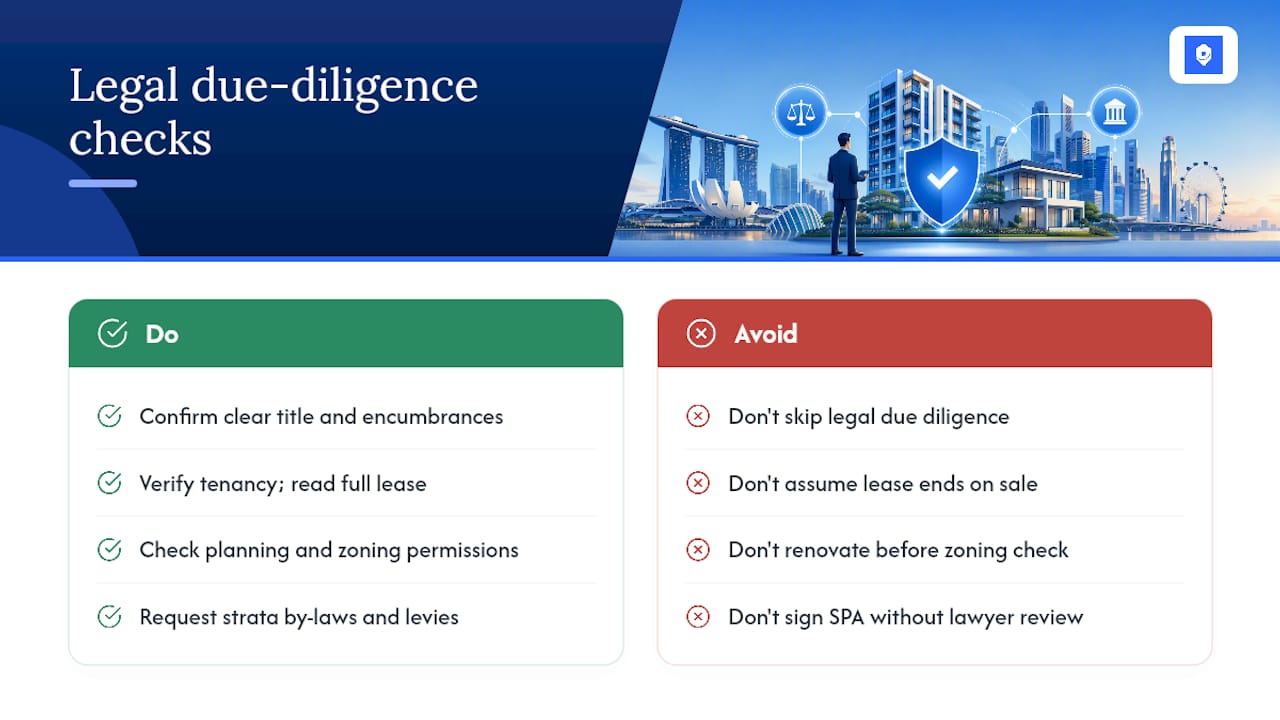
Planning and zoning restrictions determine what the property can legally be used for, and any renovation plans should be checked against those restrictions before, not after, a purchase completes. For strata properties, management corporation by-laws and any pending or upcoming special levies for building works are worth requesting directly, since they can add unexpected costs after handover.
Finally, the sale and purchase agreement itself deserves a full legal read, with particular attention to completion timelines, penalty clauses for delay, and what happens if financing falls through after the option has been exercised. None of this replaces a lawyer. It simply means walking into that legal conversation already knowing which questions matter.
How do you choose a reliable property manager?
A managing agent is the difference between a passive investment and a part-time job, particularly for anyone holding property they do not live near. The right agent handles tenant sourcing, rent collection, maintenance coordination and lease renewals, freeing the investor from the day-to-day calls that eat evenings and weekends.
Start by asking any prospective managing agent for their current vacancy rate across their portfolio and their average time to re-let a unit. An agent who cannot answer either question quickly is not tracking performance closely enough to manage yours well. Ask how maintenance requests are handled, whether there is a cap below which repairs proceed without prior approval, and what the reporting cadence looks like month to month.
Fee structures typically run as a percentage of monthly rent collected, sometimes with a separate leasing fee charged when a new tenant is placed. Compare that fee against what self-management would actually cost in time, not just against a headline percentage, since an investor's own time has a real value that rarely gets counted honestly.
References from other landlords using the same agent, ideally on similar property types, tell you more than any marketing brochure the agency hands over. An agent good at managing landed houses is not automatically good at managing a high-rise condominium with a management corporation to coordinate with.
A long horizon beats a clever trade
Moderate leverage and a long holding period outperform aggressive leverage and short timelines more often than not, a pattern echoed in how large institutional managers such as Blackstone frame their own real estate strategy. Speculative short-term plays, flips especially, have a place, but only when the investor treats the timeline and cost overruns as the real risk, not the market. The practical next step is straightforward: take one property you are actually considering and run it through the underwriting checklist this week, not after you have already made an offer.
— HAIO
Run your own numbers before you commit
Haio gives property investors a single place to check a price, model affordability and track the market shifts that change a deal's numbers overnight. Start with Property Analysis to pull comparables and valuation data for a specific unit, then run the Affordability tool to see what a lender is realistically likely to offer before you make an offer of your own. Investors who want deeper analytics, valuation reports and Master Plan tools can move to haio+ through the haio+ subscription page. For everything else, from live listings to policy news, haio's home page is the starting point.
Where to verify rates, rules and your own numbers
- IRAS — Additional buyer's stamp duty (ABSD) for current stamp duty rates and remission rules.
- MAS — TDSR for property loans for how lenders calculate your debt-servicing ratio.
- Rent vs buy calculator for running your own affordability and rent-versus-buy scenarios.
- Go for official government communications on property policy changes.
Sources
- IRAS — Additional buyer’s stamp duty (ABSD)
- MAS — TDSR for property loans: calculating TDSR
- MoneySense — Understanding real estate investment trusts (REITs)
- Opendoor — Investment property mortgage: rates, requirements, down payment
FAQ
How much will an investor pay for a property?
The total cost includes the purchase price plus buyer's stamp duty, ABSD where it applies, legal fees, valuation costs and any agent commission not covered by the seller. Rates for ABSD vary by residency status and how many properties you already own, so check the IRAS ABSD guidance for the figure that applies to your own situation before making an offer.
What is the 2% rule for properties?
The 2% rule is a rough screening tool used mainly in some overseas markets, suggesting monthly rent should equal roughly 2% of the purchase price for a deal to be worth deeper analysis. It is a first filter, not a final answer, and full underwriting against PITI, DSCR and net cash flow matters far more than this shortcut.
Who are the top 10 investors?
There is no single official ranking of the world's top property investors, since portfolios and net worth figures vary by source and are rarely fully public. What matters more for an individual reader is studying the discipline large institutional managers apply, particularly around leverage and holding periods, rather than chasing a named list.
Who is the richest property investor?
Public rankings of the wealthiest property investors shift depending on the source and how privately held real estate is valued, so no single definitive figure holds across all lists. Rather than fixating on a name, the more useful takeaway for an individual investor is that most large, durable property fortunes were built through moderate leverage and long holding periods rather than rapid trading.
What is the difference between DSCR and cash flow when evaluating a deal?
DSCR measures whether rental income covers the loan payment from a lender's perspective, while cash flow measures what is actually left over for the investor after all operating costs and the full mortgage payment. A property can pass a lender's DSCR threshold and still be cash-flow negative once real running costs are counted, which is why both numbers belong in the same underwriting sheet.
Can a platform like Haio help me check affordability before I approach a lender?
Yes. Haio's Affordability tool models your financing capacity against current mortgage rates, giving you a working estimate before you spend time on formal lender applications.