
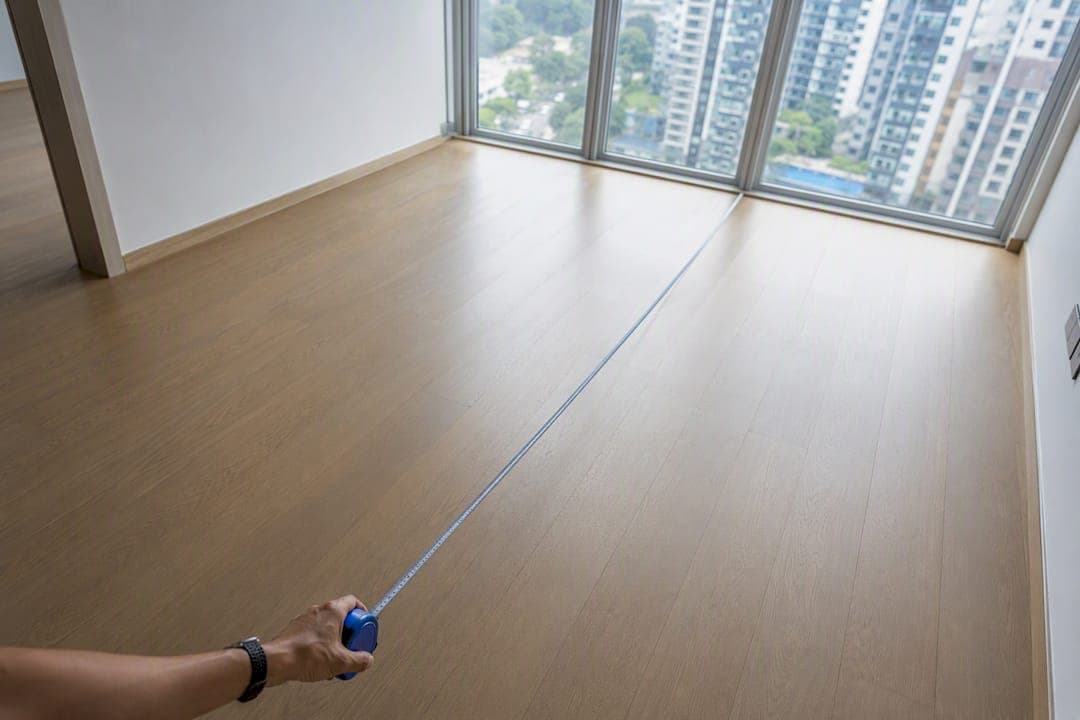
PSF stands for price per square foot, expressed in Singapore dollars per square foot of floor area. It is a quick way to compare the cost efficiency of different units, not a measure of what you can actually afford. Once you know a unit's PSF, the next step is checking the total purchase price, or quantum, against your borrowing limits before going any further.
TL;DR:
- Buyers should focus on the transaction PSF rather than asking PSF, as market conditions and actual sale prices provide more reliable data.
- The total quantum determined by the PSF and the unit’s floor area is what banks use to assess borrowing capacity, not the PSF itself.
- Variations in lease remaining, view, layout, and development age can cause significant differences in PSF figures within the same project.
- Always compare PSF only within the same project, tenure, and floor band, and verify the area basis before making calculations.
- Using tools like Haio helps cross-reference recent transactions and run affordability checks, ensuring more accurate property decisions.
Table of Contents
- What does PSF mean in Singapore property listings?
- How do you calculate PSF? Formula and example
- PSF versus quantum: why total price still decides what you can borrow
- What are typical PSF ranges across Singapore districts?
- What factors change a unit's PSF beyond the sticker number?
- How do you use PSF to compare listings and make a decision?
- How does haio help you use PSF correctly?
- A straightforward take on PSF from haio
- Check your numbers before you view
- Sources
What does PSF mean in Singapore property listings?
PSF is the price of a unit divided by its floor area in square feet, expressed as S$ per sq ft. A $1,500,000 condominium unit measuring 1,000 sq ft, for instance, has a PSF of $1,500. Agents and developers use this figure constantly because it strips out the effect of unit size, letting buyers compare a 500 sq ft one-bedder against a 1,200 sq ft family unit on a common basis.
The area figure behind that number matters more than most buyers realise. Singapore listings usually quote strata area, which includes the unit's share of common facilities, though some quote saleable or floor area depending on the property type. URA's planning circulars set out how these measures are defined and recorded, and small differences in area basis can shift a PSF figure noticeably.
There is also a gap between asking PSF, the number a seller lists at, and transacted PSF, the figure that actually closes a deal. Asking PSF reflects hope; transacted PSF reflects the market. Always treat the two as separate data points when you research a project.
How do you calculate PSF? Formula and example
The formula behind PSF is straightforward, and CommLoan's explainer on the term confirms it works the same way across markets: divide the total price by the floor area in square feet.
- Take the unit's asking or transacted price, say $1,380,000.
- Take the floor area in square feet, say 900 sq ft.
- Divide price by area: $1,380,000 ÷ 900 = $1,533.33 PSF, usually rounded to $1,533.
- Round to the nearest dollar for comparison purposes; developers often round to the nearest whole PSF in marketing materials.
If a listing omits the area, ask the agent for the floor plan or check the Singapore Land Authority's title records before trusting any PSF quoted verbally.
PSF versus quantum: why total price still decides what you can borrow
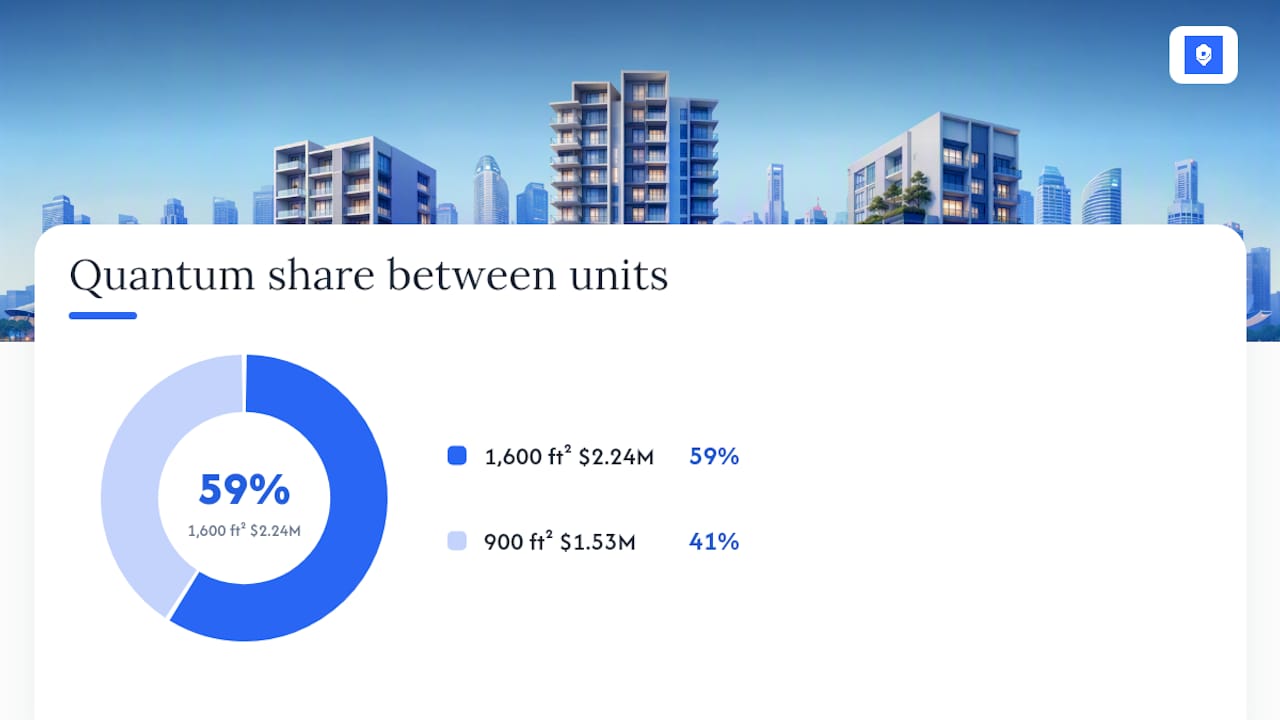
PSF tells you about efficiency per square foot. Quantum, the total price of the unit, is what your bank and the Total Debt Servicing Ratio actually assess. The TDSR framework caps loan repayments against your income and existing debt, and the Mortgage Servicing Ratio applies an additional ceiling for HDB flats and executive condominiums. Neither rule references PSF at all.
This creates a trap that catches out plenty of buyers comparing listings side by side.
- A 1,600 sq ft unit at $1,400 PSF has a quantum of $2,240,000.
- A 900 sq ft unit at $1,700 PSF has a quantum of $1,530,000.
The second unit carries the higher PSF, yet its lower quantum makes it the more serviceable loan for most buyers. Chasing the "cheaper" PSF on the larger unit can quietly push a buyer past what TDSR and MSR will allow, forcing a bigger down payment or a rejected mortgage application further down the line. The mistake is treating PSF as a proxy for affordability when it only ever measures value per square foot.
What are typical PSF ranges across Singapore districts?
PSF varies widely by zone, and the ranges below are indicative rather than fixed, since transaction prices shift with each market cycle. Core Central Region (CCR) projects, covering districts like Orchard and Marina Bay, typically command the highest PSF in the private market. Rest of Central Region (RCR) developments sit in the middle tier, while Outside Central Region (OCR) projects in areas such as Woodlands or Punggol generally post the lowest PSF among private condominiums.
Tenure changes the picture further. Freehold units within the same district usually carry a premium over 99-year leasehold equivalents, though the gap narrows as a freehold project ages and its own maintenance and facilities come into play. A newly launched project also tends to command a higher PSF than a comparable resale unit nearby, partly reflecting the developer's pricing strategy rather than intrinsic value.
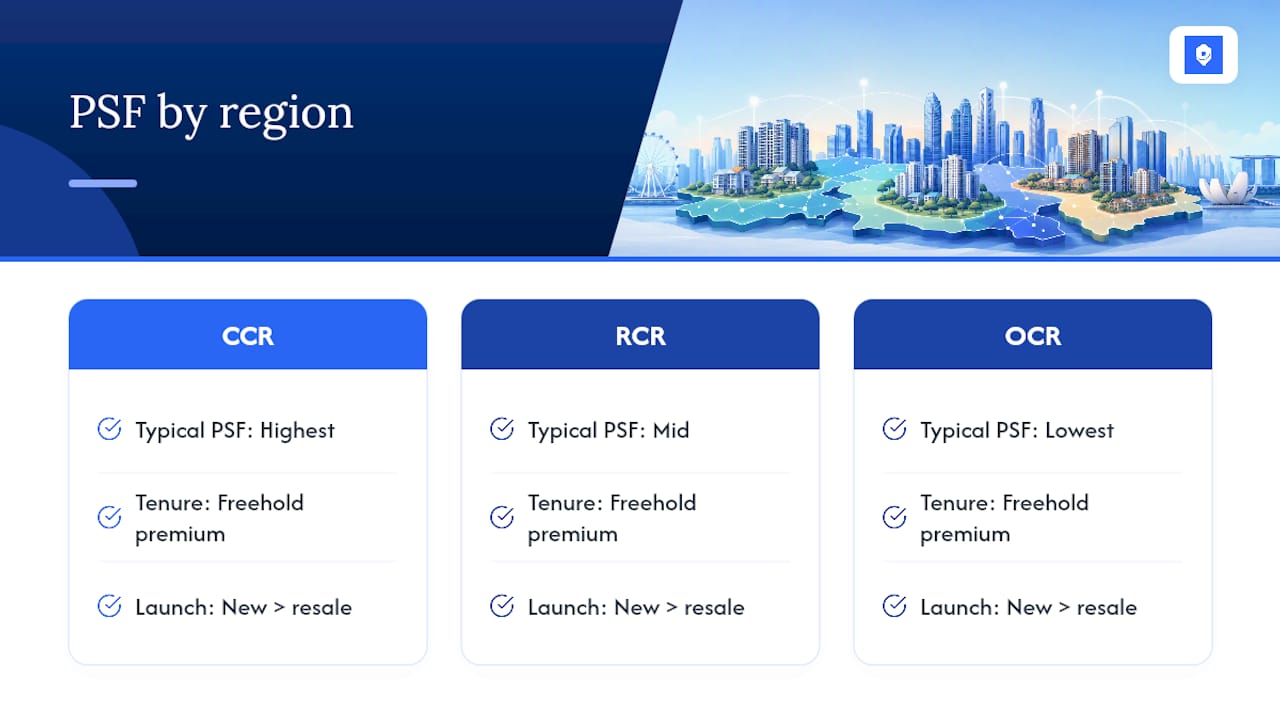
Because these bands move with each launch and each cooling measure, always check recent transaction records through URA's transaction search or a tool that pulls live data, rather than relying on a headline figure from a listing.
What factors change a unit's PSF beyond the sticker number?
Two units in the same project can carry noticeably different PSF figures, and the gap usually comes down to a handful of attributes rather than random pricing.
- Lease remaining: a unit with 60 years left on a 99-year lease typically prices lower than a fresher lease in the same block.
- Floor level and view: higher floors and unblocked views command a premium, sometimes several hundred dollars per square foot within the same stack.
- Usable area versus gross floor area: a unit with awkward layout or large bay windows can show a lower effective PSF for the space you actually use.
- Project age, facilities and developer reputation: newer developments with fuller facilities generally price above older projects nearby.
- Renovation state: a renovated resale unit can justify a higher PSF than an identical unrentated one in the same stack.
Pro Tip: When comparing two PSF figures, write down the floor, stack, and lease remaining next to each price. If those three details differ, the PSF comparison is not really like-for-like, however close the numbers look.
How do you use PSF to compare listings and make a decision?
A PSF figure only becomes useful once it is anchored to your own numbers. Work through it in order.
- Confirm the area basis stated in the listing and recalculate PSF yourself if it seems inconsistent with similar units.
- Compare PSF only within the same project, tenure, and floor band. Cross-project comparisons need the adjustments covered above.
- Check the resulting quantum against your borrowing ceiling under TDSR and MSR before shortlisting the unit for a viewing.
- Factor in buyer's stamp duty, any applicable additional buyer's stamp duty, and renovation costs, since these sit outside the PSF figure entirely.
- Run an affordability check, using a tool such as haio's calculators, before booking any viewing appointments.
Watch for red flags along the way: a PSF that looks unusually low for a large unit can signal an awkward layout or heavy common-area allocation, and inconsistent area figures across two listings for the same stack are worth querying directly with the agent.
How does haio help you use PSF correctly?
haio turns a bare PSF figure into a checked decision. Its instant valuation tool cross-references recent transactions so you can see whether a listed PSF matches what similar units have actually sold for, rather than what a seller hopes to get. The affordability checker applies TDSR and MSR logic to your income and existing debt, converting a unit's quantum into a clear yes-or-no on borrowing capacity. Mortgage rate comparisons sit alongside this, so financing costs are visible before you commit to a viewing.
The practical sequence is simple: check the PSF and quantum on haio, run the affordability check against your own numbers, then decide whether the unit is worth a site visit.
A straightforward take on PSF from haio
PSF earns its popularity because it is easy to calculate and easy to compare, but that simplicity is also its weakness. Too many buyers anchor on a low PSF and skip the affordability check entirely, only to find the total quantum sits above what a bank will lend against. Treat PSF as a filter, not a verdict. Verify it against recent transaction data, run the numbers through an affordability check, and only then book the viewing. A property that looks efficient on paper still needs to clear loan eligibility in practice.
— HAIO
Check your numbers before you view
Working out a PSF figure by hand is useful once. Doing it across a shortlist of ten listings, each with different tenures, floors, and area bases, is where mistakes creep in. A platform can pull transaction data and valuation estimates together in one place, so you can see a unit's PSF against comparable sales and run an affordability check against your own income and CPF position in the same session, rather than juggling spreadsheets and separate mortgage calculators. If you are shortlisting units this month, run your affordability numbers on Haio before booking a single viewing.