

Verify any agent on the CEA public register before you commit to anything. Once confirmed, judge candidates on three things: recent local sales in your property type, a written fee structure, and how they communicate. Agents earn their keep most clearly in complex negotiations, tight timelines, or unfamiliar markets, where their access to comparables and paperwork know-how outweighs the commission.
TL;DR:
- Verify an agent's license using the CEA public register, checking registration number, license status, disciplinary history, and recent local transactions.
- Confirm the agent's recent local sales, marketing plan, clear fee structure, and a designated point of contact before making a hiring decision.
- Prefer agents with proven recent sales in your property type and area, and consider professional tools to cross-check their pricing claims independently.
- Be cautious of scam indicators like requests for upfront payments, unverified credentials, suspiciously low listings, or pressure to transfer funds prematurely.
- Choosing between a solo agent or a team depends on transaction complexity, with tight timelines favoring a team and straightforward sales often suitable for a single dedicated agent.
Table of Contents
- How do I verify a real estate agent is licensed?
- What should I check before hiring an agent?
- What does a real estate agent actually do?
- Should you hire a solo agent or an agency team?
- What are the warning signs of a scam agent?
- Where haio's tools fit into your verification process
- Our take: pick the checklist over the pitch
- A faster way to check the numbers behind any agent's pitch
- Official resources and recommended reading
- Sources
- FAQ
How do I verify a real estate agent is licensed?
Every practising salesperson in Singapore must hold a valid licence issued through the Council for Estate Agencies, and this is checkable in minutes rather than assumed on trust. The CEA public register is the first stop: it confirms whether someone is currently registered, which agency they are attached to, and whether any disciplinary action sits on their record. The ACEAS Public Register e-service performs the same lookup and is worth using as a cross-check, since the two systems occasionally display information with slightly different formatting.
When you search, check these fields specifically:
- Registration number and current licence status (active, suspended, or lapsed)
- The estate agency the salesperson is currently attached to
- Any disciplinary history or past enforcement action
- Transaction records, where available, to confirm recent activity in your area
Cross-check the name and registration number against the business card or property listing the agent gave you. Discrepancies here are not always fraud, but they are always worth a direct question. Confirm too that a supervising key executive officer sits behind the agency, since this is a licensing requirement rather than an optional courtesy.
Screenshot the register result and save it alongside your correspondence with the agent. It costs nothing, takes seconds, and gives you a dated record if a dispute over representation ever arises later in the transaction.
What should I check before hiring an agent?
A ranked checklist beats a gut decision, particularly when several agents are competing for the same listing. Work through these in order:
- Recent, local, same-type sales. Ask for transactions closed in the last six to twelve months in your neighbourhood and property category, not a career highlight reel from a decade ago.
- List-to-sale ratio and days on market. An agent who consistently sells close to asking price, and quickly, is showing you their pricing judgment rather than just their sales pitch.
- A written marketing plan. For sellers, this means knowing exactly how the property will be presented, photographed, and distributed before you sign anything.
- Named point of contact. Confirm who actually handles your file day to day, especially if you are dealing with a larger agency team rather than a sole practitioner.
- Communication cadence agreed upfront. Weekly updates, same-day replies to offers, whichever suits you, but agree it before you need it.
- The full fee, in writing. No verbal estimates, no vague percentages to be confirmed later.
Interview at least two or three agents before deciding. Consumer guidance from Zillow suggests this is enough to compare pricing logic and marketing plans without turning the search itself into a project. Group your questions by theme: experience ("What have you sold in this postcode this year?"), process ("How will you price my property?"), fees ("What is included, and what costs extra?"), and references ("Can I speak to a client from your last two closings?"). If an agent cannot produce verifiable recent sales in your exact price band and area, treat that as a genuine screening signal to ask harder questions or walk away.
What does a real estate agent actually do?
Buyer's agents and seller's agents serve different masters, even when they sit in the same agency. A seller's agent prices the property, builds the marketing plan, screens buyers, and negotiates upward. A buyer's agent sources suitable listings, negotiates downward, and manages the paperwork trail through to completion. Dual agency, where one salesperson represents both sides of the same deal, is permitted but carries an inherent conflict of interest: nobody can negotiate hard against themselves.
Work that typically justifies the fee includes:
- Coordinating valuations, inspections, and financing timelines so nothing collapses at the last stage
- Handling the Option to Purchase and Sale and Purchase Agreement paperwork correctly
- Managing counter-offers without either party losing composure or leverage
Should you hire a solo agent or an agency team?
The trade-off is continuity against coverage. A solo agent typically means one person, direct accountability, and no confusion over who made which promise. A team spreads the work across specialists, which usually buys you broader availability and stronger marketing resources, but can also mean the agent who won your business is not the one who turns up to your viewing.
Solo agent strengths:
- Personal continuity from first meeting to key handover
- Direct accountability, no relay of information through a junior colleague
Team strengths:
- Wider coverage across evenings, weekends, and multiple simultaneous viewings
- Backup cover if your main contact is unavailable during a critical negotiation window
Complex transactions, tight timelines, or a need for out-of-hours responsiveness tend to favour a team. Straightforward sales in a familiar area often work fine with a single dedicated agent, and some buyers report stronger personal advocacy from that arrangement.
Pro Tip: Ask directly, "Who will physically attend my viewings and who negotiates the final offer?" If the answer involves a name you have not yet spoken to, ask to meet them before you sign anything.
What are the warning signs of a scam agent?
Certain patterns recur often enough to be worth memorising. Watch for:
- Requests for unusual upfront payments before any service has been delivered
- Credentials or a licence number that cannot be found on the ACEAS Public Register
- Listings priced suspiciously low to generate enquiries, then "unavailable" once you call
- Pressure to sign or transfer money before you have seen a property in person
Validate any listing independently rather than relying solely on the platform it appeared on, and confirm the offer terms in writing before transferring anything. If something feels off, report it through ScamShield or the relevant government portal, including the agent's name, registration number, screenshots, and any payment details involved. Act immediately rather than waiting to see how the situation develops.
Where haio's tools fit into your verification process
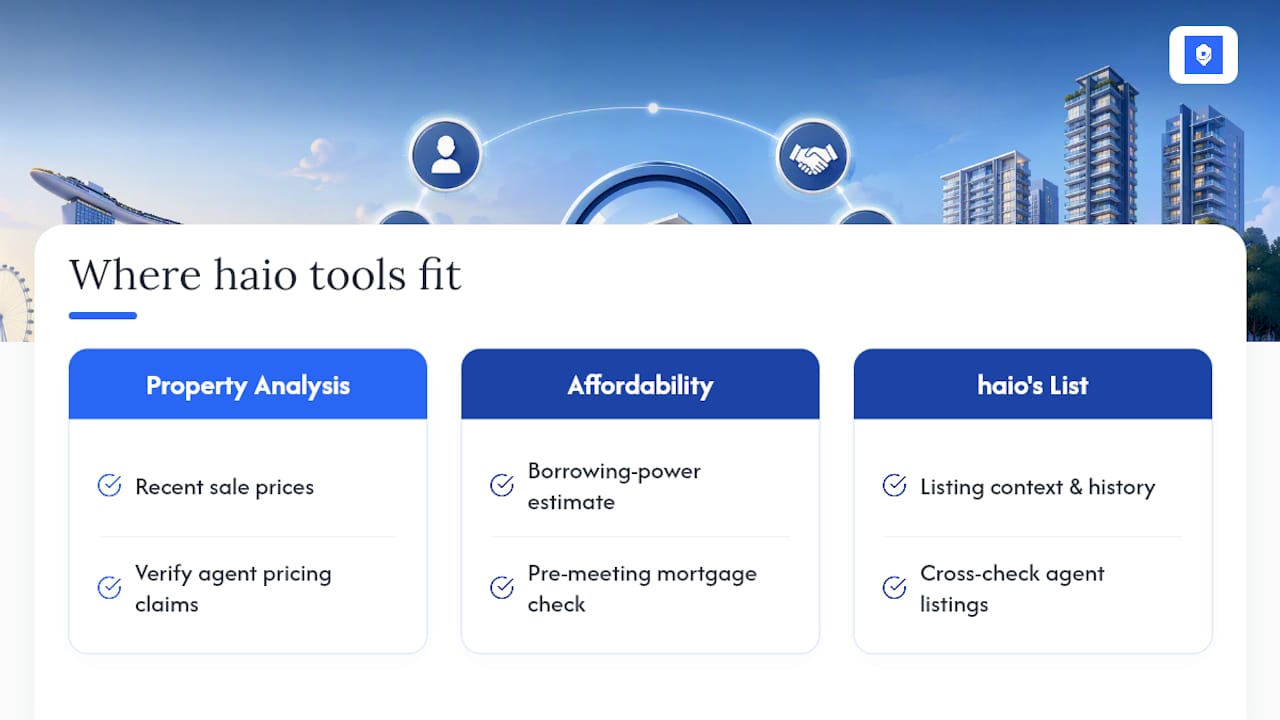
Haio's data tools sit alongside the official checks rather than replacing them. Property Analysis lets you pull recent sale prices and build a comparable set before an agent hands you their own figures, so you can judge whether their pricing argument holds up. The Affordability check gives you a borrowing-power estimate before you sit down with an agent, similar in spirit to getting mortgage preapproval early, which consumer guidance consistently recommends. haio's List adds another layer of listing context worth cross-checking against what an agent presents.
Our take: pick the checklist over the pitch
Prioritise recent, local, same-type sales and a transparent fee structure over polish or years of experience quoted without evidence. The cheapest agent is rarely the best value if their marketing plan is thin, and the most expensive one is not automatically superior. Balance cost against demonstrated service quality, not reputation alone. Use the official registers first, then the interview checklist, and let the paperwork do the convincing rather than the sales pitch.
— HAIO
A faster way to check the numbers behind any agent's pitch
Verifying a licence takes minutes; verifying whether an agent's pricing argument actually holds up takes longer, unless you have the transaction data in front of you already. Haio's Property Analysis and Transactions tools pull recent sale prices and comparables directly, so you walk into an agent interview already knowing what similar units nearby have actually sold for, rather than relying on the figure they hand you. Pair that with the Affordability check to know your borrowing position before the conversation even starts. Readers who want ongoing access to valuation reports and deeper market analysis can look at haio+. Current prices are available on haio's pricing page. Start by pulling your own comparables before your next agent meeting.
Official resources and recommended reading
- Council for Estate Agencies (CEA) — the primary register for licence verification
- ACEAS Public Register — direct e-service lookup for salesperson and agency status
- ScamShield — report impersonation or fraud attempts tied to property transactions
- Reasons to avoid real estate agents when selling — an external perspective worth weighing against the checklist above
Sources
FAQ
Is it worth paying a real estate agent?
For complex transactions, tight timelines, or negotiations where you lack local pricing knowledge, an agent's fee is usually justified by the paperwork handling, market access, and negotiation support they provide. For a straightforward sale where you already know the comparable prices, the value proposition weakens considerably.
Who is the best real estate agent to choose?
There is no single best agent. The strongest choice is whoever passes CEA verification, shows recent local sales in your exact property type, and gives you a fee structure in writing before you commit.
What does an agent do in a property transaction?
A seller's agent prices the property, builds the marketing plan, and negotiates upward, while a buyer's agent sources listings and negotiates downward. Both handle the paperwork trail through to completion, and both should coordinate valuations and inspections along the way.
What is the biggest complaint people have about agents?
The most common frustrations centre on poor communication and pricing arguments that are not backed by real comparables. Agreeing a communication cadence and asking for recent local sales data upfront, as covered in the checklist above, addresses both directly.