
Singapore's private residential market is posting modest headline gains, but the strength is uneven across regions and buyer segments. The Core Central Region is outperforming, while the Rest of Central Region is correcting. Resale transactions are carrying more weight than new launches, and a large Government Land Sales pipeline is keeping supply pressure in check. Watch resale volumes and the GLS calendar for the next real signal.
TL;DR:
- Resale transactions now make up a significant portion of private residential sales, indicating active secondary-market demand despite a quieter primary launch pipeline.
- The Urban Redevelopment Authority's price index increased by 0.5% quarter on quarter, with higher-end segments in CCR and landed homes leading the gains while RCR declined.
- Landed property prices rose by 2.5%, and a large government land sale bid at S$1.4 billion shows developers are still willing to pay premium for scarce suburban sites.
- Upcoming Q4 launches will be a true test of demand, especially as resale volume trends and mortgage rates may influence buying decisions more than project launches.
- Monitoring key indicators like GLS bidding activity, resale volumes, and mortgage rate movements is essential for timely market insights and investment decisions.
Table of Contents
- Latest real estate news Singapore: the headlines that matter this quarter
- Market indicators: what the URA and HDB data actually say
- What's driving price and volume moves right now
- What this means for buyers, sellers and renters today
- How to follow real time Singapore property news properly
- Where Singapore's residential market is heading next
- Sources
Latest real estate news Singapore: the headlines that matter this quarter
Anyone tracking real estate news Singapore this quarter has seen a familiar pattern: quiet on the surface, busy underneath. Prices have edged up, but the story is really about where the strength sits and who is buying.
The main developments shaping the current cycle:
- Private residential prices ticked higher. The Urban Redevelopment Authority's price index rose 0.5% quarter on quarter, with landed homes and CCR non-landed units leading the gains while the RCR softened.
- A landmark GLS bid landed in the suburbs. UOL and CapitaLand's joint S$1.4 billion bid for the New Upper Changi site at a high price per square foot per plot ratio, shows developers are still willing to pay up for the right suburban parcel.
- Resale is doing the heavy lifting. Resale transactions made up a significant share of all private residential sales in the quarter, a sign that secondary-market buyers are more active than new-launch queues suggest.
- Analysts flag a quieter launch calendar ahead. Upcoming Q4 launches are being watched closely as a test of underlying demand rather than a signal of weakness.
- A rare high-end auction event. A batch of luxury condo units in the CBD, Orchard Road, and River Valley, tied to a S$3 billion money-laundering case, has gone up for auction, with guide prices reported to range widely among the units going up for auction.
Market indicators: what the URA and HDB data actually say
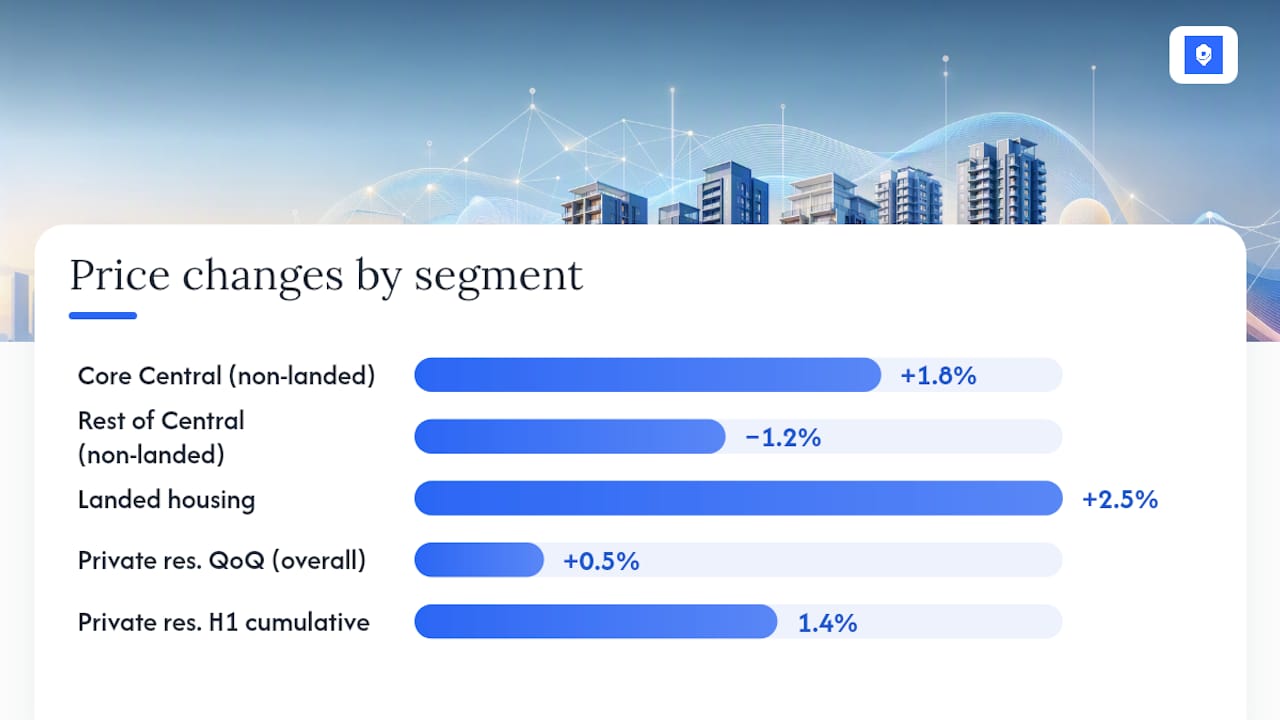
The most useful figure for anyone following property market news Singapore right now is the private residential price index. It rose 0.5% quarter on quarter, and cumulative gains for the first half of the year reached 1.4%. That is a modest pace by historical standards, and it hides a sharper regional split than the headline number implies.
Statistic callout: the Core Central Region posted non-landed price growth of 1.8% for the period, while the Rest of Central Region actually contracted by 1.2%. Landed housing led every segment with a 2.5% gain, underlining how much of the current strength sits with higher-value stock rather than the mass market.
The supply side tells its own story. The full-year 2026 GLS Confirmed List adds roughly 9,320 units, more than 50% above the ten-year average. That is a deliberate policy lever: keep enough land coming to market to stop prices running away, even as demand for select sites (New Upper Changi being the clearest recent example) stays strong.
Developer sales volumes have generally been lower than resale activity, partly because launch calendars have been deliberately paced rather than rushed. That distinction, resale strength against a quieter primary market, is the single most important nuance in the current data.
What's driving price and volume moves right now
Three forces are doing most of the work behind these numbers, and none of them are new headlines, they are structural.
Land supply and developer risk appetite. The GLS programme is large enough this year to act as a stabiliser, yet the New Upper Changi result shows developers will still stretch for parcels they see as scarce or well-located. That combination, ample supply overall but fierce competition for specific sites, explains why average price movements look calm while individual land deals look aggressive.
Collective-sale rules are being recalibrated. Parliament has debated changes to the en bloc framework, including stricter requisition thresholds designed to protect minority owners. The practical effect is a more predictable but slower collective-sale pipeline, which matters for anyone in an older development weighing a redevelopment premium against holding on.
Affordability and mortgage sentiment are shaping who buys. HDB upgraders remain a steady source of private demand, but buyers across the board have grown more price sensitive. That selectivity is exactly why analysts are treating the coming Q4 launches as a genuine test rather than a formality.
Key drivers to track:
- GLS Confirmed List additions and how aggressively developers bid for them
- Progress of the collective-sale rule changes and their effect on en bloc timelines
- HDB resale volumes as a proxy for upgrader demand
- Mortgage rate direction and its effect on buyer confidence at upcoming launches
Pro Tip: Don't read a single quarter's launch sales figure in isolation. A quiet developer-sales number can simply mean fewer projects were released that month, not that demand has dried up. Cross-check it against resale volumes before drawing a conclusion.
What this means for buyers, sellers and renters today
Different readers need different actions from the same dataset. Here is what each group should be doing right now.
- Buyers: Start with your HFE letter if you're eligible for HDB routes, since HDB advises applying well in advance before any sales exercise. Confirm your CPF and loan headroom before you fall in love with a unit, and factor stamp duty into your ceiling price, not as an afterthought once you've already negotiated.
- Sellers: Price against regional comparables, not last year's peak. If you're in the RCR, the recent softening means overpricing will simply extend your time on market; if you're CCR or landed, current strength gives you more room to hold firm on price.
- Renters and investors: Watch leasing cycle timing and vacancy signals in your target district before committing to a long lease or an investment purchase. Yield compression in overheated pockets can erase the benefit of a headline price gain.
- Everyone: Keep a short risk checklist. If GLS bids suddenly cool, if resale volumes drop sharply for two consecutive quarters, or if mortgage rates move fast in either direction, treat that as a trigger to pause or accelerate your decision, not a data point to ignore.
The auction of seized luxury units is a reminder that exceptional supply events can distort the high-end segment temporarily. Don't assume that pricing pattern reflects the wider market.
How to follow real time Singapore property news properly
Reliable Singapore real estate insights come from a short list of primary sources, not from every headline that trends for a day. Build your monitoring routine around these:
- URA statistics releases, published quarterly, for the private residential price index and regional breakdowns.
- HDB resale statistics and HFE notices, which show upgrader and public-housing demand trends.
- IRAS stamp duty updates, since any change to Additional Buyer's Stamp Duty or other duties immediately reshapes buyer calculations.
- Parliamentary and Ministry releases, particularly around collective-sale and land-use policy shifts.
- Sourced analyst commentary from outlets such as The Business Times, alongside research from firms like Savills and CBRE, for interpretation the raw numbers don't provide.
A practical routine: check URA and HDB release dates weekly, review the GLS confirmed list monthly, and set an alert for any large bid announcement, since a result like the New Upper Changi tender often moves sentiment faster than the quarterly index does.
This is where a tool matters more than a bookmark folder. A SuperApp pulls URA and HDB data, developer launch activity, and curated news into one feed, alongside instant valuations and affordability checks, so you're not manually cross-referencing five government websites every week.
Pro Tip: Set your alerts around release dates, not around news cycles. The market moves on data releases and land tender results, not on opinion pieces published between them.
Where Singapore's residential market is heading next
Haio expects the next three to six months to bring continued moderation rather than a sharp correction. Resale strength should persist, GLS supply will likely keep a lid on runaway pricing, and the real test arrives with the Q4 launch calendar, where buyer selectivity will separate well-priced projects from over-ambitious ones. The early warning signal to watch isn't the headline index, it's whether resale volumes hold up if launches disappoint. For readers who want that signal before it becomes a headline, haio's alerts and valuation tools are built for exactly this kind of tracking.
— HAIO
Sources
For anything data-related, go to URA for quarterly price indices, HDB for resale and eligibility rules, and IRAS for stamp duty changes. Pair these with Business Times property coverage, and check Prop Report's articles for management and leasing commentary, and DWELR for rental due diligence. Check URA quarterly, HDB monthly, IRAS whenever duty changes are announced.