

For contractor-scoped renovation work, a renovation loan is usually cheaper than a personal loan because Singapore banks price it lower and calculate interest on a reducing balance. The exception is speed and flexibility: if you need funds fast, or you're paying for furniture and appliances rather than built-in works, a personal loan often serves better despite the higher rate.
TL;DR:
- Renovation loans are typically cheaper than personal loans for structured, built-in works, with lower advertised rates and interest on a reducing balance.
- Personal loans disburse faster, are more flexible in usage, and often have higher effective interest rates due to flat-rate quotes and fewer fees.
- Qualification for renovation loans depends on property ownership, residency, and income, with disbursements usually staged to contractor milestones, unlike instant transfers for personal loans.
- Effective interest rate modeling is essential to compare true costs, as headline rates and fees vary widely and impact total repayment amounts.
- Combining both loan types requires careful timing to avoid over-borrowing, starting with renovation loans for fixed works and personal loans later for furnishings.
Table of Contents
- Renovation loan vs personal loan: how the two compare
- How do you choose the right renovation financing?
- What do the numbers actually look like?
- What do you need to qualify, and what's the paperwork?
- Which loan fits your renovation scenario?
- Can you combine a renovation loan with a personal loan?
- Why modelling your numbers matters more than the headline rate
- Model your renovation numbers before you sign anything
- Where to check current rules and rates
- Sources
Renovation loan vs personal loan: how the two compare
A renovation loan is purpose-bound. Banks disburse the funds directly to your contractor, usually against a signed quotation, and restrict use to structural and fixed renovation work such as flooring, wiring, plumbing and built-in carpentry. A personal loan carries no such restriction. The bank pays it into your own account, and you decide how it's spent, whether that's a new sofa, kitchen appliances, or simply covering a shortfall.
The headline interest rate rarely tells the full story. Renovation loans are typically advertised with lower rates than personal loans, but banks in Singapore may add handling fees and deduct an insurance premium from the approved sum before you receive it, and interest is commonly calculated on a reducing balance basis. Personal loans often quote a flat rate that looks deceptively small until you convert it. That's why the effective interest rate, not the number printed in the brochure, is what actually determines your repayment.
Typical figures homeowners should expect:
- Renovation loan caps often sit around thirty thousand Singapore dollars, or a multiple of your monthly income, depending on the bank and your property type.
- Personal loans can stretch considerably higher, sometimes several times monthly income, but usually at a steeper effective rate.
- Renovation loan tenures commonly run up to several years; personal loans often offer similar or shorter windows with more flexible early repayment terms.
- Processing fees and insurance premiums are more standard on renovation loans, while personal loans sometimes waive fees but charge a higher EIR to compensate.
None of this happens outside Singapore's lending framework. The Monetary Authority of Singapore's Total Debt Servicing Ratio rules cap how much of your income can go towards debt repayments across all your loans, so your existing car loan, credit card balances, or mortgage will shape how much a bank is willing to lend you for renovation, regardless of which loan type you choose.
How do you choose the right renovation financing?
Start with a clear-eyed look at your project before comparing a single lender.
- Scope the project properly. Get at least two or three written contractor quotes that separate built-in works (flooring, carpentry, electrical) from loose items (furniture, appliances, décor).
- Estimate the scoped share. If built-in, contractor-invoiced work makes up 70% or more of your total spend, a renovation loan is usually the stronger option on cost.
- Ask lenders for the EIR, not the flat rate. A bank quoting "3% p.a." on a renovation loan is not directly comparable to a personal loan quoted at "7% flat" without converting both to EIR.
- Ask what's deducted upfront. Confirm the exact processing fee and insurance premium, and whether either is waived for existing customers.
- Check disbursement timing against your renovation schedule. Renovation loans pay contractors on approval, sometimes in stages; personal loans land in your account almost immediately.
Watch for lenders that quote a rate but stay vague on fees until the approval letter arrives, and for contractors who ask for large deposits ahead of any loan disbursement milestone.
Pro Tip: If built-in works are the bulk of your budget, apply for the renovation loan first and lock in your contractor quote before shopping personal loan offers, since your scoped figure won't change once work begins.

What do the numbers actually look like?
EIR captures the true annual cost of borrowing once fees, the calculation method, and repayment schedule are all factored in. A flat rate applied to the original loan amount every year overstates how much of your instalment goes toward principal versus interest, which is why the same headline numbers can produce very different real costs depending on loan type.
Take two representative cases, both using plausible published rate ranges rather than a specific bank's current offer.
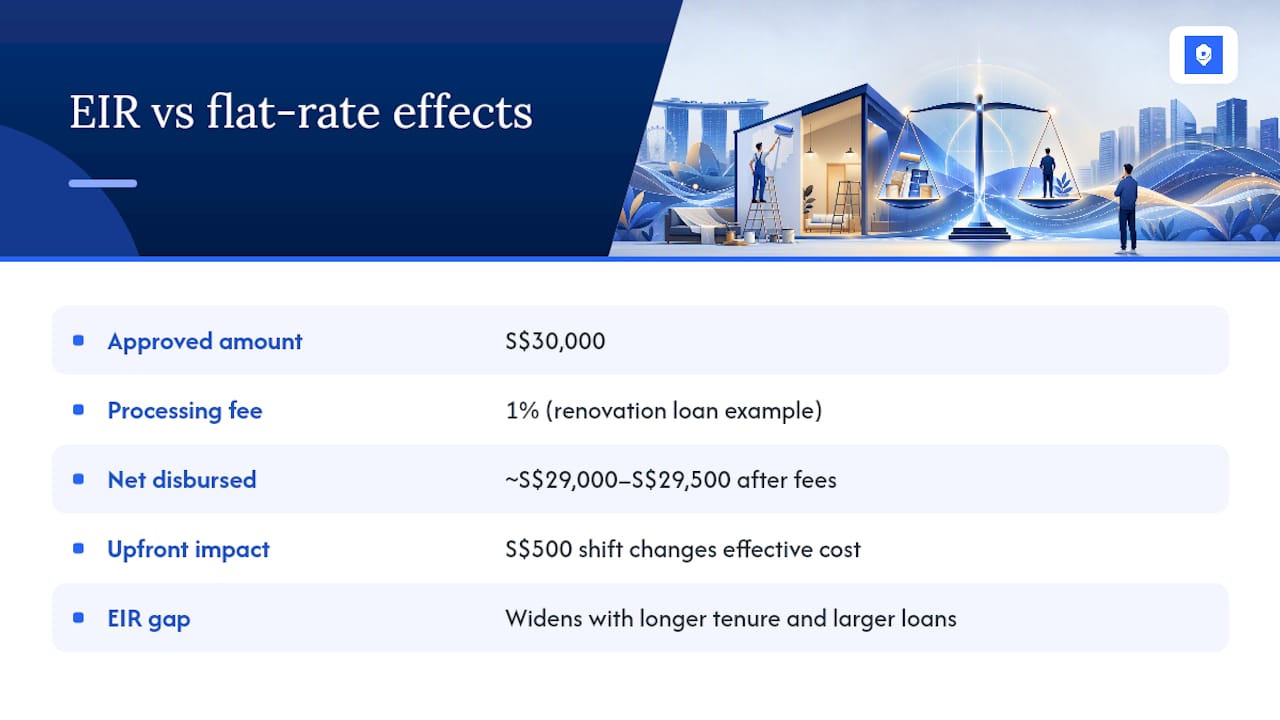
These figures are illustrative, built to show the mechanics rather than quote a specific bank. The gap between the two loan types widens with tenure and loan size, because a flat rate keeps charging interest on the original principal long after you've paid a chunk of it down.
Fees narrow the gap in the other direction. A renovation loan with a 1% processing fee and a small insurance premium deducted upfront on a S$30,000 approval might only put roughly S$29,000 to S$29,500 in your contractor's hands, even though your instalments are calculated on the full approved amount. Model your own numbers with a calculator or an affordability tool like Haio's before signing anything, since a S$500 shift in upfront deductions changes your effective cost more than most people expect.
What do you need to qualify, and what's the paperwork?
Renovation loans generally require you to be a Singapore citizen or permanent resident, own or be renovating the property in question (HDB flat, condominium or landed home), and meet a minimum income threshold set by the bank, commonly starting around S$24,000 to S$30,000 a year. Personal loans have similar residency and income requirements but don't require you to own property at all, which is why renters and buyers awaiting handover sometimes rely on them instead.
Documentation differs sharply between the two:
- Renovation loan: signed contractor quotation, proof of contractor's registration, proof of property ownership or tenancy, income documents, and sometimes the HDB or MCST renovation permit.
- Personal loan: NRIC, income proof (payslips or CPF statements), recent bank statements, and sometimes existing loan statements for TDSR assessment.
Disbursement mechanics reflect the purpose restriction. Renovation loans are typically released to the contractor via cashier's order or direct transfer, sometimes in stages tied to work milestones, while personal loan funds hit your own bank account, often within one to three working days of approval. Renovation loans can take slightly longer to approve, given the extra documentation, but both are generally faster than a mortgage-linked facility.
Which loan fits your renovation scenario?
Match the scope of your project to the financing route before you start comparing lender rates.
- Cosmetic refresh (repainting, new flooring): renovation loan if contractor-invoiced, personal loan if you're doing it yourself with purchased materials.
- Wet works (kitchen, bathroom overhaul): renovation loan, since plumbing and tiling are exactly what the product is built for.
- Full reconfiguration (hacking, rewiring, built-ins): renovation loan, ideally supplemented by a personal loan for furnishings once the contract is signed.
- BTO fit-out from bare shell: renovation loan for base works, personal loan or savings for appliances and furniture.
- Urgent repairs (leaks, electrical faults): personal loan, because speed usually matters more than the rate difference on a small, one-off job.
Renovation loans win on cost and structure but lose on flexibility; personal loans win on speed and unrestricted use but usually cost more over the same tenure.
Can you combine a renovation loan with a personal loan?
Many homeowners end up using both, and doing it in the right order avoids over-borrowing.
- Lock in contractor quotes first, then apply for the renovation loan against the built-in works that must be paid directly to the contractor.
- Wait until the renovation scope is fixed before applying for a personal loan to cover furniture, appliances, or décor, since renovation-loan proceeds typically exclude loose items by design.
- Time the personal loan disbursement to your furnishing schedule, not your renovation start date, and check your combined instalments against your TDSR limit before signing either agreement.
Why modelling your numbers matters more than the headline rate
Comparing advertised rates without converting to EIR is the single most common mistake homeowners make when choosing between these two products. The right decision depends on your specific contractor quote, your income bracket, and how upfront fees affect your net disbursement, not on which loan type generally wins in principle. Tools that let you model affordability and compare mortgage-linked and personal financing side by side, such as Haio's affordability checks and rate comparisons, give you a clearer read on your own numbers before you commit to either product.
— HAIO
Model your renovation numbers before you sign anything
Bank branches and comparison sites will show you advertised rates, but converting those into a real EIR, and checking how they interact with your existing TDSR limit, is harder to do without the right tool. Haio's affordability checks let you stress-test a renovation loan or personal loan against your actual income and existing commitments, while its mortgage-rate comparison tools show how your renovation financing sits alongside your home loan. If you're weighing up contractor quotes right now, run your numbers through Haio before you approach a bank, so you walk into the conversation already knowing what a fair EIR looks like for your situation.
Where to check current rules and rates
For the latest on loan types and responsible borrowing limits, see MoneySense's guidance, DBS's explainer on renovation loan mechanics, and Standard Chartered's comparison of both loan types. HDB flat owners should also check HDB's own updates for public-housing-specific renovation rules, and a further lender-side comparison is available from Aurea's guide to true borrowing costs.
This article is general information, not a substitute for advice from a qualified financial advisor. Consult a qualified financial professional about your own circumstances before acting on anything here.