

Rental stamp duty applies to almost every tenancy agreement in Singapore where the average annual rent exceeds $1,000. The rate is 0.4% of the total rent for leases of four years or less, or 0.4% of four times the average annual rent for leases longer than four years or with an indefinite term. Tenants conventionally pay by market practice, though the Stamp Duties Act 1929 makes both parties jointly liable if it goes unpaid.
TL;DR:
- Stamp duty is 0.4% of total rent for leases of four years or less and based on four times the AAR for longer or indefinite leases.
- Duty is always rounded down to the nearest dollar, with a minimum payable of one dollar, and is exempt if the AAR is $1,000 or less.
- Tenants typically pay stamp duty, but liability is joint under law, and IRAS can pursue either party if duty remains unpaid.
- The stamping deadline is 14 days for Singapore-signed agreements and 30 days for overseas agreements, starting from signing or receipt in Singapore.
- Late stamping incurs penalties and makes the agreement inadmissible in court until duty and fines are settled.
Table of Contents
- How rental stamp duty in Singapore is calculated
- Who pays and legal liability for stamp duty on tenancy agreements Singapore
- When to stamp: the 14-day and 30-day rules
- How to pay rental stamp duty in Singapore through IRAS myTax Portal
- Penalties for late or unstamped tenancy agreements
- Variations, renewals and additional rent charges
- Worked examples: calculating stamp duty on rent in Singapore
- Haio's perspective on avoiding stamp duty mistakes
- How Haio supports stamping-ready tenancies
- Official IRAS resources worth bookmarking
- Sources
How rental stamp duty in Singapore is calculated
Duty hinges on one figure: the Average Annual Rent, or AAR. This is the higher of the average contractual annual rent stated in the agreement or the annualised market rent for the unit, and it captures more than the base monthly rent. Furniture rental, service charges, and maintenance fees payable under the lease all get folded into the AAR calculation, though GST is excluded.
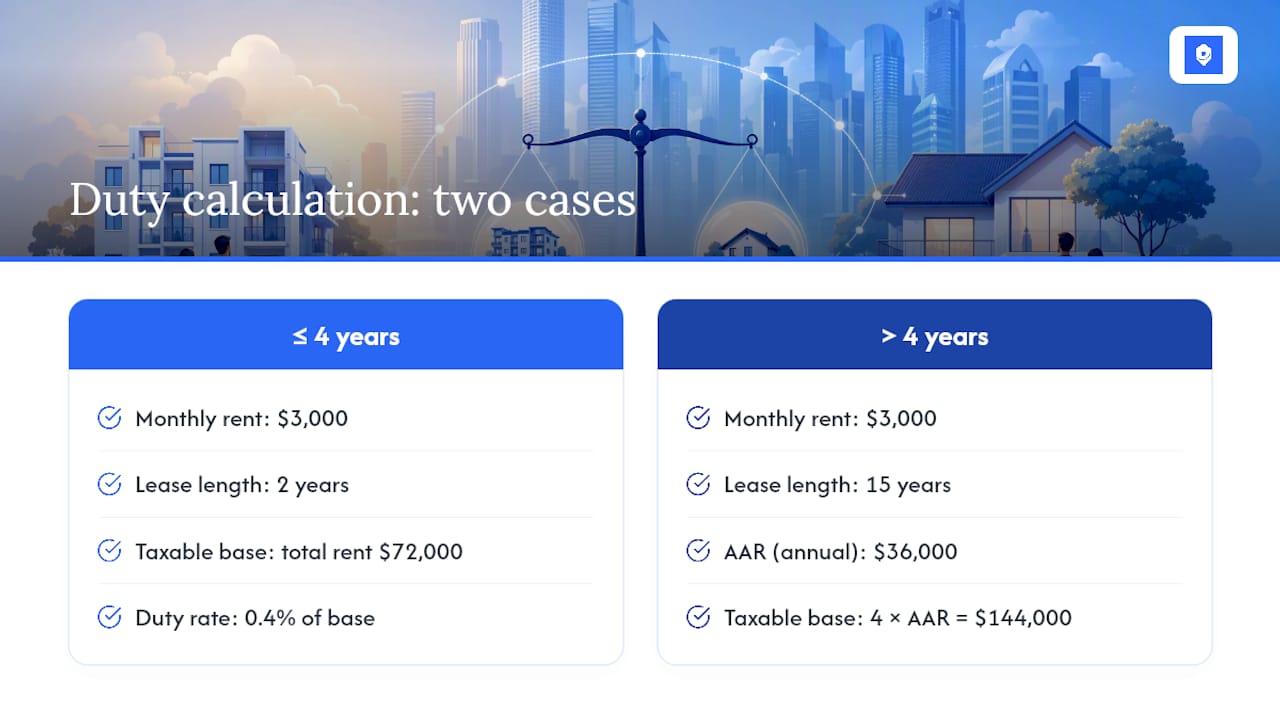
The formula splits depending on how long the lease runs. For a tenancy of four years or less, rental stamp duty in Singapore is charged at 0.4% of the total rent payable across the whole lease term, not just one year's worth. For a lease running longer than four years, or one with no fixed end date, the Inland Revenue Authority of Singapore calculates duty at 0.4% of four times the AAR, effectively capping the taxable base regardless of how many years the tenancy actually runs.
Take a straightforward example. A two-year lease at $3,000 a month works out to $72,000 total rent ($3,000 × 24 months). Duty at 0.4% comes to $288. Compare that with a fifteen-year commercial lease at the same monthly rent: the AAR is $36,000 ($3,000 × 12), so duty is calculated on 4 × $36,000 = $144,000, giving a duty payable of $576, regardless of the fifteen-year term.
Two mechanical rules matter here. Duty is always rounded down to the nearest dollar, and there's a minimum duty of $1 payable on any dutiable lease, however small the rent. There's also a genuine exemption worth knowing: if the AAR works out to $1,000 or less, no duty is payable at all. This typically covers only very low-rent room shares or informal arrangements, since most Singapore rentals, HDB or private, sit well above that threshold.
Who pays and legal liability for stamp duty on tenancy agreements Singapore
Market convention in Singapore places the cost of stamp duty squarely on the tenant, and most tenancy agreements simply repeat this as a contractual clause. But convention isn't law. Where an agreement is silent on the point, the Third Schedule of the Stamp Duties Act names the lessee, meaning the tenant, as the statutorily liable party for leases.
That said, liability under the Act is joint. IRAS can pursue either the landlord or the tenant for unpaid duty, irrespective of what the private agreement says about who was supposed to cough up. A landlord who assumes the tenant "handled it" carries real exposure if that turns out to be wrong.
Two practical checks protect both sides. First, always ask for the Stamp Certificate once payment is made. It's the only proof the agreement has been properly stamped, and either party can request to see it. Second, build a clause into the tenancy agreement specifying not just who pays, but by when, with proof of stamping to be shared within a set number of days of signing.
If the other party defaults on payment, the safer party isn't automatically off the hook. A landlord who discovers an unstamped agreement should arrange stamping themselves rather than risk the document being unusable later, since IRAS can still recover the duty from either side. Tenants in the same position should do likewise, particularly if they'll need the agreement as evidence in a rent dispute.
When to stamp: the 14-day and 30-day rules
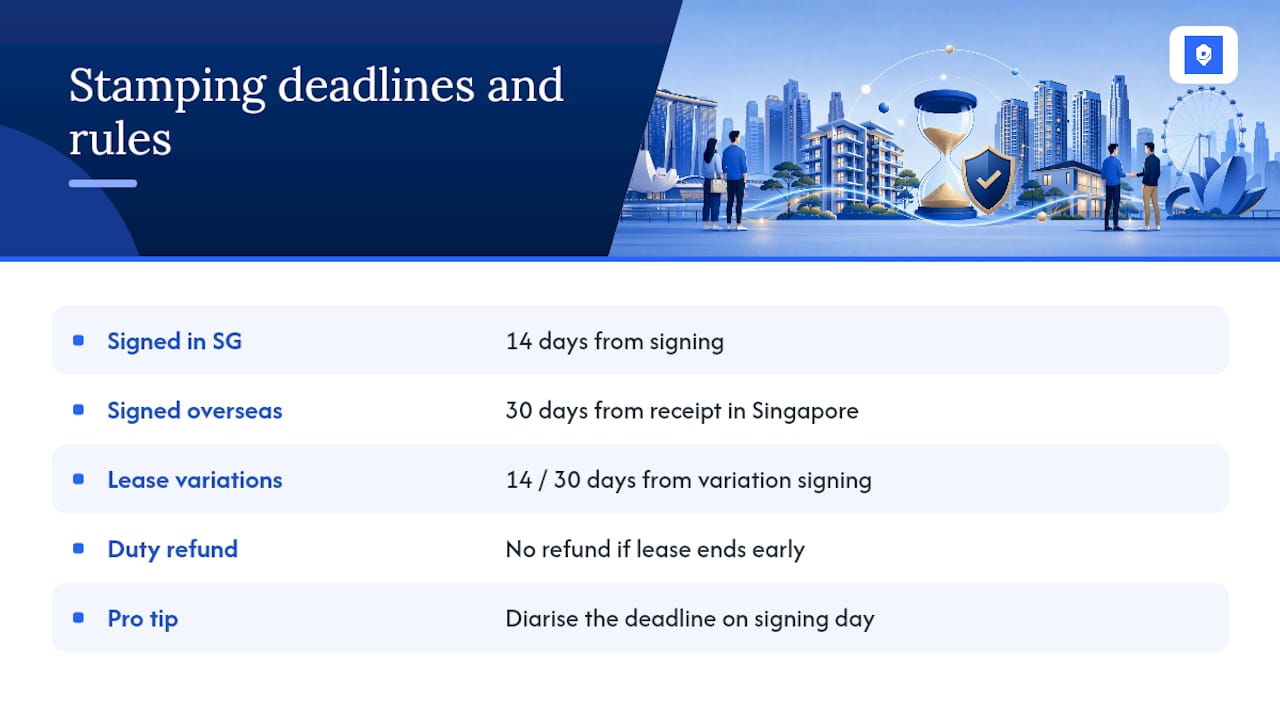
Timing is unforgiving. If the tenancy agreement is signed in Singapore, both parties have 14 days from the date of signing to stamp it. If the agreement is signed overseas, that window extends to 30 days from the date the document is received in Singapore.
These deadlines apply from execution, not from the tenancy's start date, which trips up plenty of tenants who sign a lease weeks before moving in and assume they have until move-in day to sort out the paperwork. They don't.
Variations to an existing lease trigger fresh duty obligations of their own. If a landlord and tenant later agree to increase the rent or extend the lease term, that variation is a dutiable document in its own right, and duty is charged on the incremental amount, the difference between the old and new rent or term, not the whole agreement again. The same 14 or 30-day clock starts running from when the variation is signed.
One rule surprises a lot of people: duty is non-refundable if the lease ends early. Sign a two-year lease, pay duty on the full 24 months, then move out after eight months because of a job posting overseas, and there's no partial refund. If there's a real chance the tenancy will be cut short, it's worth discussing a shorter stated term or a clean break clause with the landlord before signing, rather than paying duty on a term that never gets used.
Pro Tip: Diarise the stamping deadline the same day you sign, not the day you move in. A missed 14-day window is the single most common reason tenants end up paying late-stamping penalties on an otherwise straightforward lease.
How to pay rental stamp duty in Singapore through IRAS myTax Portal
E-stamping happens entirely online. There's no physical stamp, no counter visit, and the whole process typically takes minutes once you have the right details in hand.
Start by logging into the myTax Portal, either with Singpass for individuals or an SD account for those stamping on behalf of a company. Before logging in, have the tenancy agreement itself ready, along with the names and identification numbers of both landlord and tenant, the property address, the lease start and end dates, and the monthly rent figure.
Once inside the portal, you enter the document details directly. The system calculates the AAR and duty payable automatically based on what you input, generating a Document Reference Number immediately. Double-check the rent and term figures at this stage. Review the numbers, submit, and pay online by eNETS or a linked payment method.
The Stamp Certificate is issued the moment payment clears, and it's downloadable straight from the portal. IRAS also publishes an illustrated "How to Stamp Lease or Tenancy Agreements" guide covering the exact screens, useful if this is your first time navigating the portal. Save the certificate somewhere both parties can access it. It's the document you'll need if a dispute or tribunal case ever arises.
Penalties for late or unstamped tenancy agreements
An unstamped tenancy agreement isn't just a paperwork gap, it's a legal liability. Until duty and any penalty are paid, the document is inadmissible in court, meaning a landlord can't rely on it to enforce rent arrears and a tenant can't use it as evidence in a dispute over deposits, repairs, or notice periods.
Penalties escalate the longer stamping is delayed, and IRAS has discretion to impose fines that reach several times the original duty amount for prolonged non-compliance. The exact penalty depends on how late the stamping is and whether IRAS treats the delay as an oversight or something more deliberate.
The fix is straightforward, if uncomfortable: stamp it late. A late stamping application through the myTax Portal still produces a valid Stamp Certificate once duty and penalty are settled, and the agreement becomes usable again from that point. It's always better to regularise a late agreement than to leave it unstamped indefinitely and hope a dispute never arises.
Most calculation errors that lead to penalties come down to two mistakes: understating the AAR by leaving out furniture or service charges, or using the wrong duty basis for a lease running longer than four years. Both are avoidable by running the numbers through the official IRAS calculator before submitting, rather than estimating by hand.
Variations, renewals and additional rent charges
A lease renewal is treated as a fresh tenancy agreement, and duty is calculated on the new term exactly as it would be for a first-time lease. A variation, by contrast, only attracts duty on the incremental change: a rent increase from $3,000 to $3,500 a month is stamped on the $500 difference over the remaining term, not the full new rent.
Premiums paid for a lease, or surrender payments made to end one early, sometimes shift into Buyer's Stamp Duty territory depending on how the transaction is structured, so it's worth checking the specific arrangement rather than assuming standard lease duty applies.
Draft variation documents with exact dates for when the change takes effect. This avoids the awkward scenario where both the original lease and a poorly dated variation appear to cover the same rent period, risking duty being calculated, and paid, twice over.
Worked examples: calculating stamp duty on rent in Singapore
Numbers make this clearer than rules alone. Here are three common scenarios landlords and tenants actually run into.
- Twelve-month whole-unit tenancy at $2,800 a month. Total rent = $2,800 × 12 = $33,600. Duty at 0.4% = $134.40, rounded down to $134.
- Two-year room tenancy at $700 a month. Total rent = $700 × 24 = $16,800. AAR = $8,400, well above the $1,000 exemption threshold, so duty still applies. Duty at 0.4% of total rent = $67.20, rounded down to $67. A common misconception is that lower-rent room shares are automatically exempt. They aren't unless AAR itself falls to $1,000 or below.
- Ten-year commercial lease at $5,000 a month. Because the term exceeds four years, duty is based on 4 × AAR rather than total rent. AAR = $60,000, so 4 × AAR = $240,000. Duty at 0.4% = $960, payable once regardless of the ten-year span.
The IRAS AAR calculator on myTax Portal runs all three scenarios automatically once you enter the rent and term, removing the manual arithmetic entirely.
Pro Tip: Before hitting submit on the portal, re-check whether your lease exceeds four years. It's the single detail most likely to be missed, and it changes the entire duty basis from total rent to the four-year AAR cap.
Haio's perspective on avoiding stamp duty mistakes
Most stamping errors trace back to the same root cause: someone plugs the wrong rent figure or term length into the calculation before they've actually confirmed the numbers against a signed agreement. Haio's valuation tools exist partly to close that gap, giving tenants and landlords a clear, data backed read on market rent before a figure ever goes into the AAR calculation.
Our practical advice is simple. Store the Stamp Certificate somewhere both parties can retrieve it, and set a reminder for the 14 or 30 day deadline the moment a lease is signed, not weeks later.
— HAIO
How Haio supports stamping-ready tenancies
Haio gives tenants and landlords in Singapore a faster route to the numbers that stamp duty calculations depend on, starting with an instant read on market rent so the AAR entered into IRAS myTax Portal reflects what a unit is genuinely worth, not a guess. That single check matters because an inflated or understated rent figure is exactly what triggers the calculation errors covered above, and the penalties that follow them.
Beyond valuation, Haio's tenancy tools help both sides keep a signed lease, its variation history, and its stamping deadline in one place, rather than scattered across email threads and message apps. A data driven pre-signing check costs nothing and takes minutes, against penalties that can run to multiples of the original duty. Visit Haio to check your rental figures and keep your next tenancy agreement stamping ready from day one.
Official IRAS resources worth bookmarking
Keep IRAS's renting a property page, the myTax Portal for e-stamping, and your Stamp Certificate download on hand for every lease you sign.