

A second-timer buying another subsidised HDB flat, or collecting keys to an Executive Condominium still within its five-year Minimum Occupation Period, will typically owe the resale levy. For 2026, the resale levy ranges from fifteen thousand dollars for a 2-room flat to fifty-five thousand dollars for an Executive Condominium, and it must be settled in cash or from sale proceeds; the Central Provident Fund's Ordinary Account and housing loans cannot be used.
TL;DR:
- The resale levy for 2026 ranges from $15,000 for a 2-room flat to $55,000 for an Executive Condominium and must be paid in cash or sale proceeds, not using CPF or loans.
- Second-timers or EC collectors within their five-year Minimum Occupation Period owe the levy, and it only becomes payable when committing to a second subsidised purchase, not when selling the current flat.
- The levy is a fixed amount based on your previous subsidised flat type, with reductions for Singles Grant recipients and possible exemptions for earlier EC launches or certain elderly applicants.
- Proper planning requires confirming your levy amount early with HDB, including checking eligibility for exceptions, and factoring the cost into your net proceeds before committing to a new flat.
- Using valuation and affordability tools helps model the exact cash impact of the levy, ensuring households avoid surprises when finalizing their housing upgrade.
Table of Contents
- What is the resale levy and why does HDB charge it?
- Who has to pay, and when does it become due?
- How much is the resale levy? Current rates and calculation rules
- How and when do you actually pay the resale levy?
- Exceptions, concessions, and edge cases worth checking
- Planning your upgrade: a checklist and worked example
- When the levy fits your plan, and when it should make you pause
- Model your resale levy before you commit to an upgrade
- Where to verify your resale levy status officially
- Sources
- FAQ
What is the resale levy and why does HDB charge it?
The resale levy is a fixed, interest-free sum that HDB deducts when a household buys a second subsidised flat. It exists to keep housing subsidies fair across the population, on the principle that a household should benefit from one major subsidy at a time rather than stacking grants across multiple purchases.
It is not a tax in the way stamp duty or property tax works. There is no percentage calculation and no annual accrual; it is a flat figure tied to the flat type you previously received a subsidy for. The rationale is spelled out in HDB's own policy pages: the levy reduces the housing subsidy attached to the second flat, which keeps the system equitable for first-timer households who have not yet drawn on any subsidy.
Two things worth checking before you go further:
- Whether your previous purchase counted as a subsidised flat (BTO, Sale of Balance Flats, or a subsidised resale purchase with a grant).
- Whether your intended next purchase is itself subsidised, since the levy generally does not apply if you are buying an unsubsidised resale flat or private property, according to HDB's conditions after buying a new flat.
Who has to pay, and when does it become due?
HDB draws a firm line between two buyer categories, and which one applies to you decides whether the levy is even a question.
- First-timers have never enjoyed a housing subsidy before (no prior BTO, SBF, or subsidised resale purchase with a grant). They are exempt from the resale levy entirely.
- Second-timers have already used a subsidy once. Buying a second subsidised flat, or taking keys to an EC still inside its five-year Minimum Occupation Period, triggers the levy, per HDB's guidance on conditions after buying a new flat.
- Timing matters more than most upgraders assume. Selling your current flat does not, by itself, create a levy obligation. Liability crystallises when you commit to the second subsidised purchase, whether that is signing for a BTO unit, an SBF flat, or collecting keys to a qualifying EC.
The most common mistake is assuming the levy gets deducted automatically when the first flat is sold. In practice, many households sell, rent for a period, then buy again months or years later, and the levy only becomes payable at that second purchase point.
How much is the resale levy? Current rates and calculation rules
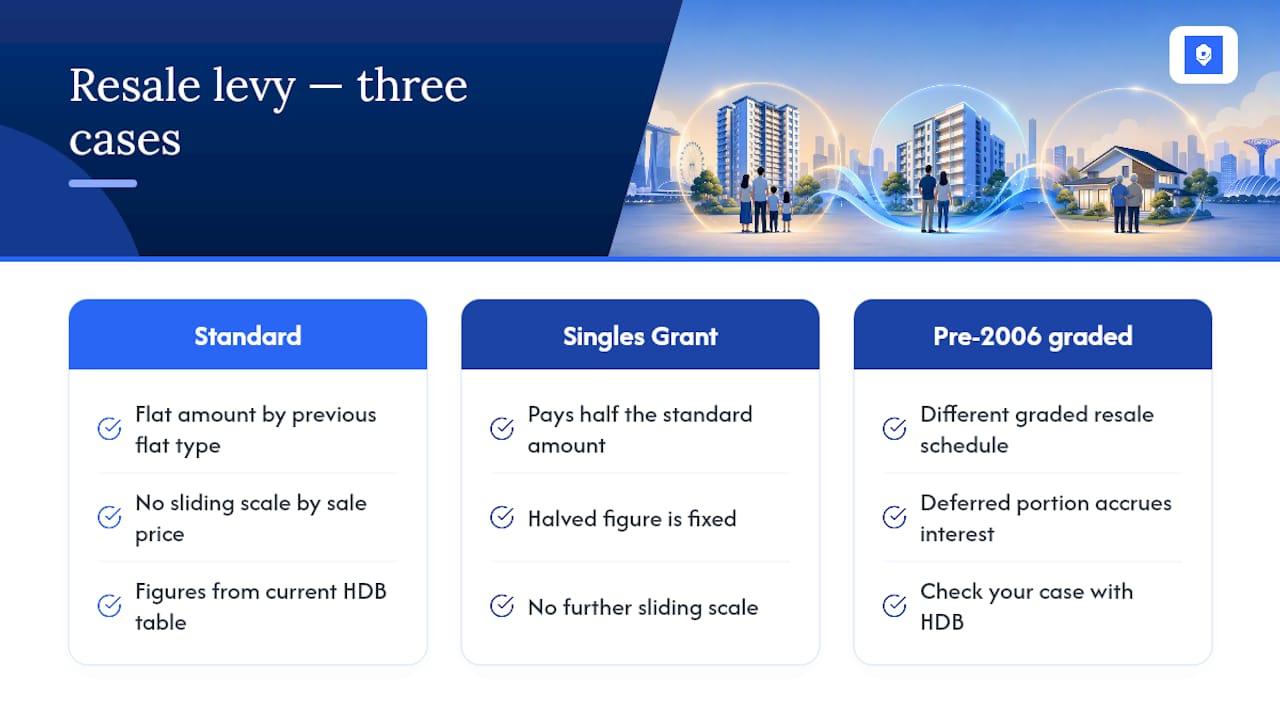
HDB sets the resale levy as a flat amount based on the flat type your household previously held a subsidy for, not on the value of either flat involved in the transaction. There is no sliding scale tied to sale price.
These figures apply under current rules and come directly from HDB's published table on conditions after buying a new flat.
Households that received the Singles Grant on their first subsidised purchase pay half the standard repayment amount. There is no further sliding scale beyond that halving; the figure is fixed regardless of how much your current flat eventually sells for.
Flats sold before 3 March 2006 fall under an older graded resale levy structure, where any deferred portion accrues interest at the prevailing rate rather than being interest free. If your first flat transaction predates that cutoff, the flat figures above do not apply, and you should check your specific case directly with HDB, as the graded system uses a different schedule.
How and when do you actually pay the resale levy?
Funds discipline matters here, because the rules are stricter than for most other property costs.
- Payment must be made in cash or from sale proceeds of your current flat.
- CPF Ordinary Account savings and housing loans cannot be used to pay the levy, per HDB's payment conditions.
- Collection typically happens at the point of signing for the new subsidised flat, or at key collection for an EC, rather than earlier in the process.
- Build the levy into your net proceeds calculation before you commit to a purchase agreement, not after.
Pro Tip: Ask HDB to confirm your exact levy amount and payment method in writing before you exercise your Option to Purchase on the new flat. Verbal estimates from agents or forums sometimes miss grant history that changes the figure.
Because the levy sits outside CPF and loan financing, it is one of the few five-figure costs in an HDB upgrade that must be covered from liquid cash or the proceeds banked from your outgoing sale. That timing gap, between selling one flat and settling on another, is where households most often get caught short.
Exceptions, concessions, and edge cases worth checking
Not every second-timer situation triggers the full standard levy. Several carve-outs change the amount or remove it altogether.
- Executive Condominiums launched before 9 December 2013 may be exempt from the resale levy, since HDB's terms and conditions for resale purchases treat these earlier EC launches differently. Worth reading a broader comparison of EC eligibility and launch-date rules if you are weighing an EC against a private condo.
- Singles Grant recipients pay half the standard resale levy amount across every flat type, as shown in the standard table above.
- Eligible elderly applicants (applicants and spouse aged 55 or above) can have interest on the resale levy waived for certain 2-room or 3-room flats, reducing the cash burden for downsizing seniors, per HDB's senior resale levy page.
- Pre-3 March 2006 sales fall under the graded levy structure mentioned earlier, with deferred balances accruing interest rather than sitting interest free.
If your situation touches any of these, do not rely on the standard rate table. Confirm your category with HDB directly, since misreading which exception applies is one of the costlier planning mistakes an upgrader can make.
Planning your upgrade: a checklist and worked example
Before signing anything, work through this sequence.
- Confirm your first-timer or second-timer status and whether you received a Singles Grant on your earlier purchase.
- Check your resale levy status on the HDB portal or your My HDBPage account rather than relying on memory of past grants.
- Estimate the exact levy using the flat-type table, halving it if the Singles Grant applies.
- Secure the cash or confirm sale proceeds timing, since neither CPF nor a loan can cover this cost.
A simple worked example: suppose your outgoing 4-room flat sells for $550,000, and your household previously held a subsidised 3-room flat, putting the levy at $30,000. Your usable net proceeds before other costs fall to $520,000. If a Singles Grant halved that to $15,000, net proceeds rise to $535,000, a $15,000 swing that changes how much cash you need on hand for the next purchase.
The resale levy does not appear on your sale contract. It surfaces at the second subsidised purchase, which is exactly why so many households discover the figure later than they should.
Valuation and affordability tools can help model these numbers against your specific flat and target purchase before you commit, treating them as planning support rather than a guarantee of your final figure.
When the levy fits your plan, and when it should make you pause
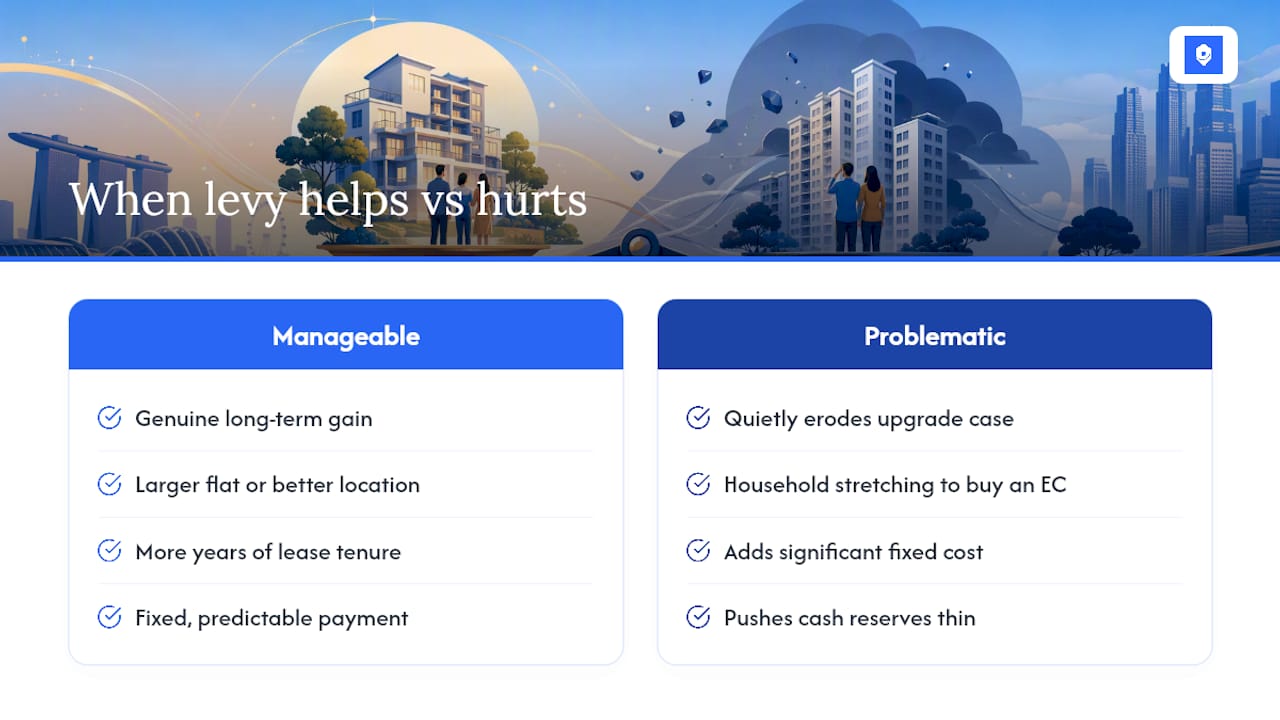
The resale levy is manageable when your upgrade genuinely improves your household's position long term, such as getting a larger flat, better location, or more years of lease tenure, and the fixed payment is a foreseeable line item rather than a surprise. It becomes a problem when it quietly erodes the financial case for upgrading, especially for households stretching to afford an Executive Condominium where the resale levy adds a significant fixed cost.
Rethink the timing, or consider an unsubsidised resale flat instead, if the levy pushes your cash reserves uncomfortably thin. When your situation touches an exception, an older EC launch, a graded pre-2006 sale, verify directly with HDB rather than trusting a rule of thumb.
— HAIO
Model your resale levy before you commit to an upgrade
Working out the true cash impact of a resale levy alongside stamp duties, agent fees, and your next mortgage is where most upgraders lose track of their numbers, especially when comparing several flat types or EC options at once. Haio brings instant property valuations, affordability checks, and mortgage rate comparisons into one place, so you can model your net proceeds after the levy before you sign anything rather than after. Run a scenario against your current flat's estimated value, factor in your specific levy amount from the table above, and see what cash buffer you actually need for the next purchase. Start by checking your flat's valuation and affordability position on Haio.
Where to verify your resale levy status officially
Confirm your exact figures directly with these sources rather than relying on secondhand estimates.
- Conditions After Buying a New Flat — HDB's core resale levy policy and payment rules.
- Terms and Conditions for HDB Resale Purchases — EC exceptions and graded levy details.
- Seller's Stamp Duty — IRAS — separate but relevant timing and cost context.
Sources
FAQ
Who needs to pay the resale levy?
Second-timers who previously received a housing subsidy and are now buying another subsidised flat, or collecting keys to an EC within its Minimum Occupation Period, owe the levy. First-timers are exempt.
How can you legally avoid paying the resale levy?
You cannot avoid it if you are a second-timer buying another subsidised flat, but buying an unsubsidised resale flat or private property instead generally removes the obligation, and Singles Grant recipients or eligible ECs launched before 9 December 2013 may qualify for a reduced or waived amount.
How is the resale levy calculated?
It is a fixed amount set by the flat type you previously held a subsidy for, not a percentage of your sale price, the resale levy is a fixed amount set by the flat type you previously held a subsidy for. Singles Grant recipients pay half the standard amount.
How much is the HDB resale levy?
Rates run from $15,000 for a 2-room flat up to $55,000 for an Executive Condominium in 2026, with intermediate amounts for other flat types.