

Seller's Stamp Duty applies to any residential property in Singapore acquired on or after 20 February 2010 that you sell within the holding period, and that holding period now runs longer than most sellers expect, following the MAS-announced changes of 3 July 2025, residential properties acquired on or after 4 July 2025 face a four-year holding period rather than the previous three years, with rates raised across every tier. There was no transition window, so if your Option to Purchase falls on or after that date, the new schedule applies regardless of when you agreed to buy.
The headline rates, as confirmed by IRAS-for-residential-property), now stand as follows:
- Sold within 1 year of acquisition: the highest applicable rate
- Sold within 1 to 2 years: a lower rate
- Sold within 2 to 3 years: a reduced rate
- Sold within 3 to 4 years: a minimal rate
- Sold after 4 years: no SSD payable
If you bought your property before 4 July 2025, the older three-year schedule with lower rates may still govern your sale, depending on your acquisition date. The next sections work through exactly how to establish which schedule applies to you, how the duty is computed, and what genuinely qualifies for exemptions.
Key Takeaways
| Point | Details |
|---|---|
| Check your acquisition date | Use the exercised OTP or vesting deed date, not the SPA signing date, to start the holding-period clock. |
| Know your rate schedule | Acquisitions from 4 July 2025 face 12%, 12%, 4%, 4%, then nil across four one-year tiers. |
| Computation base matters | SSD applies to the higher of selling price or market value at disposal, never the lower figure. |
| Exemptions are narrow | Developer and compulsory-acquisition exemptions and divorce or bankruptcy remissions each carry their own strict conditions. |
| Verify value before selling | Tools like haio's instant valuation help sellers cross-check market value and transaction history ahead of a sale. |
Table of Contents
- What determines whether seller stamp duty singapore rules apply to your sale?
- What are the current SSD rates and how is the duty calculated?
- How do you calculate SSD for a typical sale?
- Are there any SSD exemptions or remissions?
- What should you check before you sign anything?
- How do you pay SSD and keep the right records?
- How can haio help you check your SSD position?
- What the July 2025 changes actually mean for sellers
- Check your property's value before you decide on timing
- Frequently asked questions
- Sources
What determines whether seller stamp duty singapore rules apply to your sale?
SSD only applies to residential property, which IRAS defines broadly enough to catch most private homes, condominium units, and landed housing, but treats mixed-use buildings differently. When a property combines residential and commercial space, SSD is levied only on the portion attributable to residential use, calculated on that component's own higher-of-value figure rather than the whole building's sale price, according to IRAS's stamp duty guidance.
The date that starts your clock is not always obvious. For most private property purchases, the acquisition date is the date you exercised the Option to Purchase, not the date the Sale and Purchase Agreement was signed or the date the deal completed. For properties bought through other means, such as inheritance or a deed of gift, the vesting date typically governs instead. Getting this date wrong is one of the most common ways sellers miscalculate their exposure, particularly when they assume the OTP acceptance date matches whatever date appears on a covering letter rather than the date actually recorded on the exercised option.
Here is how to establish your position with reasonable confidence:
- Locate the exercised OTP or the deed that transferred the property to you, and note the exact date on that document.
- Calculate the number of full years between that acquisition date and your intended completion date.
- Check which SSD schedule governs, based on whether your acquisition date falls before or after 4 July 2025.
- If you acquired the property in stages, or hold only a partial interest, calculate each portion's holding period separately from its own acquisition date, since IRAS treats multi-acquisition parcels as distinct computations rather than averaging them together.
HDB owners generally have little to worry about here, because the Minimum Occupation Period, usually five years, almost always exceeds even the new four-year SSD threshold. That said, "usually" is not "always": owners who acquired an HDB resale flat through a route with a shorter or different occupation requirement should still confirm both dates independently rather than assuming MOP completion automatically clears SSD too.
Pro Tip: Pull your exercised OTP from your solicitor's file rather than relying on memory or a completion statement. The exercise date, not the negotiation date, is what IRAS uses to start the holding-period clock.
What are the current SSD rates and how is the duty calculated?
SSD is computed on the higher of the actual selling price or the market value of the property at the time of disposal, never on whichever figure happens to be lower or more convenient. This matters more than it sounds: if you sell below market value to a related party or in a rushed transaction, IRAS will still assess duty on the higher market valuation, not your discounted price.
The table below sets out the rates for residential properties, split by acquisition-date band, as confirmed by IRAS and the July 2025 policy announcement.
| Holding period | Acquired on/after 4 July 2025 | Acquired before 4 Jul 2025 |
|---|---|---|
| Up to 1 year | 12% | 12% |
| More than 1, up to 2 years | 12% | 4% |
| More than 2, up to 3 years | 4% | 4% |
| More than 3, up to 4 years | 4% | Not applicable |
| More than 4 years | Nil | Nil |
That fourth row is the real change. Under the old schedule, anything held past three years escaped SSD entirely. Under the revised rules, a seller in year three and a half now still owes 4% on the higher of price or valuation, a cost that did not exist for an identically timed sale under the previous regime.
Once you know your rate and your value base, the arithmetic itself is simple multiplication, but IRAS applies rounding conventions and a minimum duty threshold on the computed figure, so very small transactions may still attract a nominal minimum charge rather than a proportionally tiny sum. Where a property was acquired in separate tranches, for example a couple who bought an initial share and later acquired the remaining interest from a third party, SSD is calculated on each tranche independently, using each tranche's own acquisition date and its own share of the higher-of-value figure at disposal, rather than blending everything into a single average holding period.
For sellers with mixed-use property, remember the earlier point: only the residential-use portion is dutiable, and that portion's value, not the building's total sale price, forms the computation base.
How do you calculate SSD for a typical sale?
Numbers make this concrete. Assume in each case that the market value at disposal is confirmed to be equal to or below the actual selling price, so the selling price is the relevant base.
Scenario one: sale within 10 months of purchase. You bought a condominium unit for $1,200,000 and, ten months later, receive an offer of $1,250,000.
Scenario two: sale at 18 months. You bought a unit for $900,000 (acquired after 4 July 2025) and sell 18 months later for $950,000, comfortably in the "more than 1, up to 2 years" band. The rate is 12%.
To work out your own figure, you need four inputs:
- Your exact acquisition date, taken from the exercised OTP or vesting deed.
- Your intended or actual disposal date.
- The higher of your selling price or a current market valuation.
- The applicable rate for your holding-period band under the correct schedule (pre or post 4 July 2025).
Are there any SSD exemptions or remissions?
Statutory exemptions exist, but they are narrower than many sellers assume. Licensed housing developers selling units in the ordinary course of business are exempt under specific conditions, and properties acquired through compulsory acquisition by the state are also excluded from SSD, but neither exemption applies simply because a sale feels involuntary or urgent.
Remission, which is different from exemption, is available in certain circumstances but each ground has its own strict test:
- Transfers arising from a matrimonial court order or divorce settlement, where the transfer falls within the terms IRAS recognises.
- Sales connected to bankruptcy proceedings, where a trustee disposes of a bankrupt's property under specific statutory conditions.
- Cases involving death or the winding up of an estate, which carry their own separate treatment outside the general remission framework.
Some of these situations require no application because they fall outside SSD's scope entirely, while others require a formal application to the Commissioner of Stamp Duties with supporting documentation before any relief is granted. Legal commentary is consistent on this point: exemptions and remissions are scenario-specific, and assuming you qualify without checking the exact statutory wording against your own facts is a common and costly mistake.
Pro Tip: If your situation involves divorce, bankruptcy, or an estate, raise the SSD question with your conveyancing lawyer before you accept an offer, not after. Some remission applications need to be lodged alongside the transfer, not retrospectively.
What should you check before you sign anything?
Run through this sequence before agreeing a sale price or signing an OTP as a seller:
- Retrieve your original exercised OTP, Sale and Purchase Agreement, and Title Deed, and confirm the acquisition date printed on the earliest binding document.
- Request a current market valuation from a certified valuer, particularly if you intend to sell below what you believe the market value to be.
- Calculate your exact holding period in years and months, then identify which rate schedule, pre or post 4 July 2025, governs your acquisition.
- Speak to a property lawyer if your holding period sits close to a tier boundary, if you hold a partial interest, or if a divorce, bankruptcy, or estate matter is involved.
The 4 July 2025 changes took effect with no transition period, so a seller who assumed the old three-year rule still applied because they exchanged contracts years ago could be badly wrong if their actual acquisition date falls on or after that cut-off.
How do you pay SSD and keep the right records?
SSD is declared and paid through IRAS's myTax Portal using your stamp duty login credentials, typically arranged through the conveyancing lawyer handling your sale. A few practical points worth flagging:
- Your law firm is obliged to complete the Seller's Stamp Duty declaration form as part of the transaction and retain it for at least five years for audit purposes.
- IRAS applies rounding conventions to the computed duty figure and enforces a minimum duty on very small transactions.
- If your computation involves an unusual scenario, such as a partial interest or a mixed-use property, contact IRAS directly for clarification rather than guessing.
How can haio help you check your SSD position?
Working out whether SSD applies, and for how much, depends heavily on getting the market value and the acquisition date right, and this is where a tool like haio earns its place in the process. haio's instant valuation feature gives you a data-backed estimate of current market value, useful for sanity-checking a selling price against recent comparable transactions before you commit to a figure. Its transaction history and market analytics let you see how comparable units in your development have traded recently, which is broadly the same kind of evidence IRAS itself may weigh when assessing market value at disposal.
haio's tools are built for estimation and planning, not for legal or tax determination. Where a sale is contested, or where the SSD figure has real financial consequences, the authoritative valuation and the final ruling on liability rest with IRAS and with certified valuers, not with any app.
What the July 2025 changes actually mean for sellers
The policy intent behind extending the holding period to four years and raising every tier's rate is straightforward: discourage short-term speculative flipping, not penalise ordinary homeowners who sell for genuine life reasons. If you are within touching distance of a rate-tier boundary, the arithmetic now punishes an early sale more heavily than it used to, so confirming your exact acquisition date and getting an independent market valuation early is worth the modest effort. Tools like haio can narrow the guesswork around timing and value considerably, though the final call on liability always sits with IRAS.
Check your property's value before you decide on timing
Working out your SSD exposure starts with a number most sellers only guess at: what your property is actually worth today. Haio's instant valuation tool gives you a data-backed estimate in minutes, drawn from real transaction history in your development and surrounding area, so you are not relying on a single agent's opinion or an outdated listing price when you weigh up whether to sell now or wait out the holding period.
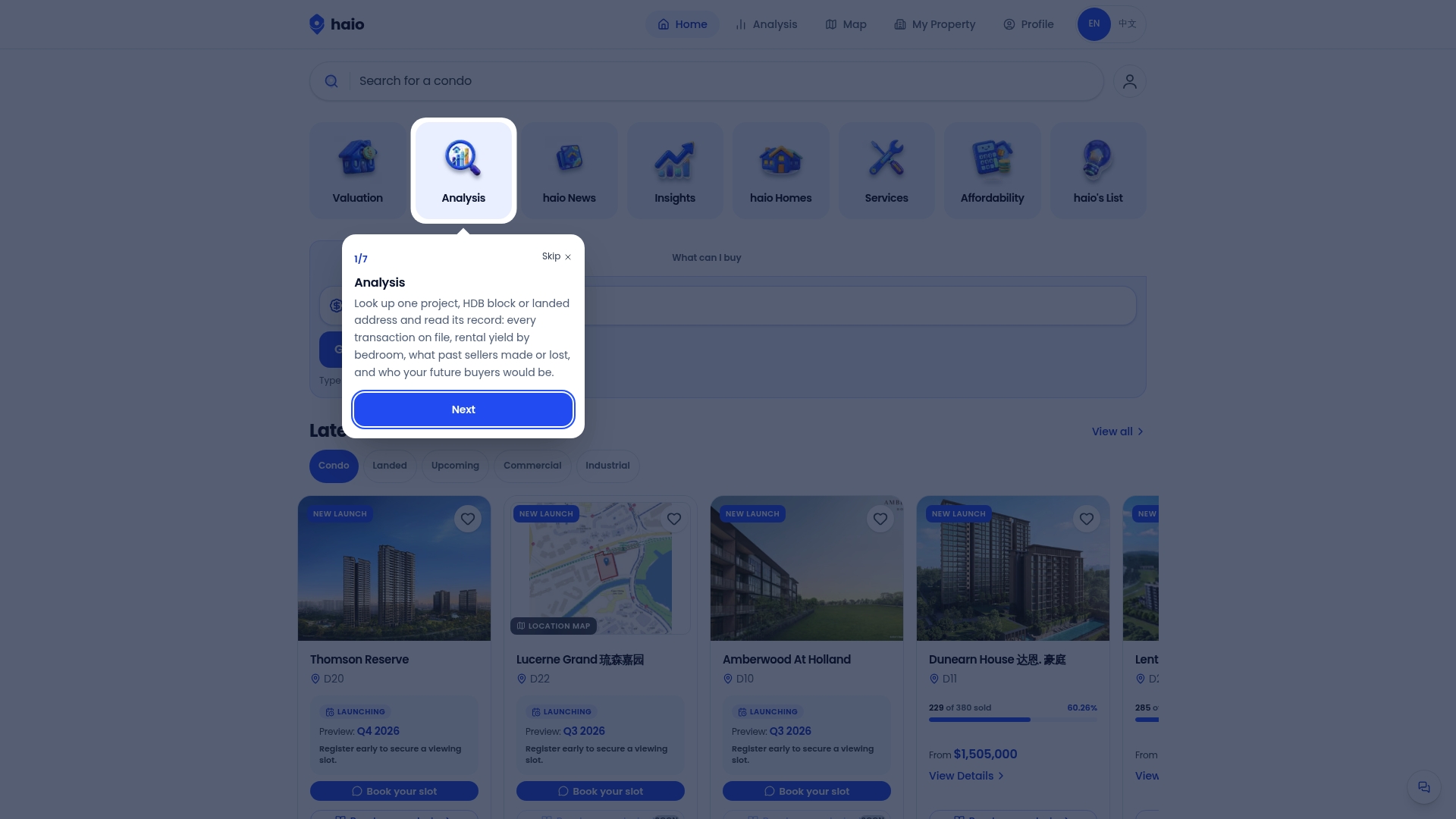
The platform also lets you track comparable transactions over time, which is useful if your holding period sits close to a rate-tier boundary and the difference between selling this month and selling in three months could mean thousands of dollars in duty. None of this replaces a certified valuation or legal advice where the numbers genuinely matter, but as a first check before you commit to a sale price, it gives you a firmer footing. Explore haio's valuation tools to get a current estimate for your property and see how it compares against recent transactions nearby.
Frequently asked questions
Does seller stamp duty in Singapore apply to HDB flats? Yes, in principle, but the Minimum Occupation Period, typically five years, almost always exceeds the four-year SSD threshold, so most HDB owners never actually pay it. Confirm both dates independently rather than assuming one clears the other.
What happens if I exercised my OTP just before 4 July 2025? Your acquisition date governs which schedule applies. If your OTP was exercised before 4 July 2025, the earlier three-year schedule with lower rates may apply; if exercised on or after that date, the new four-year schedule applies immediately, with no transition period.
Is SSD calculated on my agreed selling price or the market value? IRAS uses whichever figure is higher between your actual selling price and the market value at the time of disposal, which prevents sellers from understating duty by selling below market value.
Can I get SSD waived if I'm selling due to divorce? Remission may be available for transfers connected to a matrimonial court order, but the exact statutory conditions must be met and, in many cases, a formal application to the Commissioner of Stamp Duties is required rather than an automatic waiver.
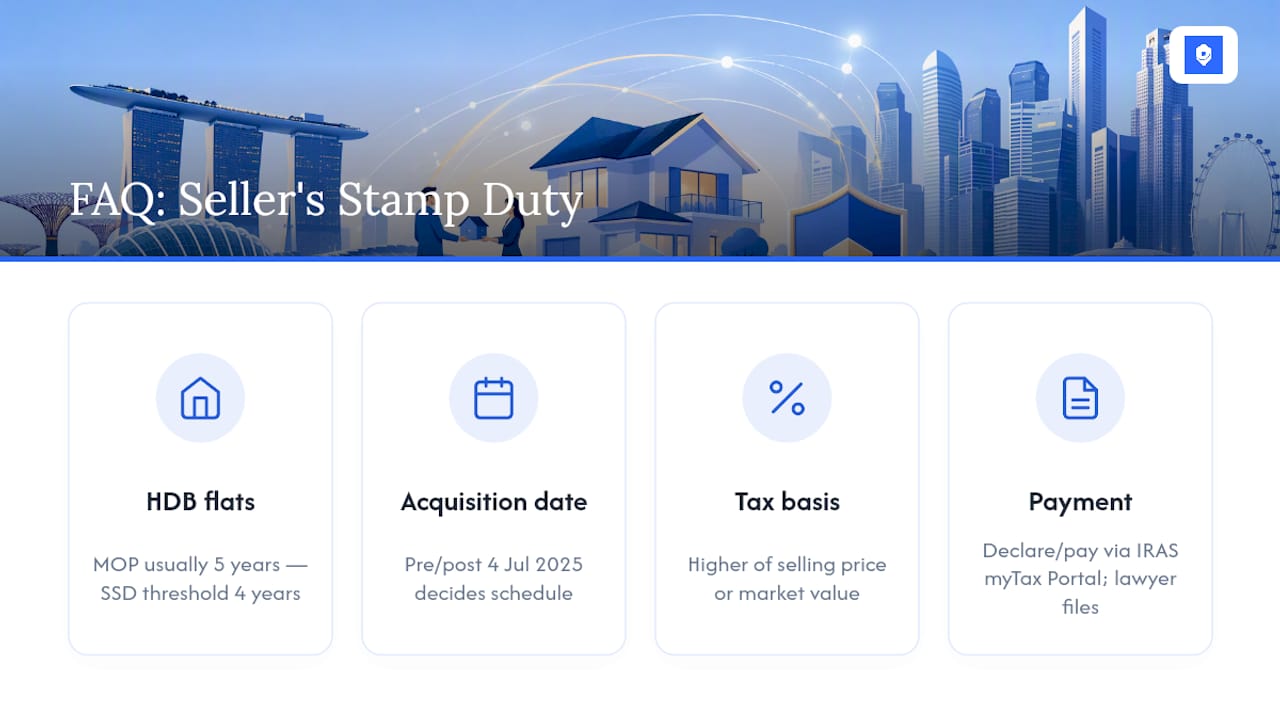
How do I pay SSD once my sale completes? Payment and declaration are handled through IRAS's myTax Portal, usually arranged by the conveyancing lawyer managing your transaction, who is also required to complete and retain the SSD declaration form.