

SORA has fallen sharply since 2023 and, according to bank forecasts, is now stabilising near the bottom of its cycle. Three-month compounded SORA sits close to 1.1 to 1.2%, meaning most SORA-pegged mortgages are repricing lower this quarter than a year ago. Homeowners should treat any further downside as limited and start stress-testing their budgets for a rebound, not a further fall.
TL;DR:
- The 3M compounded SORA has decreased to around 1.1 to 1.2% and is expected to stabilize near this level until late 2026, with a potential slight increase afterward.
- Repricing on most SORA-pegged mortgages occurs every three months, allowing for some lag and smoothing of short-term SORA fluctuations.
- A 1 percentage point rise in SORA would increase monthly payments on a $600,000 loan by roughly $280 to $300, so homeowners should stress-test their budgets for this scenario.
- The divergence between 1M and 3M SORA can signal upcoming rate movements, with short-term rates leading longer-term trends, crucial for timing refinancing or rate management.
- SORA's transactional, real-market basis makes it more stable and less manipulable than previous benchmarks like SIBOR or LIBOR, driving a more transparent mortgage market.
Table of Contents
- Current SORA rate trend: the latest snapshot
- Why SORA has been falling, and what happens next
- How SORA moves show up in your mortgage payments
- Which SORA tenor should you actually watch?
- A practical checklist for homeowners and buyers
- SORA versus SIBOR and LIBOR: what changed and why it matters
- How MAS monetary policy moves SORA
- What actually pushes SORA up or down
- Where SORA is headed over the longer term
- What this means for borrowers and lenders alike
- How Haio helps you make sense of SORA movements
- SORA data and mortgage decisions: a straight-talking view
- Get guided mortgage analytics built for the SORA era
- Sources
- FAQ
Current SORA rate trend: the latest snapshot
The Monetary Authority of Singapore publishes SORA, the SORA index, and the 1M, 3M, and 6M compounded rates every business day at 9am, one day after the transactions they reflect. That daily cadence is what makes SORA verifiable in a way older benchmarks never were, since MAS calculates it from the actual volume-weighted average of unsecured overnight SGD interbank transactions rather than from bank estimates.
By mid-2026, market trackers showed 3M compounded SORA had fallen to roughly 1.1 to 1.2%, down from around 2.9% in May 2026. That is the figure most SORA-pegged home loans use for repricing.
A few practical points worth bookmarking:
- MAS also releases the SORA index and transaction volume alongside the rate, which analysts use to gauge market depth.
- Third-party sites such as mortgage brokers and rate trackers redistribute this data quickly, but always check the publication date, since a rate quoted from two weeks ago can already be stale.
- Overnight SORA moves daily; the compounded tenors smooth that noise over one, three, or six months.
Why SORA has been falling, and what happens next
SORA's descent from its 2023 peak has tracked global rate cycles quite closely, but not perfectly. The rate climbed through 2023 as the US Federal Reserve tightened aggressively, then began easing through 2024 and 2025 as inflation cooled and SGD liquidity conditions shifted.
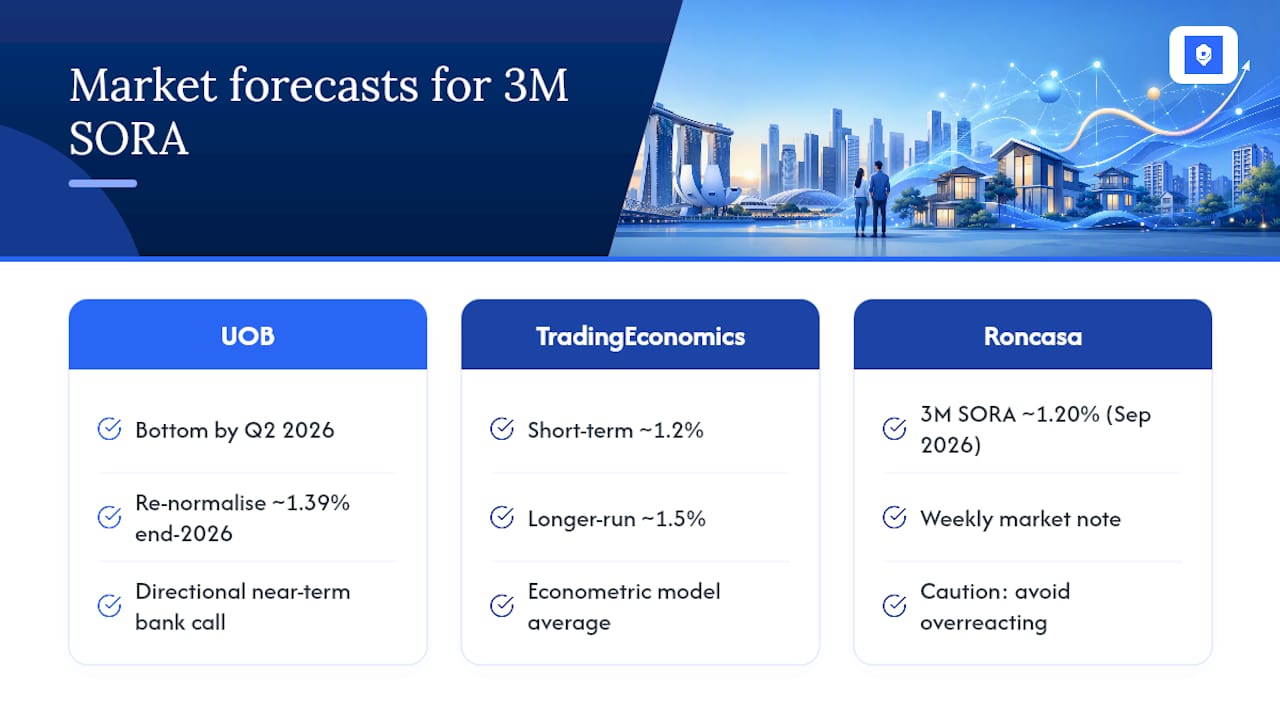
By the numbers: UOB told The Straits Times that Singapore rates could bottom out by the second quarter of 2026, with a re-normalisation toward roughly 1.39% by the end of the year. TradingEconomics' macro models put short-term expectations closer to 1.2%, with longer-run scenarios centring nearer 1.5%.
The gap between those two figures is not a contradiction. It reflects the difference between a bank's directional call on the next few quarters and an econometric model's longer average. Singapore's rate path is shaped by MAS's exchange-rate-centred monetary policy and local SGD liquidity, not purely by the Fed. That is why Singapore rates can bottom out ahead of, or diverge from, US rate cycles, a pattern The Straits Times has flagged in its coverage of bank commentary on the rate-bottoming timeline. Roncasa's weekly market notes, tracking 3M SORA around 1.20% in early September 2026, add a useful caution here: don't overreact to a single day's print. Treat the UOB figure as a plausible base case and the TradingEconomics range as the wider band of possibility, not a competing prediction.
How SORA moves show up in your mortgage payments
Banks price most floating-rate home loans off 3M compounded SORA plus a spread, because that tenor balances responsiveness with stability better than the overnight rate. Spreads on Singapore mortgages typically run 0.5 to 1.2 percentage points, depending on the bank, loan size, and package terms.
Here is how that plays out on paper:
- Take the current 3M compounded SORA, around 1.1 to 1.2%.
- Add your bank's typical spread for a mid-range package.
- Your all-in rate lands near 1.9 to 2.0%, a meaningful drop from the 3.7 to 4% many borrowers faced when SORA peaked in 2023.
Stress-test example: on a $600,000 outstanding loan over 25 years, a 1 percentage point rise in SORA adds roughly $280 to $300 to the monthly instalment, depending on the remaining tenure. That is the kind of swing a household budget needs to absorb before signing up to a SORA-pegged package, not after.
Because repricing follows the 3M compounded average rather than daily prints, payments only adjust every quarter. That lag smooths short-term volatility but also means your rate can keep falling (or rising) for weeks after the underlying SORA trend has already turned, a point Roncasa's commentary makes explicit when it warns against reading too much into any single day's figure.
Which SORA tenor should you actually watch?
Not all SORA figures carry equal weight for a homeowner. Each tenor tells a slightly different part of the story:
- 1M compounded SORA moves fastest and works as an early warning signal for where 3M SORA is heading next quarter.
- 3M compounded SORA is the pricing benchmark most banks use, so it is the number that determines your actual repricing.
- 6M compounded SORA and overnight SORA offer broader context, useful for spotting longer cycles or unusual daily spikes.
When 1M SORA starts rising faster than 3M, or 3M rises while 6M has yet to follow, that divergence often signals repricing pressure building before it shows up in your statement. Short-term movers and investors planning an exit within a year or two should watch 1M closely. Long-term owners are better served tracking 3M and 6M together, since those tenors reflect the trend that will actually shape years of repayments.
A practical checklist for homeowners and buyers
Turning the SORA trend into a decision takes five steps, not a vague sense of direction:
- Check your spread. Pull your loan contract and confirm the exact percentage your bank adds to 3M SORA.
- Calculate your current all-in rate. Add that spread to the latest published 3M compounded SORA.
- Run a 1 to 1.5 percentage point stress test. Model what your instalment looks like if SORA rises by that much, a rule of thumb many mortgage brokers apply when assessing affordability buffers.
- Watch for tenor divergence. If 1M SORA starts climbing while 3M lags, treat that as an early cue to review your package.
- Compare risk options. Short fixed-rate periods, SORA packages with rate caps, and partial hedging structures each trade off certainty against upside if rates keep falling.
Pro Tip: Size your buffer around the stress-tested rate, not the current one. If your household can comfortably absorb a 1.5 percentage point rise in SORA today, a future refinancing decision becomes a choice rather than an emergency.
SORA versus SIBOR and LIBOR: what changed and why it matters
SORA replaced SIBOR as Singapore's primary interest rate benchmark, a transition that mirrored the global retirement of LIBOR after regulators found it vulnerable to manipulation because it relied on estimated, rather than transacted, interbank rates. SIBOR was similarly quote-based, which meant it could drift from actual market conditions during periods of stress.
SORA fixes that structural weakness. It is calculated purely from real, executed overnight interbank transactions, which is why MAS can publish a statement of compliance with the IOSCO Principles for Financial Benchmarks, the international standard for benchmark governance. That transaction-based design makes SORA harder to distort and more reflective of genuine market liquidity conditions at any given moment.
For homeowners, the practical difference shows up in volatility patterns. SIBOR sometimes moved in step with expectations rather than actual conditions, occasionally lagging or overshooting real market shifts. SORA tends to track realised liquidity more tightly, which is part of why 3M compounded SORA has become the standard reference for new mortgage packages since the market-wide shift away from SIBOR. Older loans still pegged to SIBOR are now a shrinking minority, and most banks no longer originate new SIBOR-linked packages, having migrated their product shelves to SORA-based pricing.
How MAS monetary policy moves SORA
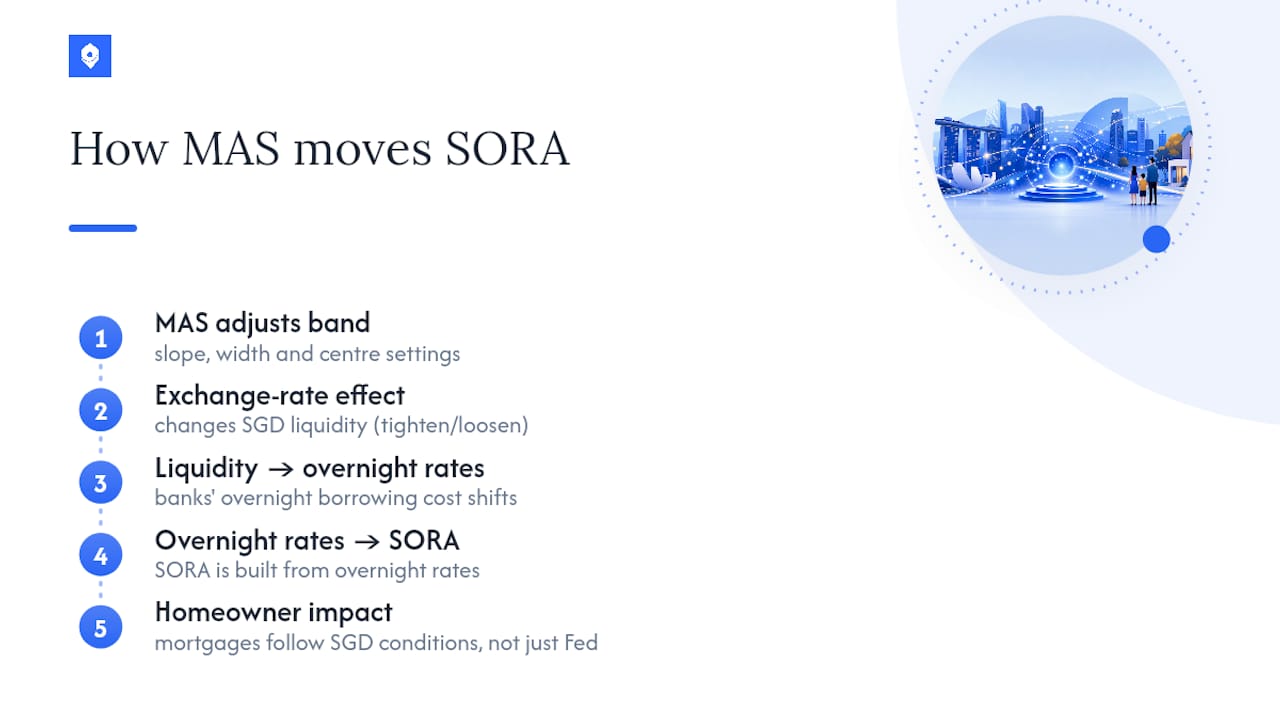
MAS does not set SORA directly the way some central banks set a policy rate. Instead, it manages monetary policy through the Singapore dollar's exchange rate against a basket of currencies, adjusting the slope, width, and centre of the currency's trading band. Those settings influence SGD liquidity conditions in the banking system, which in turn shape the overnight rates banks charge each other, the raw material SORA is built from.
When MAS tightens by steepening the exchange-rate band, SGD liquidity tends to tighten, and SORA drifts upward. When policy eases, as it has done through parts of 2024 and 2025, liquidity loosens and SORA falls. This is the mechanism behind the point The Straits Times raised in its coverage of bank forecasts: Singapore rates can bottom out on a different timeline than US rates, because MAS is responding to SGD-specific conditions, not simply importing the Fed's decisions.
That distinction has real consequences for homeowners tracking headlines. A Fed rate cut does not automatically mean SORA falls next quarter, and a Fed pause does not guarantee SORA holds steady either. SGD liquidity, trade flows, and MAS's own policy stance all filter into the number before it reaches your mortgage statement. Watching MAS's twice-yearly monetary policy statements, typically released in April and October, gives a more direct read on where SORA is headed than watching US Federal Open Market Committee meetings alone.
What actually pushes SORA up or down
Several forces interact to produce the daily SORA print, and disentangling them helps explain why the rate does not move in a straight line.
SGD liquidity conditions sit at the centre of it. When banks have abundant SGD to lend overnight, the rate they charge each other falls; when liquidity tightens, perhaps around quarter-end reporting dates or tax payment periods, SORA can spike temporarily before settling back. Seasonal liquidity squeezes are a known feature of the market and one reason Roncasa's commentary repeatedly cautions against reading too much into any single day's print.
Global capital flows matter too. Singapore's status as a regional financial hub means large cross-border flows, from trade settlement to portfolio investment, can shift SGD demand and supply quickly. US Federal Reserve policy still exerts an indirect pull, since global dollar liquidity conditions affect SGD funding costs, even though MAS's own exchange-rate framework provides some insulation.
Market sentiment and expectations play a role as well. If traders anticipate MAS will ease policy at the next review, SORA can start drifting down in anticipation, before any formal announcement. That forward-looking behaviour is part of why 1M SORA often moves ahead of 3M, acting as an early signal of where sentiment is heading.
Finally, structural demand for SGD funding, from banks managing balance sheets around regulatory reporting dates, adds short bursts of volatility that show up in overnight SORA but rarely persist into the compounded tenors most mortgages are priced against.
Where SORA is headed over the longer term
Bank forecasts and macro models diverge on timing but largely agree on direction: further sharp falls look unlikely from here, and a gradual re-normalisation is the more probable path through 2026 and beyond. UOB's projection of roughly 1.39% by end-2026 sits close to TradingEconomics' longer-run scenario range near 1.5%, suggesting the current low-1% range may prove to be a floor rather than a new normal.
That said, treat both figures as directional guidance, not fixed appointments. Bank forecasts get revised quarterly as new data arrives, and econometric models are built on historical relationships that can break down when policy regimes shift. The honest way to use these numbers is as a planning range: assume SORA could sit anywhere between roughly 1.1% and 1.5% over the next 12 to 18 months, with the higher end more likely the longer the horizon stretches.
For long-term owners, this outlook argues for building repayment plans around the middle of that range rather than the current low point. For prospective buyers weighing fixed versus SORA-pegged packages, a fixed rate locked in near today's floating levels offers certainty, but a SORA package still carries meaningful room to fall further before it starts rising, depending on how quickly MAS eases policy in the coming reviews. Either choice is defensible if it survives the stress test.
What this means for borrowers and lenders alike
For borrowers, the current trend is straightforwardly favourable in the near term but carries a warning attached. Falling SORA has already cut monthly instalments meaningfully compared with 2023 peaks, freeing up household cash flow. The risk is complacency: a household that stretches its budget to the maximum a low SORA rate allows has no buffer left when the re-normalisation bank forecasts anticipate actually arrives.
For financial institutions, the SORA transition and its recent volatility have reshaped how mortgage products get designed. Spread structures, rate caps, and hybrid fixed-then-floating packages have all grown more common as banks compete to offer borrowers protection against the kind of swing SORA delivered between 2023 and 2026. Lenders also face their own repricing risk on the asset side, since a large book of SORA-pegged loans moving in the same direction at once affects portfolio-level interest income.
The broader implication is that SORA's transparency, publishing daily, built from real transactions, and compliant with international IOSCO standards, has made Singapore's mortgage market more predictable in one sense and more directly exposed to rate cycles in another. Borrowers can see exactly what is driving their rate. That visibility only pays off if it is used to plan ahead rather than simply to track the number each month.
How Haio helps you make sense of SORA movements
The platform pulls SORA-linked mortgage data, current bank rates, and affordability metrics into one place, so tracking your all-in rate against the latest 3M compounded figure does not mean chasing several websites. Affordability checks on the platform let you run the kind of stress test described above against your own loan numbers rather than a generic example.
Start with Haio's free tools to check your current rate exposure. Homeowners weighing a refinance or a switch between packages can then move to haio+ for deeper analytics, including custom repricing reports and mortgage rate comparisons across lenders.
SORA data and mortgage decisions: a straight-talking view
The conventional advice around SORA tends to treat every rate movement as urgent news. It isn't. What matters far more than any single print is whether your household budget survives a 1 to 1.5 percentage point swing, because that is the range practitioners actually use when stress-testing mortgage affordability. A homeowner who ignores the daily headlines but runs that stress test properly is in a stronger position than one who refreshes a rate tracker every morning and does nothing with the number.
The bigger blind spot Haio sees in how people approach SORA is the assumption that falling rates and rising rates require different strategies. They don't. Both call for the same discipline: know your spread, know your all-in rate, and know your buffer. The direction of SORA changes the urgency, not the method.
— HAIO
Get guided mortgage analytics built for the SORA era
This service is an alternative to piecing together mortgage decisions from scattered bank websites and rate-tracker screenshots. Instead of manually checking your spread against whichever SORA figure you last saw quoted, haio+ subscribers get real-time alerts when their all-in rate shifts, personalised affordability checks that already factor in current SORA trends, and custom reports comparing your package against what else the market is offering. It brings published MAS data daily, plus bank forecasts and spread benchmarks, into one dashboard built around users' own numbers rather than generic examples. If you are weighing a refinance or simply want to know where your mortgage stands against the current SORA trend, start with a free affordability check on Haio and see whether upgrading to haio+ makes sense for your situation.
This article is general information, not a substitute for advice from a qualified financial advisor. Consult a qualified financial professional about your own circumstances before acting on anything here.
Sources
- SORA interest rate benchmark — Monetary Authority of Singapore
- Singapore interest rates to bottom out by Q2 2026 — The Straits Times
- Interest Rate in Singapore — TradingEconomics
- SORA rate today Singapore — Nexus Mortgage
- SORA weekly commentary — Roncasa
FAQ
Is SORA expected to rise in 2026?
Most forecasts point to stabilisation rather than a fresh fall, with UOB projecting a gradual rise toward roughly 1.39% by end-2026 and TradingEconomics' longer-run models sitting near 1.5%.
What is the current trend of interest rates in Singapore?
Singapore rates have fallen sharply since their 2023 peak and appear to be nearing the bottom of that cycle, with 3M compounded SORA trading around 1.1 to 1.2% in mid-2026.
Will mortgage rates go down further in 2026?
Further significant falls look unlikely based on current bank and model forecasts; most analysts expect SORA-pegged mortgage rates to stabilise near current levels before edging upward later in the year.
What is the 3-month SORA rate today?
Recent tracker data puts 3M compounded SORA at roughly 1.1 to 1.2%, though the exact figure changes daily and should always be checked against MAS's own published feed.
How often does my SORA-pegged mortgage repayment change?
Most loans reprice quarterly, tracking the 3M compounded SORA average, which smooths out daily volatility but means your rate can lag behind the latest trend for several weeks.