
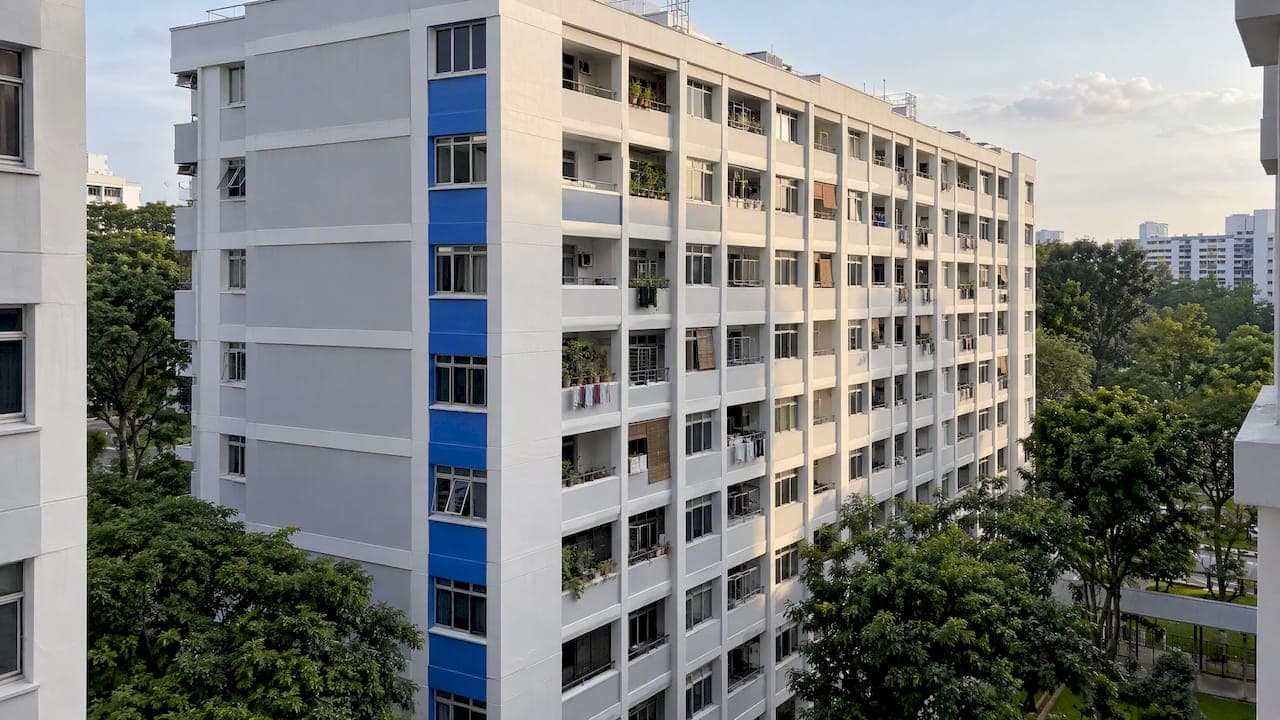
A north–south facing home in Singapore is one whose main windows open towards the north and south rather than the east and west, which keeps the low morning and afternoon sun off most glazing. Because the country sits almost on the equator, the sun rises roughly in the east and sets roughly in the west all year, so the two sides that receive the longest, lowest-angle sun are the east and west ones. The label is a useful starting point, but it describes a building's axis, not the comfort of each room, and that distinction is what this article sets out.
TL;DR
- North–south orientation in Singapore is mainly a comfort and airflow consideration: it limits low-angle east and west sun, and it is not a guarantee of a cool unit.
- The sun sets close to due west at the equinoxes, north of west from about March to September and south of west from about September to March, so west-facing units take the hottest afternoon sun throughout the year.
- Singapore research links west-facing flats with greater thermal discomfort and higher electricity use, while measurements also show that a north-facing bedroom can be hotter than an east-facing living room, so each room needs its own assessment.
- Glazing size, shading, neighbouring blocks and cross-ventilation can change the outcome as much as the compass direction.
Table of Contents
- What north–south orientation means in Singapore
- Why the sun path makes north and south the easier sides
- West sun in Singapore: heat, glare and electricity
- A north-facing room is not automatically cool
- Room-by-room guide
- How to check the sun exposure of a unit
- Managing west sun when the unit faces it
- Orientation for buyers, tenants and investors
- Perspective: reading orientation with data
- Using haio to compare units and stacks
- FAQ
- Sources
What north–south orientation means in Singapore
Orientation is the direction a building or a window faces. In practice, listings and buyers use it in two related senses. The first is the facing of the whole block: a north–south block has its long facades looking north and south, and its short gable ends looking east and west. The second is the facing of a particular unit or room, such as a living room that faces north or a bedroom that faces west.
The two senses are connected but not identical. A block laid out along an east–west axis can still contain units whose bedrooms face a gable end, and a unit in a north–south block can have a service yard or a bedroom window on the side that receives afternoon sun.
Orientation is also a planning decision. HDB's February 2025 sales brochure for Stirling Horizon states that its blocks are oriented north–south to maximise natural ventilation. The stated reason is airflow, which shows that the term covers more than sunlight, and that a north–south layout is something planners choose deliberately for tropical conditions.
Why the sun path makes north and south the easier sides
Singapore lies at about 1.3 degrees north of the equator, which means the sun passes nearly overhead at midday and moves across the sky on a steep arc. According to Harth's Singapore sun path diagram, the sunset azimuth is 293.5° (north-west) on 21 June and 246.6° (south-west) on 21 December, with sunset close to due west at the equinoxes. The same source gives a noon sun elevation of 67.9° on 21 June, 65.2° on 21 December and about 88.7° at the equinoxes.
Three practical points follow from those figures.
- East and west windows take low-angle sun. The sun is near the horizon after sunrise and before sunset, so its rays travel almost horizontally into a room. Harth concludes that this low-angle sun is the main source of glare and heat entering windows.
- North and south windows take high-angle sun. At noon the sun is steeply overhead, and a horizontal overhang or a balcony slab above the window can block much of it. Harth notes that high noon sun is more amenable to horizontal overhangs, whereas low east and west sun is harder to block.
- The sunset direction moves with the season. Monoloft's guidance for Singapore homes describes the sun setting somewhat north of west from about March to September and somewhat south of west from about September to March. A unit facing north-west or south-west therefore sees direct afternoon sun for part of the year, which is why exact bearing matters as much as the headline label.
The country's climate adds the final factor. The Meteorological Service Singapore describes a tropical climate with high and fairly uniform temperatures and humidity throughout the year, and notes that solar heating produces prominent hour-to-hour variation. Its 1991–2020 normals put daily maximum temperatures at roughly 30.5–32.4°C. Afternoon sun on a west-facing window is therefore added to an already warm day, which is why time of day matters when judging a home.
West sun in Singapore: heat, glare and electricity
West sun refers to direct sunlight entering a home from mid-afternoon until sunset, typically the hottest part of the day. East windows receive the sun earlier, when the building and surrounding air have had less time to warm up, so the curtains.sg sun and glare checker describes the west side as the hotter of the two.
Singapore research supports this at the household level. A study of 275 households in high-density housing reported greater daytime and night-time thermal discomfort in west-facing flats, and those flats used 33% more electricity than the average. West-facing flats were significantly hotter than south- and southeast-facing flats, and the south and southeast flats were among the least uncomfortable. The same authors argue that natural air circulation can matter more than perceived sunlight for comfort, partly because much of the occupancy happens at night, when no direct sun is present.
That last point is relevant for bedrooms. A west-facing wall absorbs heat during the afternoon and can release it into the evening, so the effect of west sun is not confined to the hours of direct light.

What the numbers do not say
The 33% figure and the comfort findings describe a particular sample of Singapore households from a 2009 study, not a rule for every unit. They compare averages across many flats with different layouts, floor levels, ventilation and cooling habits. A west-facing unit with deep balconies, good shading and a through breeze may perform better than a north-facing unit with large unshaded glazing and a blocked airflow path.
A north-facing room is not automatically cool
The popular shorthand, that north and south are the "good" directions, holds as a general tendency. A facade study linked to NUS found that east and west facades had the highest simulated annual indoor temperatures, while north and south had the lowest. It also found that increasing glazing generally increased indoor air temperature.
The same paper includes a measurement that qualifies the shorthand. In one HDB unit measured in July, the north-facing bedroom was up to 4.7°C hotter than the east-facing living room on a sunny afternoon. A single unit on a single month cannot be generalised, but it shows that room-level conditions (window size, the height of the sun, shading from neighbouring blocks, and whether air flows through the room) can override the orientation label on the day.
The Joya Architects guide to house orientation reaches a similar conclusion: east-facing rooms generally face lower-angle morning sun, west-facing rooms face lower-angle afternoon sun, and north and south rooms can receive seasonal sun depending on date and exact bearing. Its advice is to assess each room's windows, glazing size, shade, neighbouring buildings and intended use rather than apply one label to the whole home.
Room-by-room guide
The table below summarises how the sources above translate into room choices. It describes tendencies, and the checks in the next section decide the individual case.
| Room | Facing that usually suits | Reason | What can change it |
|---|---|---|---|
| Living room | North or south, or east if morning light is welcome | Steady daylight with less low-angle sun | Large glazing, an unshaded balcony, a blocked breeze |
| Master bedroom | North, south or east | Avoids afternoon heat that carries into the night | Neighbouring blocks, floor level, window size |
| Children's or study room | North or south | Less glare on screens and desks | Time of use: afternoon study meets west sun |
| Kitchen | East, or any side with a clear exhaust path | Morning sun when the room is least used for cooking | Cross-ventilation and extraction |
| Service yard and bathrooms | West is a common location | Rooms with short occupancy tolerate afternoon heat | Drying clothes benefits from the sun |
The kitchen and service-yard rows reflect a common planning logic, not a finding from the research cited here: rooms used briefly or for drying can sit on the hot side so that bedrooms and living areas do not.
How to check the sun exposure of a unit
A compass label on a listing is a starting point, and a few checks turn it into evidence.
- Find the real bearing of each window. A map compass shows the direction of the block, and a phone compass on the balcony confirms the window. A unit labelled north–south may have its bedroom window on a gable end.
- Visit in the afternoon. The Meteorological Service points to time of day as the key variable. A viewing at 3pm to 5pm shows direct west sun, glare and heat that a morning viewing hides. NEA reports that the UV Index commonly reaches Very High or Extreme levels between 11am and 3pm on days with little cloud, so midday also matters for exposure on balconies and unshaded windows.
- Note what shades each opening. Joya Architects recommends checking when direct sun reaches each opening, what shades it, where air can enter and leave, and how the room will be used. Neighbouring blocks, trees and the unit's own balcony all change the answer.
- Look at glazing size. NEA's guidance for new home owners says rooms with large windows, or windows facing the sun on the east–west axis, may need greater air-conditioning capacity.
- Trace the airflow. Stand at the window and check whether a breeze can pass through the room to an opening on the other side. Closed internal doors and large furniture interrupt it.
- Read the floor plan. Window positions, wall types and the location of the bomb shelter or yard are visible on the plan, and the floor plan reading guide covers the wall symbols worth checking before a viewing.
Managing west sun when the unit faces it
Orientation is often a trade-off with price, location, floor level and layout, and a west-facing unit can be livable with the right measures. NEA's household energy-efficiency guidance recommends curtains, blinds or solar window films to block unwanted heat, especially at east- and west-facing windows. It also recommends keeping windows and airflow paths unobstructed, and using partitions to reduce the area to be air-conditioned. Its interior design tips add that large furniture should not block natural ventilation.
The NUS-linked facade research supports shading as a measure: in its simulations, reducing glazing and adding a 1 m shading device lowered peak temperatures next to the facade. Design practice shows the same logic at a larger scale. Eco-Business reported on Singapore's B House, which was shaped and oriented to reduce east- and west-sun heat gain, with north- and south-facing windows and shutters supporting ventilation, daylight and shading.
In practical terms, the sequence for a west-facing room is usually: shade the glazing (film, blinds or an external device), keep the breeze path open, place wardrobes and storage against the west wall rather than in front of the window, and cool only the occupied area.

Orientation for buyers, tenants and investors
The weight given to orientation differs by reader.
- Homebuyers committing to a long tenure can reasonably treat orientation as a durable attribute, because unlike a renovation, the direction of a window cannot be changed later. Resale demand for particular facings also varies by project, so transaction history by unit helps more than assumptions.
- Tenants can test a unit with an afternoon viewing and weigh the electricity cost of a hotter unit against the rent difference.
- Investors comparing similar units can check whether recent transactions differ by stack and floor. Condo pages such as Bukit Timah Mansions and Bishan Loft list price history and transactions by project, which is the starting point for that comparison.
- Buyers weighing HDB against private options will find that orientation is only one factor among tax, tenure and layout, and the HDB versus condo comparison sets out the others.
Feng shui is a separate question. Some readers use "facing" in the sense of the direction a main door or window faces for geomantic reasons, and the rules differ by school and practitioner. The comfort considerations in this article are about sun, heat and airflow and do not depend on that tradition.
Perspective: reading orientation with data
We regard orientation as one input among several, and a label that tends to be given more weight than the evidence supports. The Singapore research points the same way: the compass direction shifts the odds on heat and glare, while glazing, shade, floor level, neighbouring blocks and airflow decide the outcome in a given room.
For that reason we suggest treating a north–south listing as a prompt to ask questions. Which room faces which way? What is the window area relative to the wall? What does the unit see on its west side? Prices in the transaction record are also informative: where two stacks in the same project sell at different levels, buyers have usually priced in something about view, floor or facing, and the record shows how large that gap has been.
Haio brings Singapore residential transaction data, valuation and market analysis into one place so that a comparison of this kind can be made on recorded sales rather than on a listing's description. We also think a viewing at the hottest time of day remains the most reliable test, and no dataset replaces it.
— HAIO
Using haio to compare units and stacks
Once a shortlist exists, Property Analysis on haio brings together the transaction record and market data for a project, and the Affordability check shows what a budget allows before viewings begin. Basic access is available, and the haio+ subscription is priced at S$49 per month or S$499 per year for premium analytics, valuation reports and Master Plan tools. Master Plan tools are relevant here because a future building on the west or south side of a unit can change its sun exposure and view.
FAQ
Which direction does the sun set in Singapore?
The sun sets in the west, but the exact point moves through the year. Harth's sun path data gives 293.5° (north-west) on 21 June and 246.6° (south-west) on 21 December, with sunset near due west at the equinoxes. West-facing windows therefore receive afternoon sun in every month.
Is north–south orientation always better in Singapore?
It is generally more comfortable, because the facades avoid low-angle east and west sun, and the NUS-linked facade study found the lowest simulated temperatures on north and south sides. It is not a guarantee, however: one measured HDB unit had a north-facing bedroom up to 4.7°C hotter than its east-facing living room on a sunny afternoon. Window size, shading and ventilation matter alongside the facing.
Is a west-facing flat in Singapore a bad choice?
It tends to be the hottest option in the afternoon, and the 275-household study found greater discomfort and 33% higher electricity use in west-facing flats. It can still suit a buyer who is out during the day, who values a lower price, or who plans shading with blinds, film and kept-open airflow paths, as NEA recommends.
What is the best orientation for a bedroom?
North, south or east facings generally avoid the afternoon heat that builds up on west walls and carries into the night. The Singapore housing study found south- and southeast-facing flats among the least uncomfortable. Checking the particular window in the afternoon is still the more reliable test.
Sources
- HDB Sales Launch February 2025, Stirling Horizon brochure
- Sun Path Diagram for Singapore, Harth
- Remedies for west-facing homes, Monoloft
- Climate of Singapore, Meteorological Service Singapore
- Sun and Glare Checker for Singapore Windows, curtains.sg
- Urban Geometry, Indoor Thermal Comfort and Cooling Load
- Impact of facade design on indoor air temperature and thermal comfort in residential buildings
- House Orientation in Singapore: Sun, Shade and Ventilation, Joya Architects
- UV Radiation and UV Index, NEA
- New Home Owners guide, NEA
- Energy Efficient Interior Design Tips, NEA
- Here's Singapore's first carbon negative house, Eco-Business