

Rental property expenses in Singapore fall into two groups: the costs of owning and letting the unit (mortgage, property tax, maintenance, insurance, agent fees, repairs) and the subset of those costs that the Inland Revenue Authority of Singapore (IRAS) lets a landlord deduct from rental income. The difference between the two decides the tax bill, and the choice between claiming actual expenses and a flat 15% deemed deduction decides how much record-keeping a landlord needs. This guide sets out both groups, the tax rules that govern them, and a worked calculation of net rental income.
TL;DR
- Costs of owning a rental unit include mortgage repayments, property tax, maintenance or MCST fees, insurance, agent commission, repairs and vacancy periods; only some are tax-deductible.
- IRAS allows deductions for expenses incurred solely to produce rental income during the tenancy, such as mortgage interest (not principal), property tax for the rental period, fire insurance, repairs, agent commission and advertising.
- Renovations, improvements, principal repayments, penalties and depreciation are not deductible.
- An individual may instead claim 15% of gross rent as deemed expenses, while still deducting actual mortgage interest; the better option depends on the year's real costs.
- Non-owner-occupied residential property is taxed at 12% to 36% of annual value, which is a ownership cost that applies even when the unit is vacant.
Table of Contents
- The two lists every landlord keeps
- Costs of owning and letting a rental property
- Property tax: the ownership cost that depends on use
- Which expenses IRAS allows against rental income
- Actual expenses or the 15% deemed deduction
- Worked example: net rental income under both methods
- Renting out a room
- Vacancy and difficult tenancies
- Checking the numbers before and after buying
- Perspective
- haio+ for landlords and investors
- FAQ
- Sources
The two lists every landlord keeps
A landlord tracks expenses for two separate purposes. The first is cashflow: what leaves the bank account each month and each year to keep the unit let. The second is tax: which of those outflows IRAS accepts as a deduction against rental income. The two lists overlap but are not the same, and mixing them up is the most common source of an overstated return.
IRAS also separates two taxes that are often confused. Property tax is a tax on ownership, payable whether the property is owner-occupied, rented out or vacant. Income tax applies to earnings, including rental income, and is payable only if the property is actually rented out. Property tax therefore sits on the cashflow list in every year, and on the tax-deduction list only for the period the unit is let.
Costs of owning and letting a rental property
The recurring costs most landlords in Singapore plan for are listed below. Amounts depend on the unit, the lease and the financing, so each should be taken from the landlord's own statements and quotes.
- Mortgage repayments. Both interest and principal leave the account, but only the interest portion is deductible for tax. The principal builds equity and is treated as a capital item.
- Property tax. Charged annually on the property's annual value (AV), the estimated yearly rent set by IRAS. Rates are covered in the next section.
- Maintenance and sinking fund contributions. Condominium owners pay management corporation (MCST) fees; HDB owners pay town council service and conservancy charges. The unit's own statements show the amount.
- Fire insurance. Mandatory for most mortgaged properties and deductible when it relates to the rental period.
- Agent commission. Paid when a tenant is found, and often equal to a share of the monthly rent for the lease term.
- Repairs and maintenance. Air-conditioning servicing, plumbing, replacing worn fittings and similar work that restores the unit to its original state.
- Utilities and internet. Where the owner pays these and does not recover them from the tenant, they count as expenses.
- Vacancy. Months without a tenant still carry the mortgage, property tax and maintenance fees, but produce no rent.
One-off costs at purchase (stamp duties, legal fees, valuation, renovation and furnishing) belong in the investment return calculation rather than the annual deduction list. Our guide to rental property cash flow in Singapore shows how these are combined with monthly outflows, and the guide to rental investment returns shows how they feed into yield.
Property tax: the ownership cost that depends on use
Property tax is the expense most affected by how the unit is used. Owner-occupier rates, which are lower, apply only where an individual or married couple owns and lives in the property, and the concession covers one home for a married couple. The rates do not apply where the whole property is rented out, sold or vacant.
For non-owner-occupied residential property, the rates effective from 1 January 2024 are:
| Annual value (AV) band | Rate |
|---|---|
| First S$30,000 | 12% |
| Next S$15,000 | 20% |
| Next S$15,000 | 28% |
| Above S$60,000 | 36% |
The government's explainer gives the reasoning: these properties are mainly investment properties that could be rented out, so they are taxed at higher rates than homes. The one-off rebates announced for recent years apply to owner-occupied properties, so a landlord whose unit is fully let should not budget for them. Our note on Singapore property tax and the rebate covers the owner-occupier side.
An owner who lets out a home and moves elsewhere changes category. IRAS treats the property as non-owner-occupied once it is let, and the owner-occupier rate must be applied for again after the tenancy ends and the owner moves back.
Which expenses IRAS allows against rental income
IRAS's test is that an expense must be incurred solely to produce the rental income, during the tenancy period, and must not be private or capital in nature (IRAS guidance for self-employed persons states the same test). Applying it to the IRAS list of deductible items for rented property gives the following.
Generally deductible
- Mortgage interest (not principal repayments)
- Property tax for the period the unit is let
- Fire insurance
- Repairs that restore the property to its original state, and routine maintenance
- Agent commission and advertising to find tenants
- Legal fees and stamp duty to obtain, grant, renew or extend a lease; from Year of Assessment (YA) 2022 this includes the first tenant, where the lease term does not exceed three years and excluding renewal or extension options
- Fees paid to a third-party property manager
- Replacement of furniture to restore the original state
- Utilities and internet paid by the owner and not reimbursed
Generally not deductible
- Principal repayments on the loan
- Penalties
- Renovations and improvements
- Depreciation
- Expenses on a property that is not generating rental income
The line between a repair and an improvement is where claims most often go wrong. Replacing a broken water heater with an equivalent unit restores the original state; adding a new feature, or upgrading kitchen cabinets to a higher specification, improves it. Keeping the invoice description specific (what was replaced, and why) makes the classification clear.
Rental income itself is wider than the monthly rent. IRAS counts the full amount of rent and related payments received, including payments for maintenance and furniture rental, and a forfeited rental deposit is generally treated as part of gross rent. Rent is taxed from the date it is due and payable, not when it is received. Landlords who handle deposits should also read the rental deposit checklist.
Actual expenses or the 15% deemed deduction
An individual landlord may choose between two methods for a residential property. Under the first, actual deductible expenses are claimed with supporting documents. Under the second, 15% of gross rental income is deducted as deemed expenses in place of those expenses, and actual mortgage interest is still deducted on top.
The conditions are:
- The same method must be used for all tenanted residential properties in the same YA.
- The deemed option is unavailable if no deductible expense other than interest was incurred.
- It is unavailable if the income is derived through a partnership or trust.
IRAS designed the 15% figure to be broadly in line with common outlays such as property tax, maintenance fees and minor repairs, and to ease record-keeping. A landlord who claims only deemed expenses does not need to keep records for those items, but should keep mortgage interest documents. Landlords who claim actual expenses should keep supporting documents for five years.
Worked example: net rental income under both methods
IRAS's own example uses gross rent of S$4,000 a month, which is S$48,000 for the year, with other deductible expenses of S$7,000 and housing loan interest of S$9,500.
| Actual expenses | 15% deemed expenses | |
|---|---|---|
| Gross rent | S$48,000 | S$48,000 |
| Other expenses | S$7,000 | S$7,200 (15% of gross rent) |
| Mortgage interest | S$9,500 | S$9,500 |
| Net rental income | S$31,500 | S$31,300 |
In this case the deemed option gives a lower net figure by S$200 and needs fewer records. A second IRAS example, with gross rent of S$5,000 a month (S$60,000 a year), interest of S$12,000 and deemed expenses of S$9,000, gives net rent of S$39,000.
The result changes with the year's costs. A landlord whose actual expenses are well above 15% of rent, for instance because of a major repair that qualifies as restoring the original state, may find the actual-expense method gives the lower net figure. A worked case from a corporate services firm makes the same point: the better choice can differ from one year to the next, so the comparison is worth redoing annually.
The net rental income is declared under the other income section of the income tax return, with gross rent and expense details. It is added to other income and taxed at the landlord's marginal rate. Where the landlord is a non-resident, the position differs and should be checked against IRAS guidance.
Renting out a room
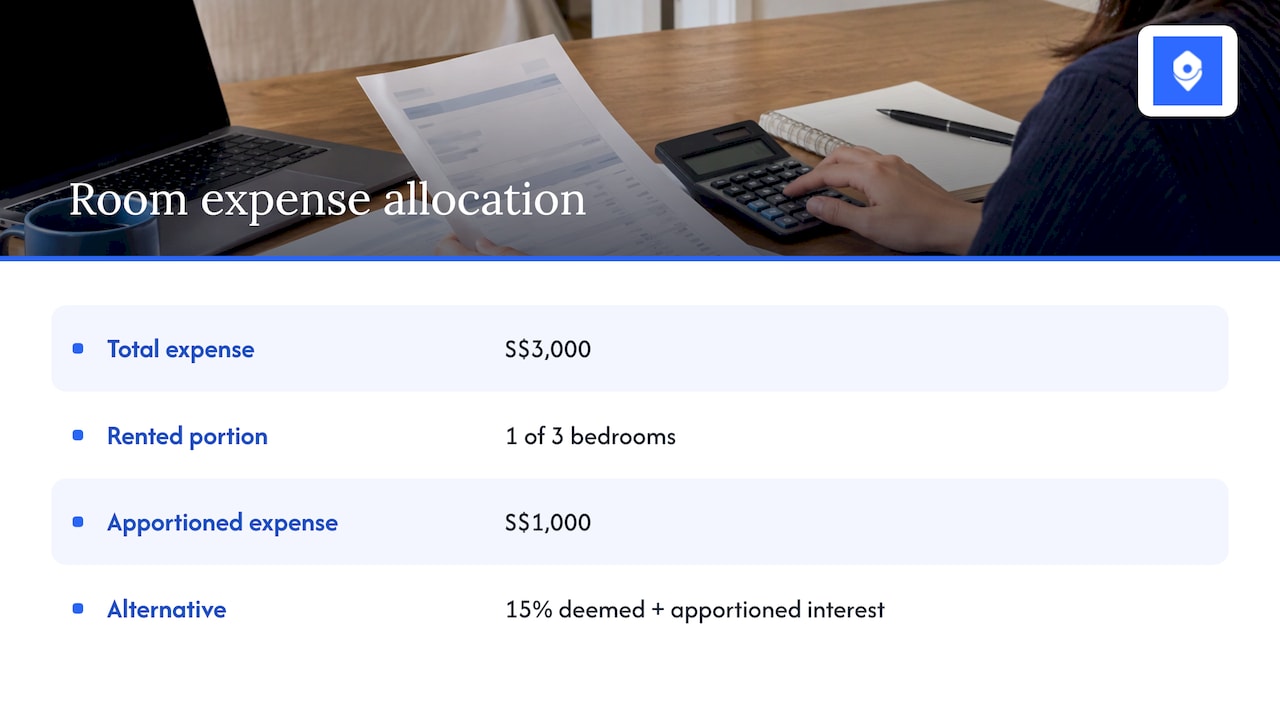
Where only part of a unit is let, expenses are apportioned. IRAS gives the example of one room out of three bedrooms: an expense of S$3,000 is apportioned to S$1,000. A landlord may instead use the 15% deemed option together with apportioned interest. For HDB flats, subletting rooms is subject to rules on tenant numbers and occupancy, which are summarised in the HDB room rental rules guide.
Vacancy and difficult tenancies
Vacancy is the expense that rarely appears in a tax return, because no rent is produced and the deduction rules are tied to the tenancy period. It still costs the owner the mortgage, the property tax at the non-owner-occupied rate and the maintenance fees. A landlord who budgets one to two months of vacancy per year in a cashflow model avoids the shortfall appearing as a surprise. The costs of an unresolved tenancy dispute are another reason some owners decide to sell; the issue is discussed in an overseas guide to selling with bad tenants, which shows how vacancy and arrears add up.
Checking the numbers before and after buying
Expenses matter most when they are set against price and rent. A landlord comparing units needs the recent transaction prices, realistic rent, the loan cost and the annual tax and fee outflows in one view. haio publishes price history and transactions for individual condominiums, such as LE MARQUE, and an affordability check that tests a budget against a purchase. The resulting net yield is explained in the net yield and cashflow guide and in the guide to rental property profitability.
Perspective
Most landlords underestimate expenses for one reason: the figures sit in different places. The mortgage statement, the property tax notice, the MCST invoice and the agent's receipt each tell part of the story, and a gross yield quoted from a listing tells none of it.
Our view is that a rental decision should start from transparent transaction data and end with a net figure. That is why haio brings Singapore residential property data sources together, so that valuation, market analysis, affordability and mortgage rates can be read side by side before an offer is made. A realistic expense line is easier to build when the price paid by comparable buyers and the loan cost are already on the same page.
For landlords who want analytics beyond the free tools, haio+ adds premium analytics, valuation reports and Master Plan tools.
HAIO
haio+ for landlords and investors
The free haio tools cover news, transactions and basic checks. haio+ is the subscription tier with premium analytics, valuation reports and Master Plan tools, priced at S$49 per month or S$499 per year. Landlords who run several units or compare purchases regularly use it to keep valuation and market data in one place.
FAQ
Are rental property expenses tax-deductible in Singapore?
Yes, where they are incurred solely to produce rental income during the tenancy and are not private or capital in nature. Mortgage interest, property tax for the rental period, fire insurance, repairs, agent commission and advertising qualify. Principal repayments, renovations and depreciation do not.
Should I claim actual expenses or the 15% deemed deduction?
Compare both for the year: calculate net rent with actual expenses and with 15% of gross rent, keeping mortgage interest in both. In IRAS's example the deemed method came out S$200 lower and needed fewer records. A year with a large qualifying repair can reverse the result.
Is the 2026 property tax rebate available to landlords?
The one-off 2026 rebate is for owner-occupied residential properties: 15% for HDB flats and 10% capped at S$500 for private homes. A property that is fully let is taxed at non-owner-occupied rates.
Is the agent commission for a first tenant deductible?
From YA 2022, legal fees and stamp duty to obtain, grant, renew or extend a lease are deductible for first tenants as well, where the lease term does not exceed three years. Agent commission and advertising to find tenants are listed among allowable expenses.
Sources
- IRAS: Renting out your property
- IRAS: Lower property tax rates for owner-occupied residential properties
- gov.sg: Property tax on residential property
- IRAS: Income from property rented out
- IRAS: Tax obligations of self-employed persons
- IRAS e-Tax guide: Simplification of claim of rental expenses for individuals
- BDO: Taxation on rental income
- Raffles Corporate Services: Rental income tax for individual landlords
- MOF: One-off property tax rebate for owner-occupied residential properties in 2026