
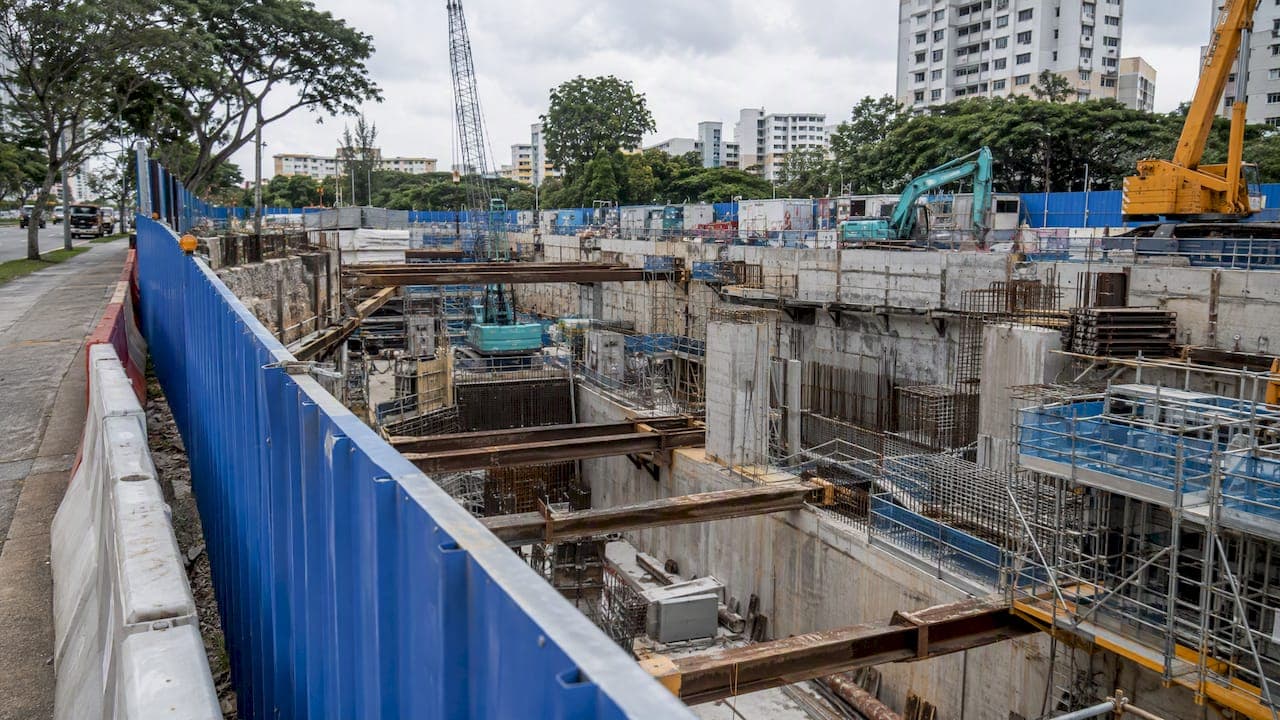
The Cross Island Line (CRL) is Singapore's eighth MRT line and its longest fully underground one, and its stations will change the transport profile of several residential areas in the east, north-east and west. For property, the line matters most in three ways: which neighbourhoods gain a direct rail link, when each phase is due to open, and how much of the benefit is already reflected in prices. This article sets out the official timeline, the areas served, the evidence from earlier MRT openings, the factors that can limit or delay any gain, and a checklist for buyers, owners, investors and tenants.
TL;DR
- The CRL spans more than 50km. Phase 1 is expected by 2030, Phase 2 and the Punggol Extension by 2032, and Phase 3 stations in the late 2030s (LTA).
- Past evidence from Singapore points to a measurable but not unlimited premium: a study of the Circle Line estimated about 8.6% for private non-landed homes within 600m of stations (ScienceDirect, 2017).
- Part of any uplift tends to arrive before opening, so buyers who enter at the announcement-to-opening stage may already be paying for some of the benefit.
- Distance to the station exit, the walking route, the lease and the nearby land supply matter as much as the line itself.
Table of Contents
- What the Cross Island Line is
- Phases and opening timeline
- Neighbourhoods and property areas served
- How the line may affect home prices
- Rents, tenants and investment yields
- Risks, delays and construction impacts
- What to check when assessing proximity to the line
- Our perspective
- Testing a CRL home with haio
- FAQ
- Sources
What the Cross Island Line is
According to the Land Transport Authority (LTA), the CRL is planned as Singapore's longest fully underground MRT line, spanning more than 50km across the eastern, western and north-eastern corridors. It is intended to link hubs such as Jurong Lake District, Punggol Digital District and Changi, offering an alternative to routes that currently pass through the central area (LTA).
The LTA states that commuters travelling to and from western Singapore on the CRL can expect time savings of up to 50 minutes, and that the line will help redistribute commuter load across the rail network. In January 2023, when construction was announced, LTA said the completed line was expected to carry more than 600,000 riders a day initially from 2030 and over 1 million in the longer term (LTA news release, 18 January 2023).
For property, the distinctive feature is the type of journey the line enables. Many existing lines radiate towards the city centre, so a trip between, for example, Pasir Ris and Jurong Lake District involves transfers. The CRL adds direct east-west and non-central connections, which changes the accessibility of regional hubs rather than only of the city fringe.
Phases and opening timeline
The line is being built in stages, and the timelines below are LTA's current expectations, which can be revised as construction progresses.
| Segment | Expected opening | Areas and notes |
|---|---|---|
| Phase 1 | By 2030 | Loyang, Tampines, Pasir Ris, Defu, Hougang, Serangoon North, Ang Mo Kio |
| Punggol Extension | By 2032 | Branch towards Punggol Digital District |
| Phase 2 | By 2032 | Western areas including Sunset Way and West Coast, with interchanges at King Albert Park and Clementi |
| Phase 3 | Late 2030s (stations targeted) | Extension west from Jurong Lake District to Gul Circle |
Source for the table: LTA.
Two points follow from this schedule. First, the openings are separated by several years, so a home near a Phase 1 station and one near a Phase 3 station sit at very different points on the same price-anticipation curve. Second, a station that is "targeted" for the late 2030s carries far more timing uncertainty than one under active construction, and a buyer's holding period should be tested against the later end of any range.
Neighbourhoods and property areas served
The LTA lists Loyang, Tampines, Pasir Ris, Defu, Hougang, Serangoon North, Ang Mo Kio, Sunset Way, West Coast, Jurong Lake District and Gul Circle among the areas served (LTA). In property terms these fall into a few groups.
Eastern and north-eastern estates
Pasir Ris, Tampines and Hougang are mature or maturing HDB-dominated estates with a mix of private condominiums nearby. The CRL adds a cross-island option to estates that already have the East-West Line or North East Line, so the incremental benefit is less about having any MRT at all and more about shorter trips to the west and to Changi. Readers can compare recent transactions in Pasir Ris and Hougang before judging how much of the line is priced in.
In Hougang, the Urban Redevelopment Authority (URA) has said a mixed-use complex will be built above the MRT station, and that nearby sites could yield roughly 750 to 800 HDB flats or about 1,000 condominium units, with another site capable of about 1,200 flats or more than 1,550 condominium units (The Straits Times, 2024). That supply supports local demand, but it also means new competing stock close to the station.

Ang Mo Kio and the central-north corridor
Ang Mo Kio is already well served by the North South Line. The CRL turns it into an interchange-style node with an east-west connection, which is relevant for owners who currently need a transfer at a central station. Current prices and transactions are summarised on the Ang Mo Kio area page.
West Coast, Clementi and the Jurong Lake District
Phase 2 improves access to western areas including Sunset Way and West Coast, with interchanges at King Albert Park and Clementi. URA states that new homes will be introduced around the upcoming CRL stations at Clementi and West Coast, and that Jurong Lake District will have a direct CRL connection to Changi Airport once the line is extended to Terminal 5 (URA Master Plan 2025). Buyers following the western story can start with the Jurong East area page for the existing price base.
Market commentators describe the CRL as a catalyst for the Jurong Lake District because it enables direct, non-central transfers and so alters the accessibility of a peripheral regional hub (Winfred Quek, 2026). This is a viewpoint rather than a measured result, and it is best treated as a hypothesis to test against transaction data.
How the line may affect home prices
Analysts quoted in 2022, when the Phase 2 stations were announced, estimated that homes near King Albert Park, Clementi and West Coast could see a price boost of up to 3% on announcement, with further gains of up to 5% when the stations are completed in 2032. One property consultant expected prices to rise by about 15% over 10 years after the locations were announced (CNA, 2022). These are forecasts by market participants, not guarantees, and they were made before the interest-rate and cooling-measure changes that followed.

What earlier MRT openings show
The stronger evidence comes from academic work on lines that have already opened.
- Circle Line. A spatial difference-in-differences study estimated a 10.6% effect on non-landed private homes within 600m of stations, and 8.6% after accounting for spatial dependence between zones (ScienceDirect, 2017). The same study found that anticipation effects appeared one year before opening but diminished closer to the opening date.
- Resale HDB flats. A Duke University hedonic analysis found significant anticipatory price effects that peak about two years before a station opens, with proximity within 1km substantially influencing transaction prices. It also observed a sharp price gradient inside 1km, with the sensitivity to distance falling significantly beyond 2km (Duke University, 2017).
Taken together, the studies suggest three practical conclusions. The premium concentrates within a short walking distance of the station. A share of it is captured before the first train runs. And the figures are averages for a specific line and period, so they indicate an order of magnitude rather than a forecast for any single unit.
Older condominiums and en bloc potential
OrangeTee & Tie, quoted in 2022, said older condominiums near new CRL stations may see higher en bloc potential because of improved accessibility and project value (CNA, 2022). En bloc outcomes depend on many other factors, including land supply, development charges and owner consensus, which haio discusses in its note on en bloc potential and Government Land Sales supply.
Rents, tenants and investment yields
The evidence on rents is thinner than the evidence on sale prices. The same CNA coverage notes that projects near MRT stations may be popular among tenants, and that leasing out homes for future rental income may enhance a project's value (CNA, 2022). No quantified rental premium for the CRL has been published by an official source, so any specific percentage in a marketing brochure should be treated with caution.
For investors, the logic usually runs through three channels:
- Tenant pool. Shorter journeys to employment nodes such as Changi, Jurong Lake District and the one-north-style hubs widen the set of tenants who will consider a location.
- Entry price against yield. If prices rise ahead of opening while rents move more slowly, gross yield can compress, so the yield at today's price matters more than the yield at last year's price.
- Construction-period drag. Properties beside active worksites can be harder to let until works end.
Tenants, for their part, should expect that rents near new stations tend to be set by the whole neighbourhood's demand, so the best time to value a station-adjacent rental is after comparing current asking and transacted rents in the same street or project.
Risks, delays and construction impacts
A station on a map is not an operating station. Factors that can limit or delay a property benefit include:
- Schedule risk. Opening dates are LTA's expectations at a point in time, and underground works can be revised for ground conditions or other constraints.
- Construction disturbance. For Phase 3, LTA identifies noise, dust, safety and traffic as construction concerns. The Government will acquire seven industrial properties and partially acquire eight others, and noise and vibration studies and mitigation measures are planned (LTA joint news release, 2026).
- Supply response. Where URA plans new housing near a station, as in Hougang, additional units can moderate price growth for existing homes.
- Priced-in effect. The academic findings above show that a portion of the gain arrives before opening, so late buyers capture less of it.
Infrastructure projects of this scale also change the surrounding built environment for years. For readers who want to understand how such works are classified and delivered, a guide to the types of civil infrastructure projects in Singapore gives useful context on what construction around an interchange can involve.
What to check when assessing proximity to the line
The following points apply to any home near a planned CRL station. They draw on the distance patterns in the research above and on standard due diligence.
For buyers and first-time homebuyers
- Walking distance, not straight-line distance. The studies measure within 600m and 1km, so check the real sheltered or unsheltered route to the station exit, including crossings and gradients.
- Which phase serves the area. A Phase 1 station and a Phase 3 station imply different waiting periods, and the later one is subject to wider uncertainty.
- Affordability at today's price. A premium that may be partly priced in should not stretch the monthly commitment. An affordability check based on a budget, tenure and unit type shows what the loan implies before the line opens.
- Remaining lease. A station helps location value but does not offset a short remaining lease, which affects both financing and resale.
For homeowners
- Compare the recent transactions of your project with those of similar projects farther from the station, to see whether a gap already exists.
- Check whether your estate has an announced redevelopment, en bloc interest or new land sale site nearby, since these can interact with the station effect.
For investors
- Calculate gross and net yield at the current price, not at the announcement-era price.
- Review the supply pipeline within the same planning area, using the area pages for Hougang, Ang Mo Kio and Pasir Ris as starting points.
- Allow for a holding period that extends beyond the later end of LTA's timeline.
For tenants
- Ask whether works are still active near the unit, and visit at peak hours to judge noise and traffic.
- Compare the rent premium for station proximity against the time you would actually save on your own commute, since the LTA's time-saving figure of up to 50 minutes applies to specific western journeys.
Our perspective
We read the CRL as a long-horizon accessibility story, not a short-term price signal. The official timeline is clear on direction, with Phase 1 by 2030, Phase 2 and the Punggol Extension by 2032 and Phase 3 later, but the academic record shows that the sharpest price response tends to occur well before opening and within a short walking radius of the station. For a buyer, that means the useful question is not whether the line is good for an area, but how much of the benefit is already in the price of a specific unit.
On haio, we combine Singapore's residential transaction data, area-level price histories and affordability checks so that a station's effect can be separated from general market movement, such as the shifts described in our overview of Singapore property market trends and our real estate news and signals. Where a figure cannot be traced to an official or academic source, we prefer to leave it out. Analyst forecasts, including those quoted above, are useful context and should be read as opinions about the future.
— HAIO
Testing a CRL home with haio
Readers who want to examine a specific project can use the Property Analysis tool for price history, transaction data and comparisons with nearby projects, and haio's List for curated selections. The free tools cover transaction data up to a point, and haio+ adds premium analytics, valuation reports and Master Plan tools at S$49 per month or S$499 per year. Details are on the haio+ page.
FAQ
When will the Cross Island Line open?
LTA expects Phase 1 to be completed by 2030 and Phase 2 and the Punggol Extension by 2032. Phase 3 stations are targeted for the late 2030s (LTA). Schedules can be revised, so the LTA project page is the reference for the current position.
Will the Cross Island Line raise property prices?
Past evidence suggests homes close to new stations can command a premium. The Circle Line study estimated about 8.6% for private non-landed homes within 600m of stations, with part of the effect appearing before opening (ScienceDirect, 2017). The outcome for any individual home depends on distance, lease, supply and the wider market.
Which areas will the Cross Island Line serve?
The LTA lists Loyang, Tampines, Pasir Ris, Defu, Hougang, Serangoon North, Ang Mo Kio, Sunset Way, West Coast, Jurong Lake District and Gul Circle, among others. Interchanges are planned at King Albert Park and Clementi in Phase 2 (LTA).
Is it better to buy before or after the station opens?
Research on resale HDB flats found that anticipatory price effects peak about two years before opening (Duke University, 2017). Buying early may capture more of the uplift but carries timing and construction risk, while buying later carries more certainty at a price that may already reflect the line.
Sources
- LTA: Cross Island Line
- LTA: Construction Commences on the Cross Island Line
- LTA: Joint news release on CRL Phase 3 (2026)
- URA: More Convenient and Connected Homes, Master Plan 2025
- CNA: Property prices near new MRT stations on Cross Island Line
- ScienceDirect: Spatial-difference-in-differences models for impact of new MRT stations
- Duke University: Hedonic Modeling of Singapore's Resale Public Housing Market
- The Straits Times: Mixed-use complex above Hougang MRT station
- Winfred Quek: Jurong Lake District Property 2026