

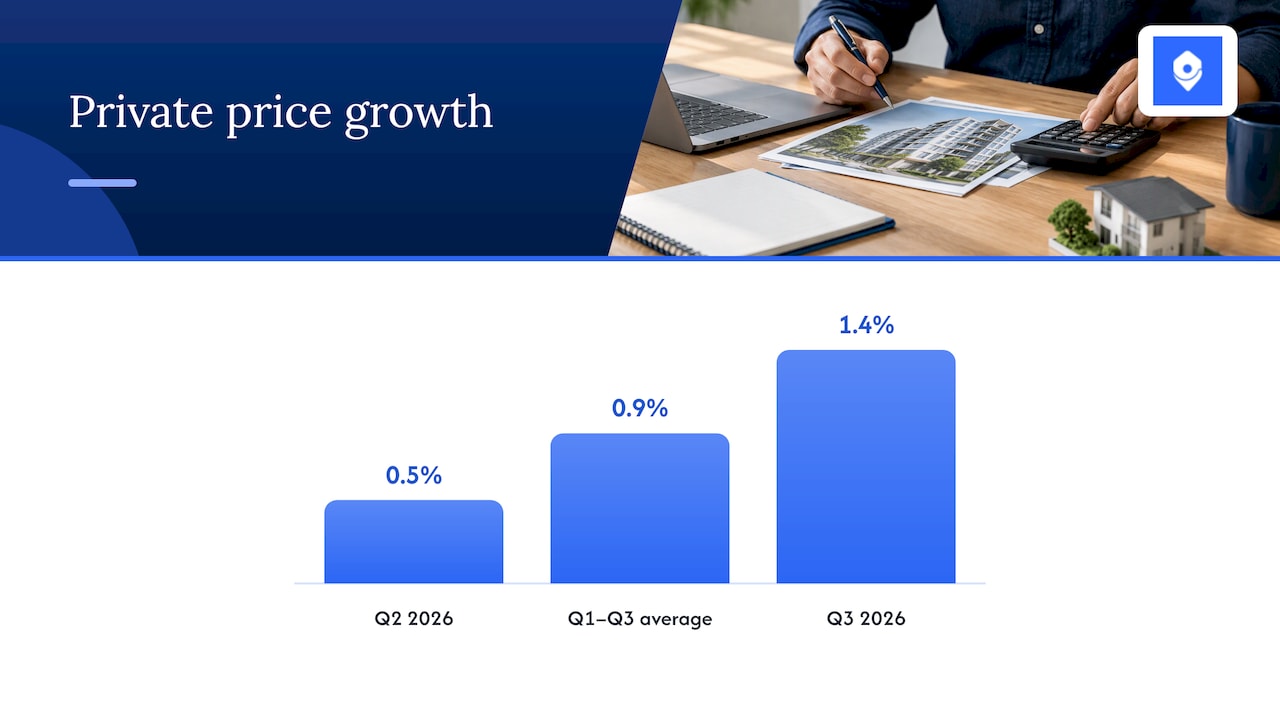
The best time to sell a property in Singapore is the point at which your own holding period, your net proceeds and your next housing plan line up with a market that is paying a fair price for your type of home. In the third quarter of 2026, URA reported that private residential prices rose 1.4% (against 0.5% in the second quarter), which makes the market backdrop supportive, although the legal holding periods and the cost of replacing the home usually decide the date more than any index does.
This article sets out the market signals worth reading, the rules that fix the earliest sensible sale date, the arithmetic of net proceeds, and how to check a valuation against transaction data before listing.
TL;DR
- URA's Q3 2026 release showed private residential prices up 1.4% quarter-on-quarter, with resale transactions nearly unchanged at 3,801 against 3,813 in Q2.
- Holding-period rules set the earliest date: Seller's Stamp Duty (SSD) now runs four years for homes acquired on or after 4 July 2025, and HDB flats carry a Minimum Occupation Period.
- Net proceeds, not the sale price, decide whether a sale works: the loan, CPF refund with accrued interest and other dues come out first.
- Small-segment price indices can swing on a few transactions, so a valuation built on comparable transactions is a safer basis than a headline figure.
- Plan the next home before committing to the sale.
Table of Contents
- What the market data says at the moment
- Resale volume: how many buyers are active
- Is there a best month to sell?
- Holding-period rules that set the earliest date
- Personal triggers that outweigh the market
- Working out net proceeds before you list
- Tax: when a sale could be treated as trading
- How long a sale takes
- Checking the valuation with transaction data
- What haio offers sellers
- Perspective
- FAQ
- Sources
What the market data says at the moment
The most reliable reference for the private market is URA's quarterly release. For Q3 2026, published on 23 October 2026, URA recorded private residential prices up 1.4% from the previous quarter, compared with 0.5% in Q2, and an average quarterly growth of 0.9% across Q1 to Q3 2026. The same release reported that vacancy increased to 7.2% and that about 32,800 units could be available for sale in the next one to two years.
These figures are published for a specific period and are revised each quarter, so the useful habit is to read the latest release rather than rely on a number quoted months earlier. URA releases its statistics quarterly, with a flash estimate in the first days after each quarter ends, and the price index moves with the mix of transactions in that quarter.
Two readings follow for a seller:
- Prices are rising, but the pace is not uniform. A 1.4% quarterly rise after 0.5% shows momentum, yet the average across the first three quarters of 0.9% is the steadier guide to the trend.
- Supply is building. A pipeline of roughly 32,800 units over the next one to two years means buyers of resale homes will have new-launch alternatives, which can widen the choice a buyer weighs against your listing.
For a longer reading of the same period, haio's own review of Singapore property market trends sets private and HDB movements side by side, and the piece on condo price trends explains why the 1.4% rise came on fewer sales.
Resale volume: how many buyers are active
Price alone does not show how easy a sale will be. Volume indicates the depth of the buyer pool.
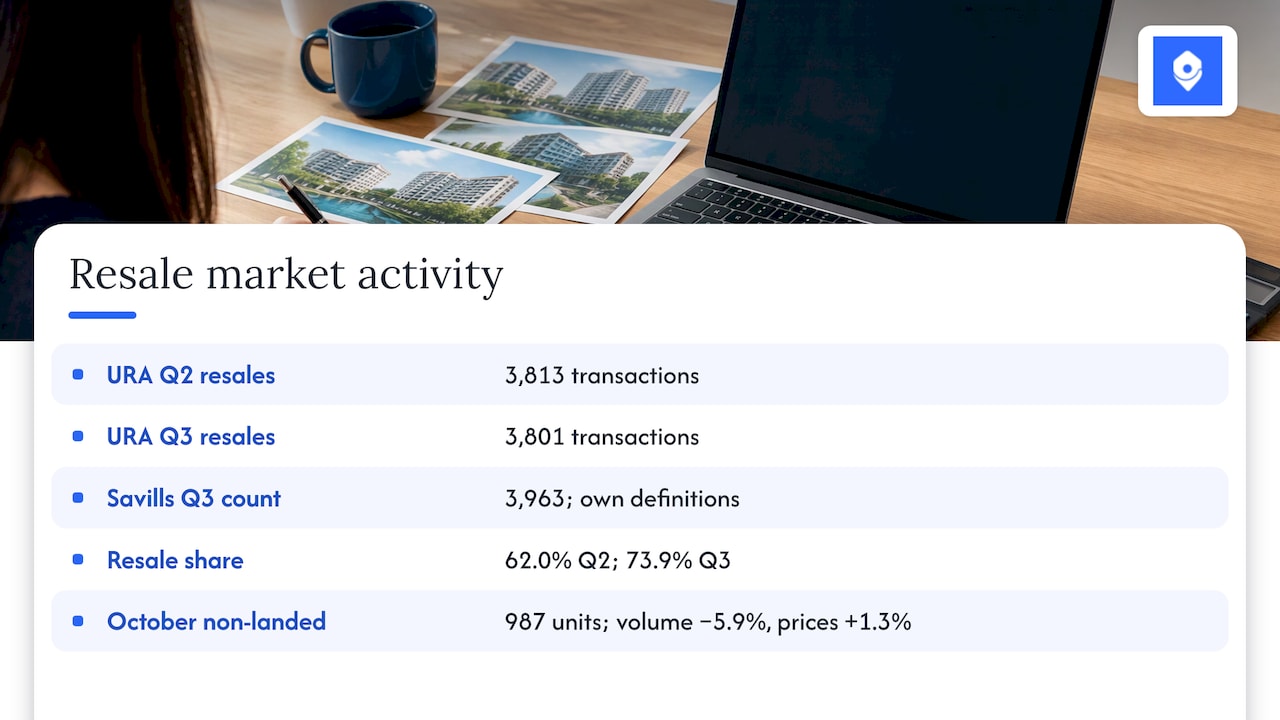
URA counted 3,801 private resale transactions in Q3 2026, nearly unchanged from 3,813 in Q2, and resales made up 73.9% of all private sale transactions, up from 62.0% in Q2 (URA). Savills' November 2026 briefing, using its own definitions, reported that resale transactions fell 1.1% quarter-on-quarter to 3,963. The two counts differ in scope, but both describe a flat resale market rather than a surge.
The monthly picture points the same way. Citing flash estimates, Lianhe Zaobao reported on 25 November 2026 that October non-landed private resale volume fell 5.9% month-on-month to 987 units, while overall resale prices rose 1.3%. Rising prices on lower volume is a pattern in which well-priced homes still sell, while overpriced listings wait.
Is there a best month to sell?
No official series identifies a month in which Singapore homes consistently sell for more. Monthly resale volume moves with new-launch calendars, school-term moves, interest-rate expectations and policy announcements, and these change every year. A seller who waits for a particular month risks missing a better offer in the meantime.
A more productive question is whether your segment is active. The same Zaobao report quotes Luqman Hakim cautioning that large index movements in the low-volume Core Central Region (CCR) may be driven by a few high-value transactions and may not reflect the broader market. The practical lesson is to compare your home with transactions in its own project, or in nearby projects of similar age and size, rather than with a regional index. The haio explainer on CCR, RCR and OCR differences shows how the three regions differ in price per square foot, which helps in choosing the right comparison set.
Holding-period rules that set the earliest date
For most owners, the date is constrained before the market is considered.
Seller's Stamp Duty on private residential property
IRAS states that the change announced on 3 July 2025 took effect without a transition period. For residential properties acquired on or after 4 July 2025, SSD applies for four years at 16%, 12%, 8% and 4% across successive one-year holding bands, and no SSD applies after that. Properties acquired from 11 March 2017 to 3 July 2025 keep the earlier three-year schedule of 12%, 8% and 4%.
| Acquisition date | SSD period | Rates by holding year |
|---|---|---|
| 11 March 2017 to 3 July 2025 | 3 years | 12%, 8%, 4% |
| On or after 4 July 2025 | 4 years | 16%, 12%, 8%, 4% |
Two details affect the arithmetic. SSD is charged on the higher of the sale price or the market value at disposal, and the acquisition and disposal dates generally follow the accepted Option to Purchase (OTP), the sale and purchase agreement, or the transfer date, as the relevant case requires. Because the rate falls at each anniversary, a sale a few weeks after a band ends can change the tax by a full percentage band of the price. On a S$1,500,000 sale, a four-percentage-point step is S$60,000, which is more than most seasonal price differences.
HDB flats: Minimum Occupation Period and quotas
HDB's eligibility page explains that the Minimum Occupation Period (MOP) is the period an owner must physically live in the flat, and that the seller must also meet the applicable Ethnic Integration Policy (EIP) and, where relevant, Singapore Permanent Resident (SPR) quota. The EIP limits the share of flats in a block or neighbourhood that may be held by each ethnic group, so a buyer pool can be narrower than the market at large. The haio guide to the HDB ethnic quota shows how it affects a resale.
For price context on flats, the HDB flat price guide covers resale, BTO and town differences.
Personal triggers that outweigh the market
Market timing is uncertain, whereas personal circumstances are known. Sales tend to be justified by one of the following:
- A replacement home is ready or secured. HDB advises sellers to plan their next housing before committing to a sale, warning that otherwise the household may be left without a home. Selling and buying in the same rising market also means the replacement costs more, so the net gain is the difference, not the sale price.
- A change in household size, job or location. These are the reasons that survive a flat market.
- Cash is needed for another purpose. A sale releases equity, but so can restructuring existing finance, and investors compare the two routes. A general overview of HELOC on investment property funding shows how some investors raise cash against a property they keep.
- The home no longer suits its purpose. An investor whose yield has fallen below alternatives, or an owner whose flat is now larger than needed, has a case independent of the quarter's index.
The common thread is that a good sale is one whose result is known in advance. That requires working out what you keep.
Working out net proceeds before you list
HDB's seller guidance states that estimated net proceeds must account for the outstanding housing loan, CPF used plus accrued interest, and amounts due to IRAS, HDB, the town council and other parties. The same principle applies to a private home, where SSD, agent fees and legal costs are added to the list.
A worked example, using round figures for illustration only:
| Item | Amount |
|---|---|
| Sale price | S$1,200,000 |
| Outstanding loan | S$500,000 |
| CPF used plus accrued interest | S$300,000 |
| Other dues and fees | S$30,000 |
| Cash in hand | S$370,000 |
The accrued interest on CPF savings used grows each year the home is held, so it belongs in the calculation from the start. haio's guide to modelling the CPF accrued interest refund at 2.5% shows how that figure builds up.
If the cash in hand does not cover the deposit and stamp duties of the next home, the sale date may need to move regardless of the market.
Tax: when a sale could be treated as trading
IRAS states that gains from selling Singapore property are generally capital gains and not taxable, but that gains may be taxable when the circumstances indicate property trading. The factors IRAS considers include how often transactions occur, the reasons for buying and selling, the capacity to hold the property long term and the holding period. An owner who has bought and sold several properties within short intervals should therefore not assume the profit falls outside income tax, and should speak to IRAS or a tax adviser about the specific pattern before selling.
How long a sale takes
The sale process has fixed steps that add to the calendar. For HDB flats, a seller needs a valid Intent to Sell for at least seven days before granting an OTP. HDB also advises using recent transacted prices to set the asking price, which is the step where preparation pays off most, since a price set from comparable transactions attracts offers sooner than one set from an agent's estimate or a neighbour's listing.
A sensible sequence is:
- Confirm the MOP, SSD band and any EIP or SPR quota position.
- Estimate net proceeds with the loan, CPF refund and other dues.
- Check the valuation against recent transactions in the same project or block.
- Plan and secure the next housing arrangement.
- Set the asking price and begin the Intent to Sell or listing process.
Checking the valuation with transaction data
The asking price is the lever the seller controls. Setting it from full transaction history, rather than a regional index or a few listings, removes much of the guesswork. haio's Valuation Analysis and Property Analysis tools are built to bring Singapore residential data sources together, and project pages such as Le Marque or Pastoral View show price history and transactions for individual condominiums. Agents can use the same unbiased data when explaining a price to a client, and buyers can use it to see what a fair price looks like.
Sellers who are also buying can run the affordability check to test the next purchase against a budget before they fix the sale date.
What haio offers sellers
haio's free tools cover transaction data, news and market analysis to a point, and the haio+ subscription adds premium analytics, valuation reports and Master Plan tools. haio+ is priced at S$49 per month or S$499 per year, and the plan details are on the haio+ page. A seller who is a year or two from listing can follow a project's transactions and the trend in the wider market, using haio's List and the Insights section for ongoing news.
Perspective
We built haio on a simple observation: the date of a sale is usually decided by facts the owner can look up, and the part of timing that depends on forecasting is smaller than most sellers are told.
The holding period, the SSD band, the CPF refund and the loan balance are known quantities. Once they are set against transaction data for the specific project, the remaining question is whether the price on offer is a fair one. That is a question of transparent pricing, and it is why we combine Singapore residential data sources in one place and give the full transaction record free up to a point.
For a seller, our view is that the strongest position is an informed one: a valuation checked against actual transactions, a net-proceeds figure worked out before listing, and a next home planned in advance. Premium valuation reports and analytics under haio+ extend that work for owners and agents who want it in more depth.
HAIO
FAQ
When is the best time to sell property in Singapore?
No official data identifies a best month. The stronger signals are your SSD band or MOP status, your net proceeds and whether comparable homes in your project are transacting. URA's Q3 2026 figures, with private prices up 1.4% and resale volume nearly flat, describe the market, but your own holding-period dates will usually matter more.
Should I sell my property now or wait?
Waiting helps when it moves the sale past an SSD anniversary or the end of the MOP. Otherwise, compare the cost of holding with the likely change in price, and consider that a replacement home may also rise in price. If a next home is not arranged, HDB advises sorting that out before committing.
How do I know if the market favours sellers?
Look at price change, resale volume and supply together. URA's Q3 2026 release showed higher prices, steady resale volume, rising vacancy and a sizeable pipeline of units, which is a mixed picture. Segment-level data matters, since small regions can move on a few transactions.
Is the profit from selling a property taxable?
IRAS generally treats gains from property sales as capital gains that are not taxable, but it may tax them where the pattern indicates property trading. Frequent transactions and short holding periods are among the factors it considers. SSD is a separate duty and applies to residential sales within the holding period.
Sources
- URA: Release of 3rd Quarter 2026 real estate statistics
- Lianhe Zaobao: Singapore private home resale volume falls 5.9% in October
- Savills: Singapore residential sales briefing Q3 2026
- IRAS: Seller's Stamp Duty for residential property
- IRAS: Gains from sale of property, shares and financial instruments
- HDB: Eligibility for selling a flat
- HDB: Managing the sale of flat