

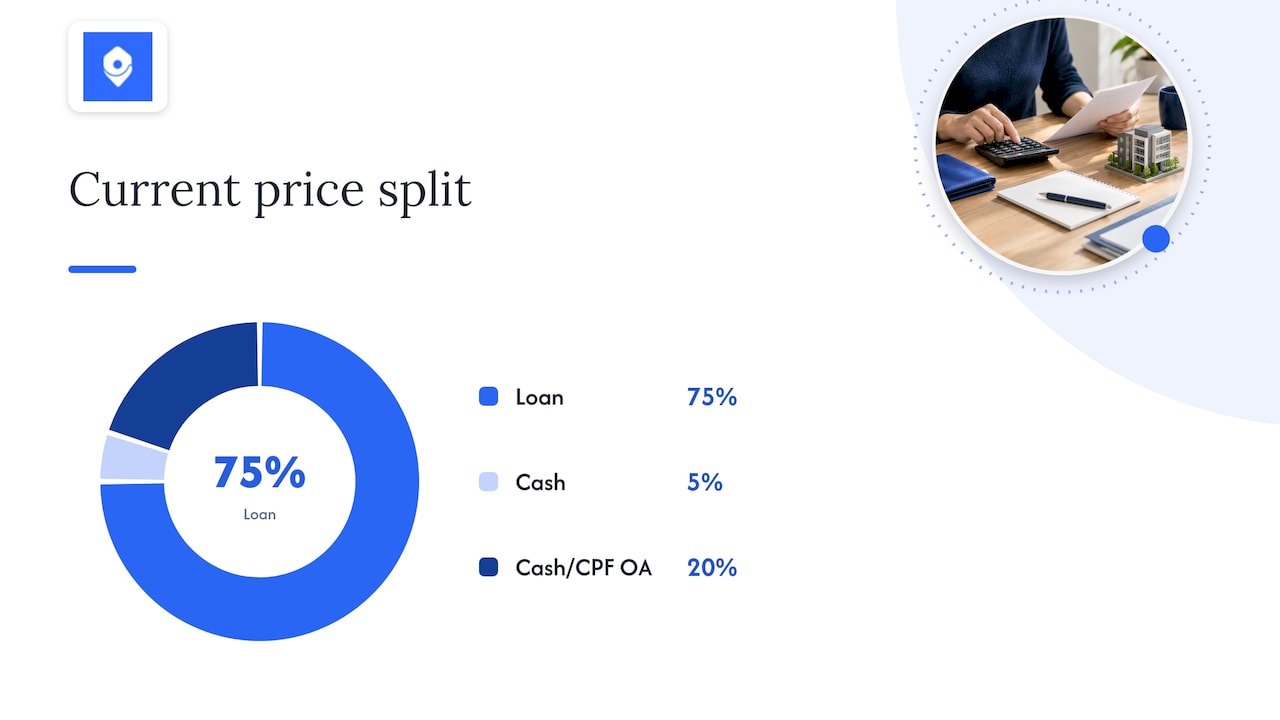
For a buyer with no outstanding housing loan, the downpayment on a private condo in Singapore is 25% of the purchase price, of which at least 5% must be paid in cash. The remaining 20% can come from CPF Ordinary Account (OA) savings or cash, and stamp duties, legal fees and the option fee sit on top of that figure. Before committing to a unit, a buyer can run the numbers against their own income and savings on haio's Affordability check, which pairs a budget with the loan rules described below.
TL;DR
- The standard rule for a first housing loan is a 75% loan-to-value (LTV) limit, which leaves a 25% downpayment, with at least 5% in cash (MAS).
- A longer loan (over 30 years for private property, or running past age 65) lowers the LTV to 55% and raises the minimum cash to 10%.
- With one outstanding housing loan the LTV is 45%, and with two or more it is 35%, each with a 25% minimum cash downpayment.
- On a S$1,500,000 condo with a first loan, the downpayment is S$375,000, of which S$75,000 must be cash.
- Stamp duties fall due within 14 days of exercising the option or signing the Sale and Purchase Agreement, so the cash plan needs to cover them early.
Table of Contents
- The rule behind the 25%
- LTV tiers: how existing loans and tenure change the downpayment
- A worked example: a S$1,500,000 condo
- How CPF fits in
- When the money is due
- Costs beyond the downpayment
- Testing the downpayment against income
- Our perspective
- Checking the price before committing the cash
- FAQ
- Sources
The rule behind the 25%
The downpayment is whatever the bank loan does not cover. The Monetary Authority of Singapore (MAS), which regulates banks and sets housing loan limits, caps the loan as a share of the property's price or value (the loan-to-value ratio, or LTV). For loans where the option to purchase was granted on or after 6 July 2018, a first-time buyer with no outstanding housing loans can borrow up to 75%, which leaves a 25% downpayment with at least 5% paid in cash (MAS, Loan Tenure and Loan-to-Value Limits).
This answers the common question of whether the figure is 20% or 25%. The 20% figure applied to first loans before July 2018. For a first private property today, the working number is 25%, split into a 5% cash portion and a 20% portion that may be cash or CPF OA.
The MAS rule binds lenders rather than buyers. Banks size the loan on the lower of the price and the valuation, and the LTV applies to that base. Haio's guide to LTV limits and the 5% cash requirement sets out how this plays out in practice.
LTV tiers: how existing loans and tenure change the downpayment
The downpayment depends on how many housing loans the buyer already carries and on how long the new loan runs. MAS and MoneySense publish the same tiers for bank loans:
| Housing loans outstanding | Standard tenure: LTV | Minimum cash | Long tenure or past age 65: LTV | Minimum cash |
|---|---|---|---|---|
| None (first loan) | 75% | 5% | 55% | 10% |
| One | 45% | 25% | 25% | 25% |
| Two or more | 35% | 25% | 15% | 25% |
"Long tenure" means more than 30 years for a private property (25 years for an HDB flat), or a loan that extends beyond the borrower's 65th birthday. MAS caps the maximum tenure at 35 years for private property, so a 35-year loan is possible but carries the lower LTV (MAS).
Two points follow for a first-time buyer. A 35-year loan trades a smaller monthly instalment for a larger downpayment, with 45% of the price to find instead of 25%. A buyer who is nearing 65 may meet the lower LTV even on a 25-year loan, because the tenure is tested against age as well.
A worked example: a S$1,500,000 condo
Take a first-time buyer with no outstanding housing loan, a 25-year loan and a purchase price of S$1,500,000.
| Item | Amount |
|---|---|
| Maximum loan at 75% LTV | S$1,125,000 |
| Downpayment at 25% | S$375,000 |
| Of which minimum cash (5%) | S$75,000 |
| Of which CPF OA or cash (20%) | S$300,000 |
Extending the same loan to 35 years changes the picture: at 55% LTV the loan falls to S$825,000, the downpayment rises to S$675,000, and the cash minimum rises to 10%, or S$150,000.
These figures cover the downpayment only. They exclude stamp duties, legal fees and, for a resale unit, any Cash Over Valuation, which is the amount a seller asks above the valuation and which a bank loan does not cover.
How CPF fits in
CPF OA savings can pay the portion of the downpayment above the 5% cash minimum, subject to the CPF Withdrawal Limit, which caps how much OA money can go into a property. The Association of Banks in Singapore advises buyers to find their CPF Withdrawal Limit before using CPF savings, alongside checking the TDSR threshold and the LTV limit.
The practical consequence is that the cash a buyer needs is often higher than 5%. A buyer whose OA balance is below the 20% portion has to make up the difference in cash, and CPF savings used also reduce retirement funds, which accrue interest. The sensible test is to add the 5% cash portion, the shortfall in OA, stamp duties and legal fees, and compare that total with liquid savings.
When the money is due
The timing differs between resale and new-launch condos.
Resale condo
The buyer pays an option fee, commonly 1% of the price, to secure the option to purchase. The buyer then usually has around 14 days to exercise it, and a further 4% is typically paid on exercise, forming a 5% deposit (PropertyNet). Completion follows some weeks later, when the bank loan and CPF funds are released and the rest of the downpayment is settled.
New-launch condo
Developers typically take a booking fee of 5% of the price when the unit is selected. This payment is part of the purchase price: where the fee is 5%, 15% remains to be paid when the Sale and Purchase Agreement (S&P) is signed, so the first stage totals 20% (Aurea SG Condo blog). Because the 5% is paid in cash at booking, it satisfies the 5% cash minimum. The balance of the price is generally paid in stages as construction progresses, so the bank loan is drawn down gradually rather than at once.
Costs beyond the downpayment
MoneySense lists the upfront costs of a purchase as the option fee, the downpayment, stamp duty, legal costs, agent's commission and fees, renovation and other miscellaneous costs (MoneySense). Two of these deserve attention in the cash plan.
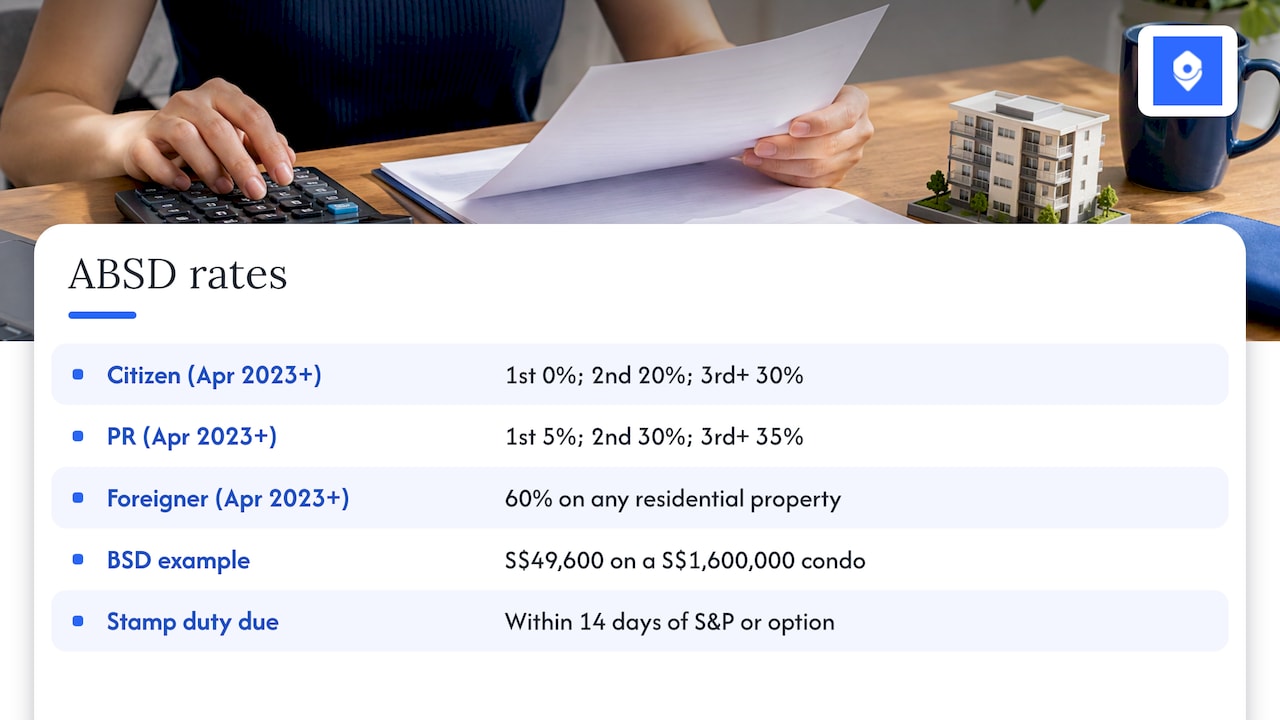
Stamp duty. Stamp duties must be paid to the Inland Revenue Authority of Singapore (IRAS) within 14 days of executing the S&P or exercising the option (PropertyNet). The same source gives an example: a S$1,600,000 condo generates S$49,600 of Buyer's Stamp Duty (BSD), which is due in that window. Additional Buyer's Stamp Duty (ABSD) depends on residency and the number of properties. For purchases on or after 27 April 2023, IRAS sets ABSD at 0% for a Singapore citizen's first property, 20% for the second and 30% for the third and subsequent. For permanent residents the rates are 5%, 30% and 35%, and for foreigners 60% on any residential property. Where buyers of different profiles purchase together, the highest rate applies to the whole property.
Ongoing costs. MoneySense advises buyers to plan for expenses that CPF cannot cover, including property tax, fire and mortgage insurance, and conservancy and management fees. It also notes that a fall in property value can push the original LTV ratio above the limit, which may require dipping into savings. Haio's condo maintenance fee checklist shows how to estimate the management fee before buying.
Testing the downpayment against income
Meeting the downpayment does not guarantee the loan. Banks also apply the Total Debt Servicing Ratio (TDSR), which caps all monthly debt repayments at 55% of gross monthly income, assessed at a stress-test interest rate. A buyer with a large downpayment but modest income may still find the loan amount limited by TDSR rather than LTV. The method for calculating this ceiling is set out in haio's guide to MSR and TDSR with two worked examples, and the five-step mortgage affordability check walks through the sequence from income to a price range.
For buyers who already own a home, the downpayment rises sharply. Haio's article on buying a second property covers the combined effect of the 45% LTV tier, the 25% cash minimum and 20% ABSD.
Our perspective
Most downpayment errors we see in buyers' plans come from treating 25% as a single number. It is three numbers: the 5% or more that must be cash, the 20% that CPF OA can cover, and the stamp duty and legal costs that arrive within weeks. A budget that fits the headline figure can still fail on the cash line.
Haio is built around that sequence. The Affordability tool starts from the buyer's budget, and the Property Analysis and Valuation Analysis pages place the price against recorded transactions, so that the base on which the bank sizes the loan is not a guess. When the valuation comes in below the price, the shortfall is paid in cash, and checking transaction history before the option fee is paid is the cheapest point at which to find that out.
The same applies to mortgage rates and loan tenure: a longer tenure lowers the instalment but raises the downpayment, and seeing both sides in one place is what allows a buyer to choose the tenure deliberately.
HAIO
Checking the price before committing the cash
The downpayment is a percentage of the price, so an overpaid unit inflates every figure above. Haio provides recorded transaction history for individual condos, such as Bartley Residences and Casa Jervois, and a Valuation Analysis tool for comparing an asking price with comparable sales. The haio+ plan, listed at S$49 per month or S$499 per year, adds premium analytics, valuation reports and Master Plan tools; plan details are on the haio+ page. A reader comparing price per square foot across projects will find the method in the guide to PSF in Singapore.
FAQ
Is the condo downpayment 20% or 25% in Singapore?
For a first housing loan it is 25% of the price, because the LTV limit is 75%. The 20% figure applied before July 2018 and now survives only as the portion that CPF OA or cash can cover after the 5% cash minimum. Buyers with outstanding housing loans face a larger downpayment of 55% or 65%.
How much cash do I need for a condo downpayment?
The minimum is 5% of the price for a first loan with standard tenure, 10% if the loan runs beyond 30 years or past age 65, and 25% if you already have one or more housing loans (MAS). Stamp duty and legal fees come on top, so the practical cash requirement is higher.
How much deposit is needed to book a new-launch condo?
Developers commonly take a booking fee of 5% of the price, paid in cash, followed by a further 15% at S&P signing (Aurea SG Condo blog). The exact schedule is in each project's sales documents.
Can I use CPF for the whole downpayment?
No. The 5% minimum must be paid in cash, and CPF use is limited by your CPF Withdrawal Limit. Confirm your own limit with the CPF Board before planning around OA savings.
Does ABSD count towards the downpayment?
No. ABSD and BSD are separate payments to IRAS, due within 14 days of exercising the option or signing the S&P, and they are in addition to the downpayment.
Sources
- MAS: Loan Tenure and Loan-to-Value Limits
- MoneySense: Buying a property, how much can you afford?
- IRAS: ABSD declaration form
- Association of Banks in Singapore: Home loans guide
- PropertyNet: Option to Purchase in Singapore
- Aurea SG Condo: New launch booking fee